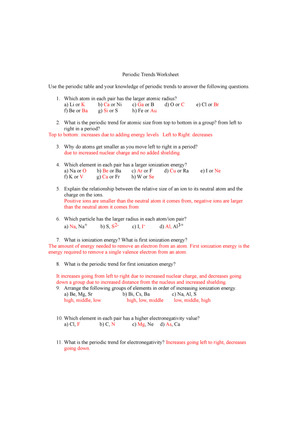
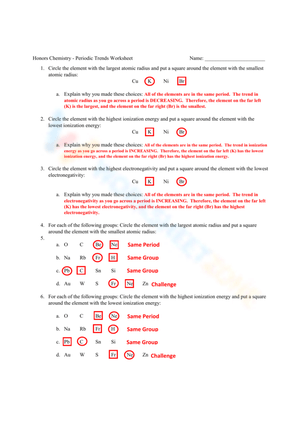
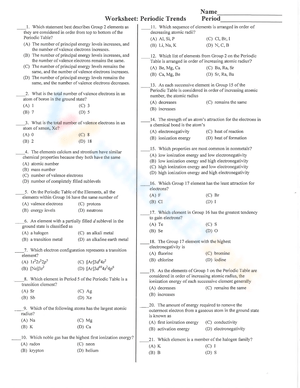
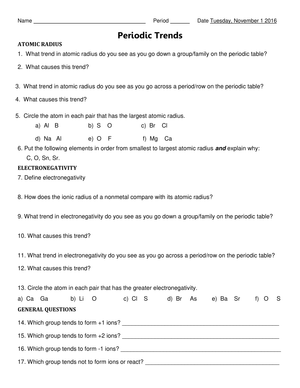
Periodic trends worksheets give chemistry teachers a fast way to move students from memorizing the periodic table to reasoning with it. The strongest sets ask students to predict atomic radius, ionization energy, and electronegativity from an element's position, which is exactly the thinking high school standards reward during a tight 50-minute period.
What Strong Periodic Trends Worksheets Should Cover
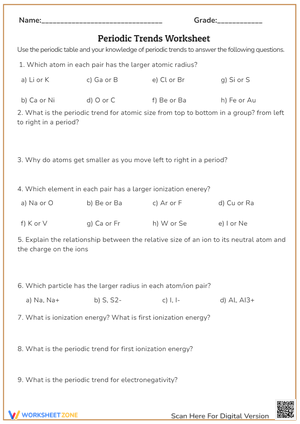
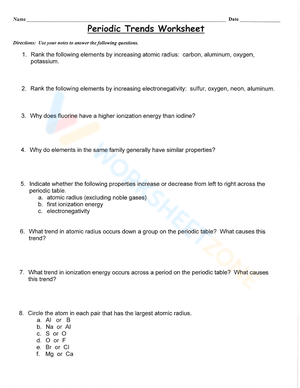
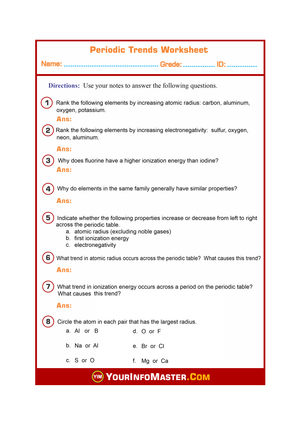
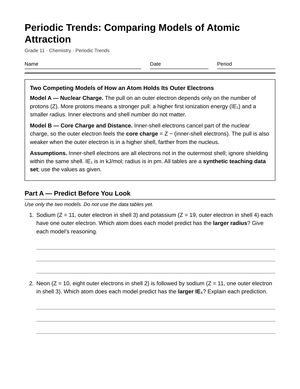
A worksheet that only asks for definitions leaves students memorizing without understanding. Effective practice pushes students to compare two elements and justify which has the larger radius or higher ionization energy based on position. That answer-first habit is what carries over to unit tests and later bonding work.
Look for worksheets that build across the three core patterns instead of treating each one as an isolated fact:
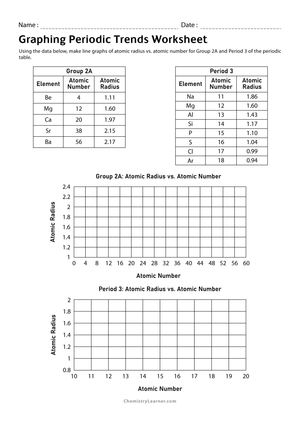
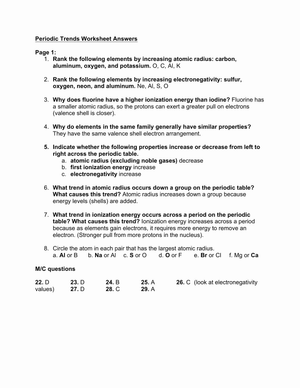
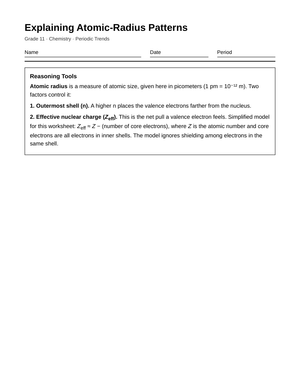
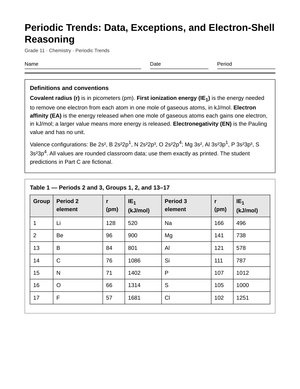
- Atomic radius decreases left to right across a period and increases down a group.
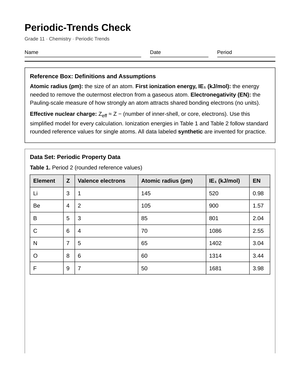
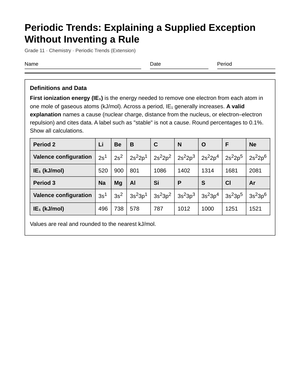
- First ionization energy generally increases across a period and decreases down a group.
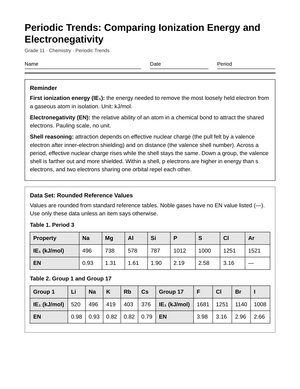
- Electronegativity increases across a period and decreases down a group, measured on the Pauling scale.
The Science Behind the Patterns
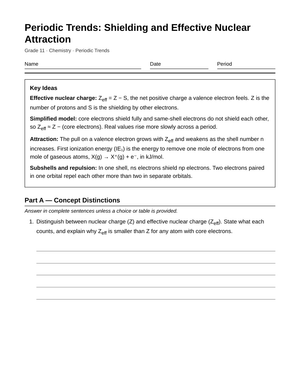
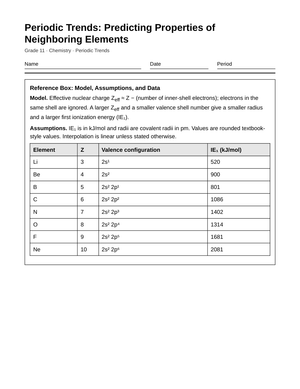
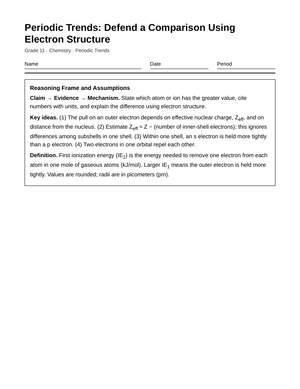
All three trends trace back to one idea: effective nuclear charge. When students can explain Zeff, they stop treating each trend as a separate rule to recall and start predicting from a single concept. Worksheets that ask students to name the underlying cause, not just the direction of the arrow, produce far more durable understanding.
A short reference capsule helps here. According to Chemistry LibreTexts, effective nuclear charge equals the nuclear charge minus electron shielding, and this single quantity drives all three major periodic trends. It explains why atomic radius shrinks across a period while first ionization energy and electronegativity both climb, reaching roughly 4.0 for fluorine on the Pauling scale that starts near 0.7.
How These Worksheets Align With HS-PS1-1
The NGSS performance expectation HS-PS1-1 asks students to use the periodic table as a model to predict the relative properties of elements based on patterns in outermost electron configuration. That is prediction from position, not recall of memorized values, so a well-built worksheet mirrors the standard almost line for line.
HS-PS1-1 assessment is intentionally limited to main group elements and to relative rather than quantitative ionization energy trends. That scope is good news for planning: worksheets that stay with representative elements and ask for comparisons like greater than or less than match the standard without drifting into transition-metal exceptions that can derail an introductory unit.
Classroom Implementation
The same worksheet can serve three different jobs depending on where you drop it in a lesson. Reusing one page across a unit saves prep time and gives students a familiar format to build fluency in.
- Guided notes: Project a blank periodic table and complete the first few comparisons together, thinking aloud about shielding and nuclear charge.
- Independent practice: Assign the middle problem set for homework once students can explain the cause of each trend.
- Formative check: Pull three questions for an exit ticket to see who still confuses radius direction with ionization energy direction.
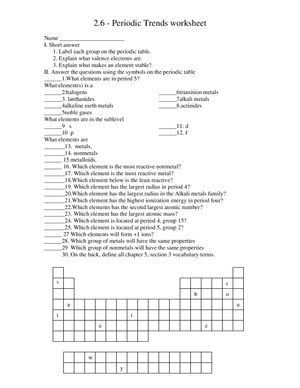
Pair the worksheet with a periodic table diagram and have students draw arrows for radius, ionization energy, and electronegativity. Mapping the arrows visually anchors the abstract patterns and gives struggling students a reference they can rebuild from memory on test day.
Common Student Misconceptions to Target
Two errors show up on nearly every first attempt. Students frequently reverse the direction of atomic radius and ionization energy, assuming both grow the same way, and they ignore shielding when moving down a group. A worksheet that forces students to write the reason for each answer surfaces these mistakes early, while they are still cheap to fix.
Sequence matters more than most pacing guides admit. When students practice atomic radius to fluency before touching ionization energy, the second trend often lands in a single class period because it is the inverse story of the same effective nuclear charge. Teams that teach all three trends in one lesson tend to see the reversal error persist for weeks, because students never separate the causes long enough to distinguish the effects.
Frequently Asked Questions
1. What grade level and course typically covers periodic trends worksheets?
Periodic trends usually appear in high school general chemistry, honors chemistry, and AP Chemistry, and in some middle school physical science courses. General chemistry stays at relative comparisons, while honors and AP layer in quantitative effective nuclear charge reasoning.
2. How do periodic trends worksheets align with NGSS HS-PS1-1?
HS-PS1-1 asks students to use the periodic table to predict relative properties from electron configuration patterns. Worksheets that require position-based comparisons of main group elements, rather than memorized values, match the standard directly.
3. What is the best way to sequence the three trends within a unit?
Teach atomic radius to fluency first, then present ionization energy as its inverse, and finish with electronegativity. Because all three share the same effective nuclear charge cause, the later trends land faster once the first is secure.
4. How can teachers use these worksheets for formative assessment?
Pull three comparison questions for an exit ticket and require a one-sentence reason for each answer. The written justifications quickly reveal who still reverses radius and ionization energy or forgets shielding down a group.
5. What visuals pair well with periodic trends practice?
A blank periodic table where students draw directional arrows for radius, ionization energy, and electronegativity works best. Mapping the arrows alongside the worksheet gives students a reference they can reconstruct from memory during assessments.