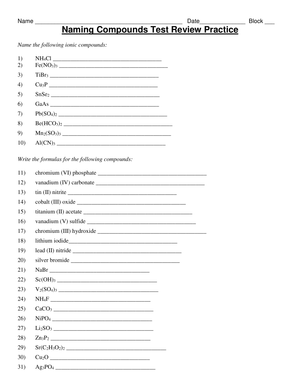
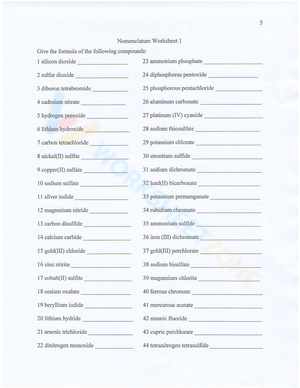
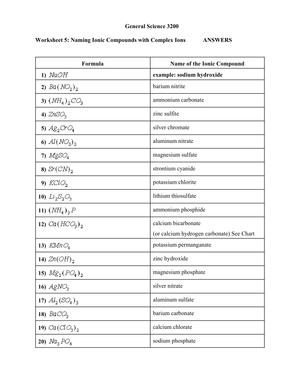
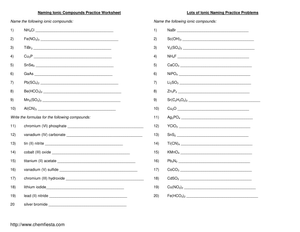
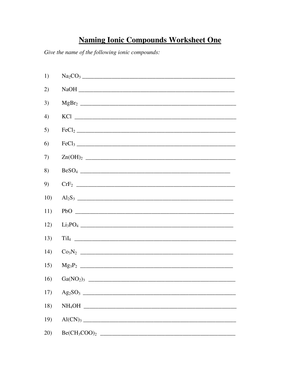
Naming ionic compounds is one of the first moments when chemistry starts to feel like a code students have to crack. A formula such as NaCl may look simple, but compounds with transition metals, polyatomic ions, or multiple charges can quickly become confusing. Naming ionic compounds worksheets give students a steady way to practice the rules, recognize patterns, and build confidence with chemical names and formulas. With enough guided repetition, learners begin to see that ionic naming follows a logical system rather than random memorization.
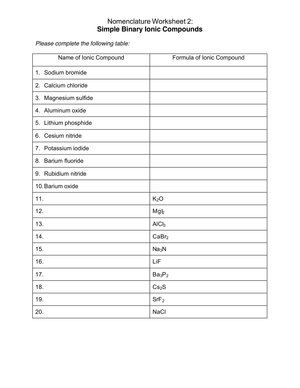
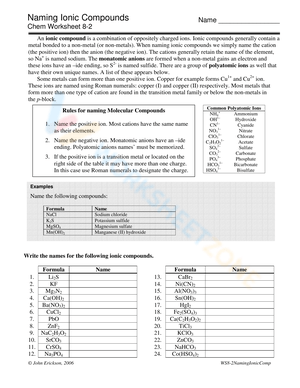
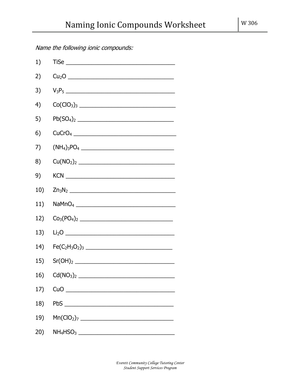
Ionic compounds usually form between metals and nonmetals, or between positive and negative ions. Students need to identify the cation, identify the anion, balance charges, and write the correct name or formula. A worksheet might ask learners to name calcium chloride, write the formula for magnesium oxide, or decide when Roman numerals are needed for transition metals. Before students move into naming practice, it helps to review how ions form and why opposite charges attract. Teachers can support this foundation with a chemical bonding practice set.
What makes naming ionic compounds worksheets especially useful is the way they separate each skill into manageable steps. Students can begin with simple binary ionic compounds, then move into compounds with transition metals, and finally practice formulas with polyatomic ions. This progression helps prevent common mistakes, such as forgetting to balance charges, using prefixes meant for covalent compounds, or leaving out Roman numerals when they are required. The more students practice, the easier it becomes to explain why each compound has the name or formula it does.
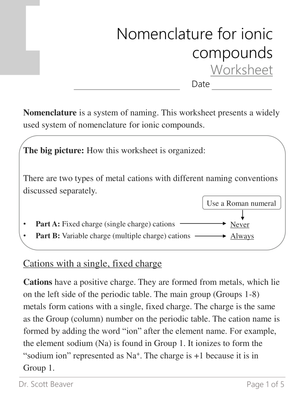
The periodic table also plays an important role in ionic compound naming. Students need to know which elements commonly form positive ions, which form negative ions, and how group patterns can help predict charges. For example, Group 1 metals usually form +1 ions, while Group 17 nonmetals usually form -1 ions. Teachers who want to make this background knowledge more engaging can use this guide on periodic table activities before assigning naming practice. When students understand the table, ionic compounds become much easier to decode.
Worksheetzone’s naming ionic compounds worksheets are designed for chemistry classrooms, homeschool lessons, and independent review. Teachers can use them as warm-ups, guided practice, homework, quiz preparation, exit tickets, or small-group reteaching. Students benefit from seeing many examples in a clear format, from simple salts to more advanced compounds involving multiple ions. Over time, these worksheets help learners build stronger chemistry vocabulary, formula-writing accuracy, and readiness for reactions, equations, and later chemistry topics.
Frequently Asked Questions
Question 1: What do students learn from naming ionic compounds worksheets?
Students learn how to identify cations and anions, name ionic compounds, write formulas, balance charges, and use Roman numerals when needed. They also practice recognizing common ion patterns and avoiding confusion between ionic and covalent naming rules.
Question 2: What grade levels are these worksheets best for?
These worksheets are most useful for middle school physical science, high school chemistry, and introductory chemistry review. They are especially helpful for students learning chemical bonding, ions, compound formulas, transition metals, and polyatomic ions.
Question 3: Why do students struggle with ionic compound naming?
Students often struggle because they must balance charges, remember ion names, and know when Roman numerals are required. Some learners also mix up ionic and covalent naming systems. Structured worksheet practice helps students follow a consistent step-by-step process.
Question 4: How can teachers use naming ionic compounds worksheets in class?
Teachers can use these worksheets for guided examples, independent work, homework, quiz review, chemistry stations, or small-group support. They work well after lessons on ions, periodic table groups, chemical bonding, and compound formula writing.