


























Views
Downloads


Ready Periodic Trend Errors Worksheet | Grade 11 Chemistry
Paste this activity's link or code into your existing LMS (Google Classroom, Canvas, Teams, Schoology, Moodle, etc.).
Students can open and work on the activity right away, with no student login required.
You'll still be able to track student progress and results from your teacher account.
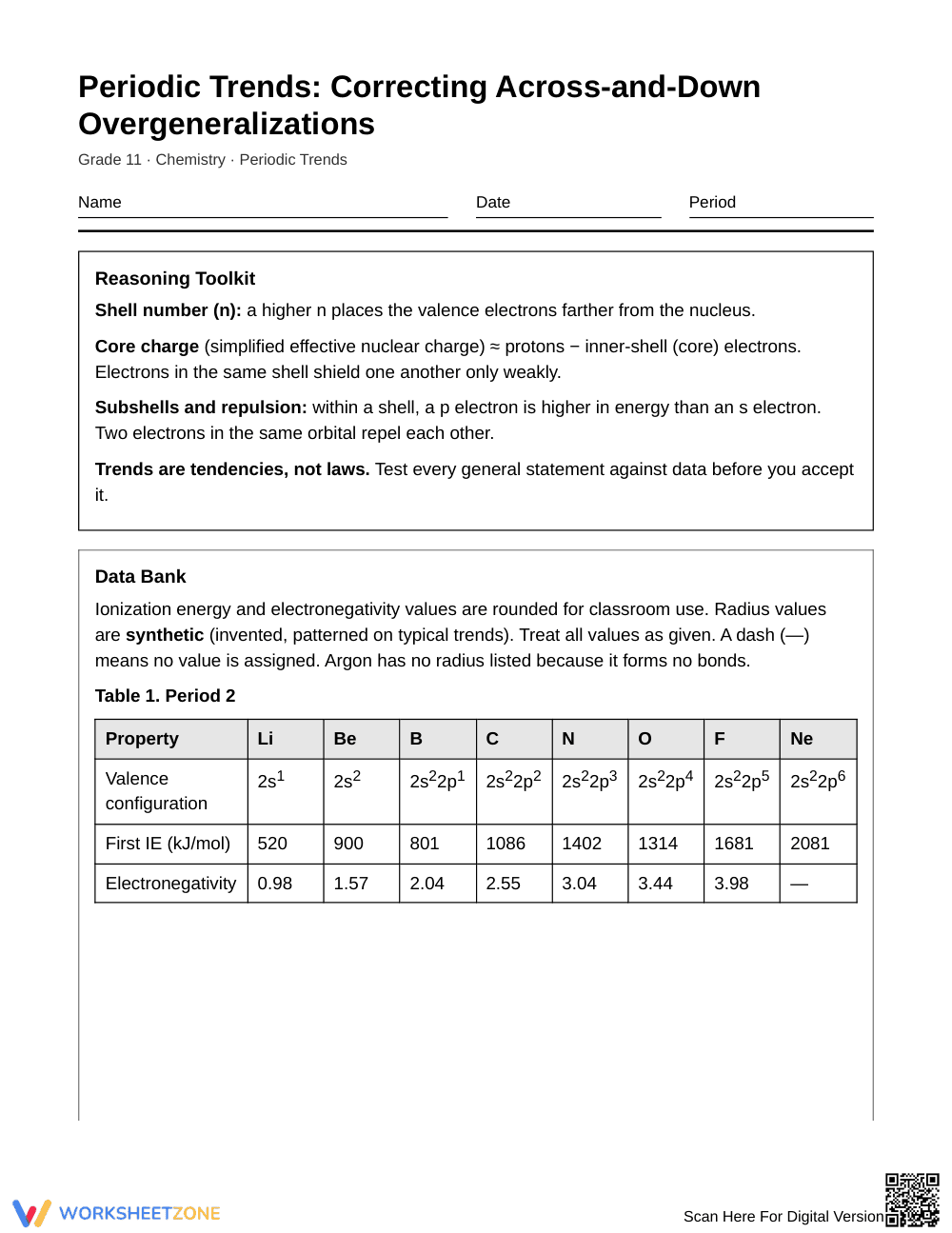
This worksheet helps Grade 11 chemistry students spot and fix overgeneralized periodic trend explanations. Students diagnose the specific error in eight flawed claims about radius, ionization energy, electronegativity, and ions, then write corrections that cite real values from a data bank and reason with core charge and shielding.
At a Glance
- Grade: 11 · Subject: Chemistry
- Standard: Periodic trends — diagnose flawed trend claims and correct them using data
- Skill Focus: Correct across-and-down trend overgeneralizations
- Format: 5 pages · 8 problems · Answer key included · PDF
- Best For: Targeted periodic trends misconception repair
- Time: 40–50 minutes
What's Inside
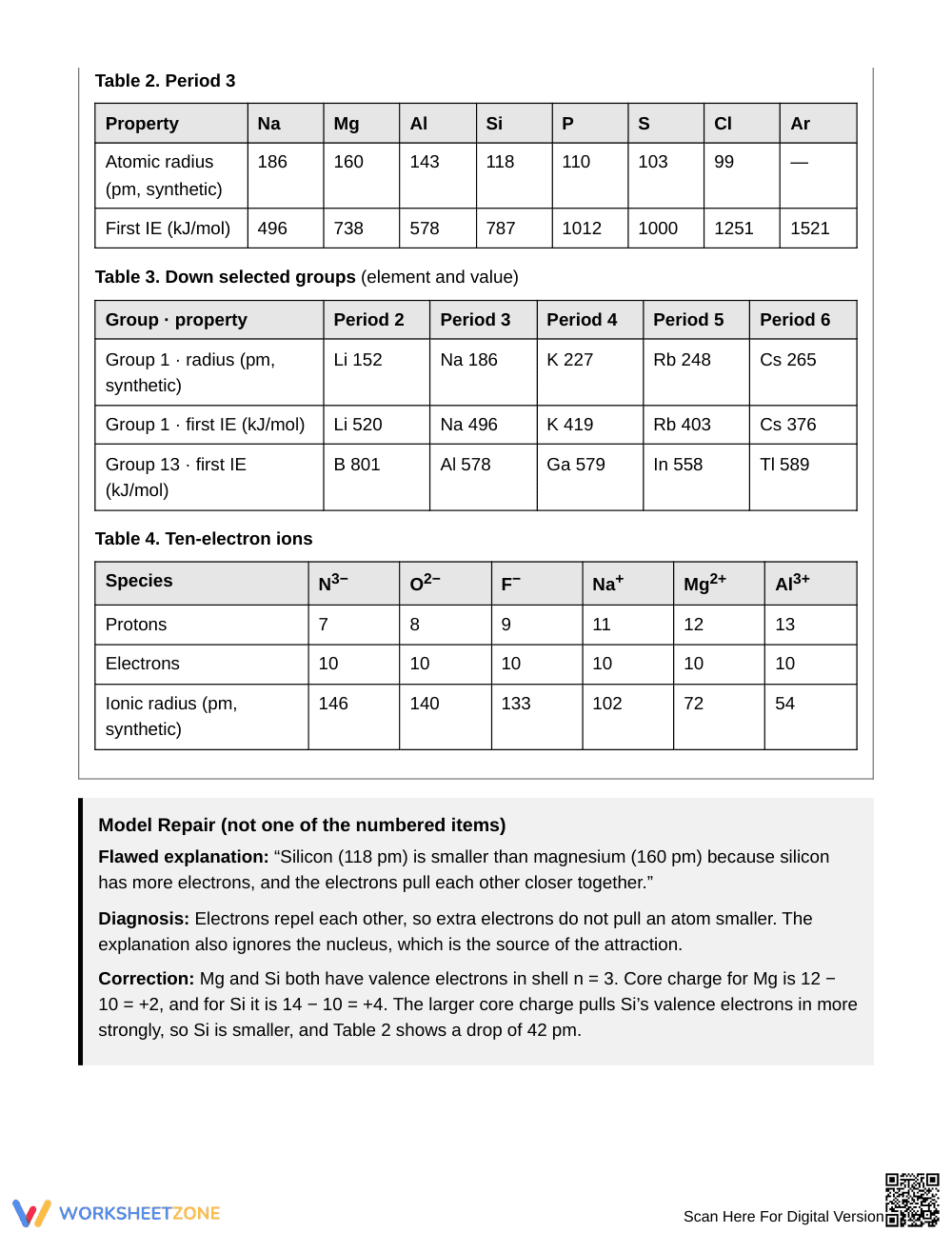
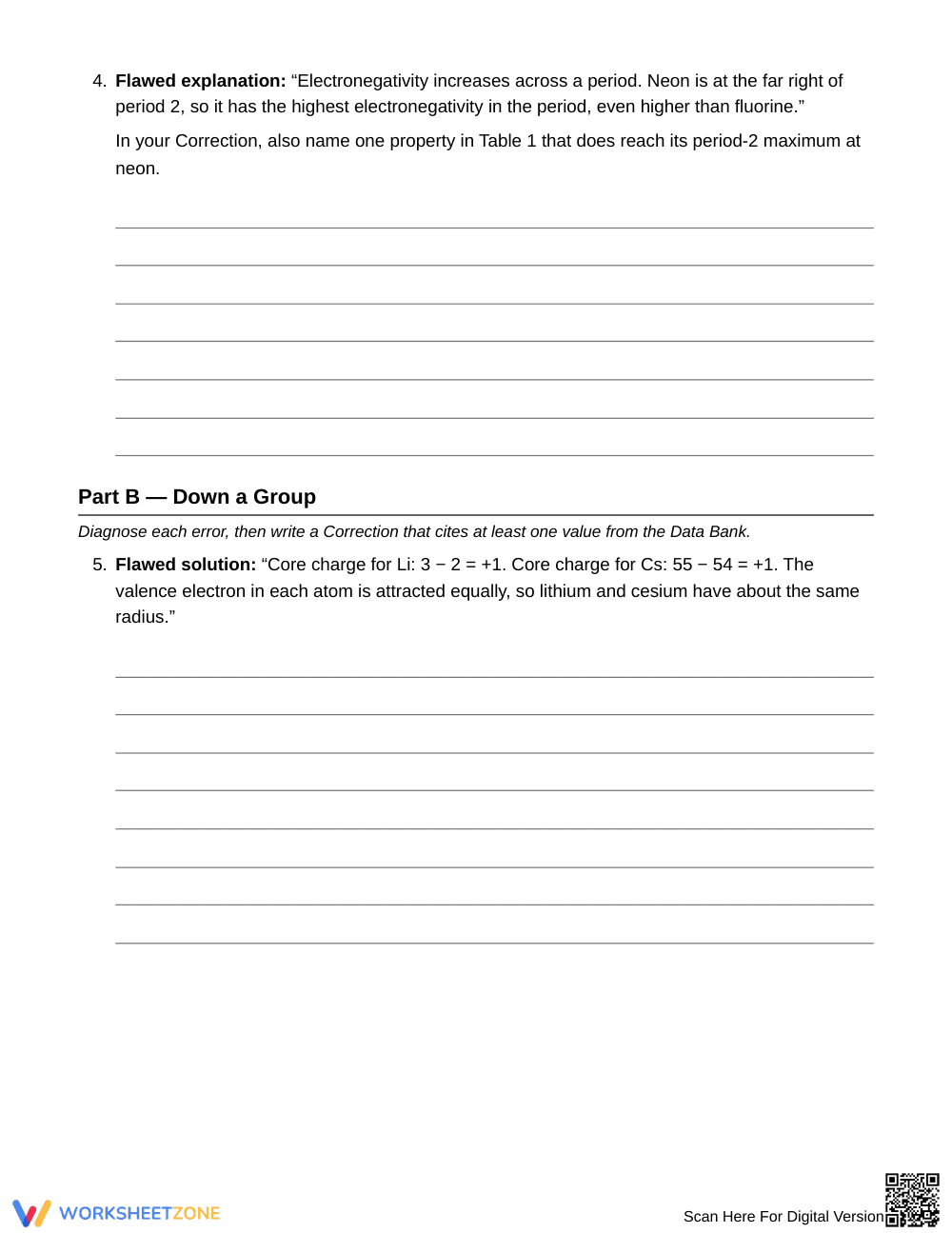
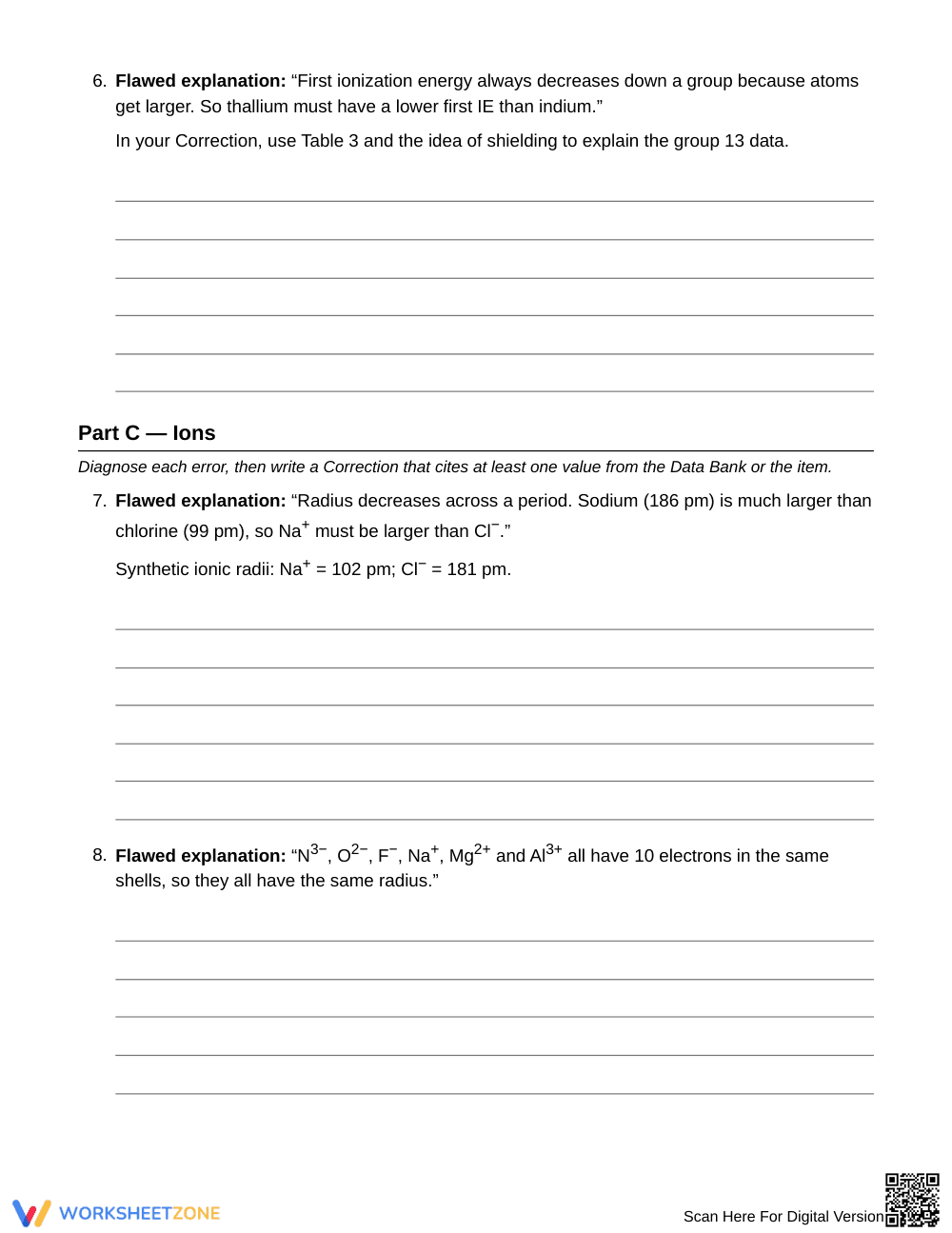
Five pages hold a Reasoning Toolkit, a Data Bank of four tables, one worked Model Repair, and eight numbered items in Parts A, B, and C. Each item presents a flawed explanation or solution, and students write a Diagnosis and a Correction. A three-page answer key is included.
Skill Progression
- Guided practice: one unnumbered Model Repair shows a full diagnosis and correction using core charge.
- Supported practice: Part A, 4 items across a period, with prompts naming the table or property to use.
- Independent practice: Parts B and C, 4 items on groups and ions, with fewer prompts.
The sequence follows gradual release: I Do, We Do, You Do.
Standards Alignment
No standard code was supplied for this worksheet, so none is listed. The tasks address high school chemistry expectations for explaining trends in atomic radius, ionization energy, electronegativity, and ionic radius using electron configuration and core charge. Add your state or district code when copying into lesson plans, IEP goals, or curriculum mapping tools.
How to Use It
- After direct instruction: assign Part A to check whether students apply trends with evidence instead of reciting rules.
- Before a unit test: assign Parts B and C as targeted review of common misconceptions.
Formative tip: while students work, check whether each Correction cites a specific number or only restates a rule. Expect 40–50 minutes.
Who It's For
Grade 11 chemistry students who can recite trend rules but misapply them. Students who need support can begin with the Model Repair and Part A, using the toolkit. Pairs well with a periodic table anchor chart and a core charge mini-lesson.
The Grade 11 Chemistry worksheet Correcting Across-and-Down Overgeneralizations trains students to test periodic trend claims against data instead of memorizing rules. Across eight tasks, students diagnose a flawed explanation, then write a correction using core charge, shell number, shielding, and subshell repulsion, citing values from four data tables covering period 2, period 3, group trends, and ten-electron ions. The sequence follows the gradual release model described by Fisher & Frey (2014): a worked model repair, supported practice in Part A, and independent practice in Parts B and C. Error analysis of this kind targets common misconceptions, such as claiming that more electrons pull an atom smaller or that ionization energy always rises across a period. The resource includes a three-page answer key and takes about 40 to 50 minutes. No state standard code is attached to this resource.


