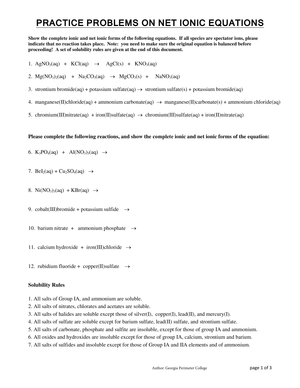
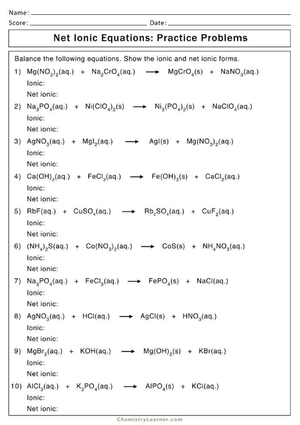
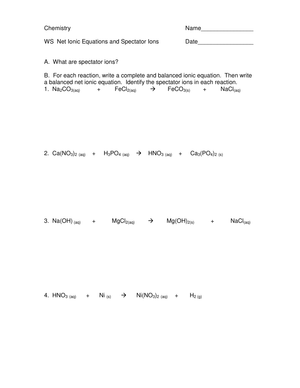
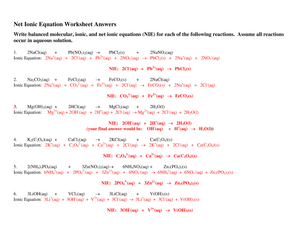
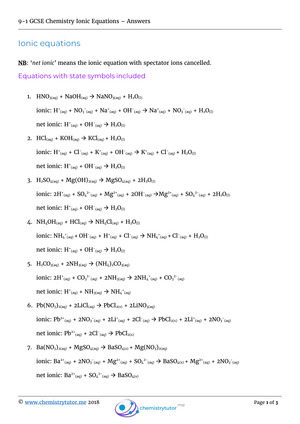
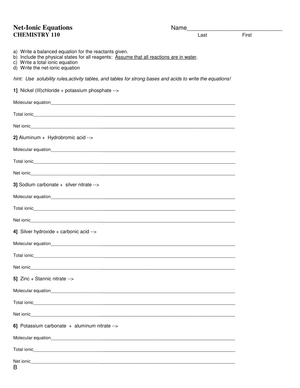
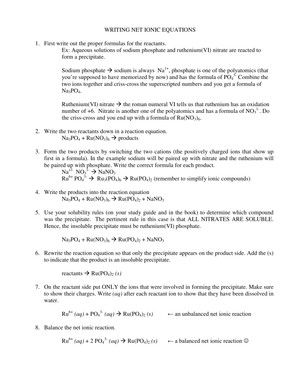
Net ionic equations are where chemistry starts to look less like memorizing reactions and more like understanding what actually changes. In a full chemical equation, every compound appears on the page, but not every ion takes part in the reaction. Net ionic equation worksheets help students separate the important players from the spectators. By crossing out unchanged ions and focusing only on the particles that form a precipitate, gas, weak electrolyte, or new product, learners begin to see reactions more clearly.
The process usually starts with a balanced molecular equation. Students identify the reactants and products, check that the equation is balanced, and then break strong aqueous electrolytes into ions. This is why a strong foundation in equation balancing is essential. Before moving into ionic forms, students can strengthen the basics with this balancing chemical equations practice set. Once the equation is balanced, it becomes easier to write the complete ionic equation and remove spectator ions correctly.
Net ionic equation worksheets are especially helpful because they reveal common chemistry misunderstandings. Some students split every compound into ions, even when a substance is a solid, liquid, gas, or weak acid. Others forget to include charges, miss state symbols, or cancel ions that are not truly identical on both sides. Structured practice gives learners a repeatable checklist: balance first, identify states, split only appropriate aqueous compounds, cancel spectator ions, and write the final net ionic equation with correct charges and coefficients.
These worksheets also connect naturally to solubility rules, ion charges, and periodic table knowledge. Students need to recognize common ions, predict products, and understand why certain combinations form precipitates. Teachers can use this periodic table activities guide to reinforce element patterns, ion formation, and table navigation before students tackle more advanced reaction practice. When learners understand how ions behave, net ionic equations become a logical process instead of a guessing task.
Worksheetzone’s net ionic equation worksheets are designed for high school chemistry, honors chemistry, AP Chemistry review, and introductory college practice. Teachers can use them for guided examples, homework, lab preparation, quiz review, exit tickets, or small-group reteaching. With steady practice, students become better at identifying spectator ions, writing ionic equations, and explaining the real chemical change in a reaction. This skill supports deeper understanding in precipitation reactions, acid-base chemistry, redox reactions, and laboratory analysis.
Frequently Asked Questions
Question 1: What do students learn from net ionic equation worksheets?
Students learn how to write balanced molecular equations, complete ionic equations, and final net ionic equations. They practice identifying spectator ions, applying solubility rules, using correct charges, and showing only the substances or ions that actually participate in the chemical change.
Question 2: What grade levels are net ionic equation worksheets best for?
These worksheets are most useful for high school chemistry students, especially grades 10 through 12. They also support honors chemistry, AP Chemistry, and introductory college chemistry courses. Students should already understand chemical formulas, ions, balancing equations, and basic reaction types before starting.
Question 3: Why do students struggle with net ionic equations?
Students often struggle because net ionic equations require several skills at once. They must balance equations, recognize aqueous compounds, split strong electrolytes into ions, keep solids and liquids together, cancel spectator ions, and preserve charges. Step-by-step worksheet practice helps reduce these mistakes.
Question 4: How can teachers use net ionic equation worksheets in class?
Teachers can use these worksheets after lessons on double replacement reactions, solubility rules, acids and bases, or ionic compounds. They work well as guided practice, homework, chemistry stations, lab follow-ups, quiz preparation, or review activities before a unit test.