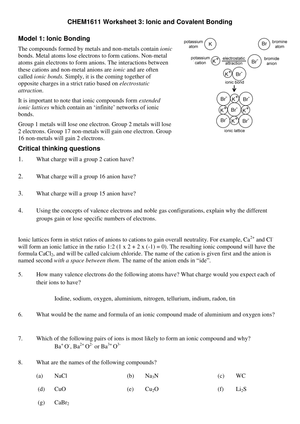
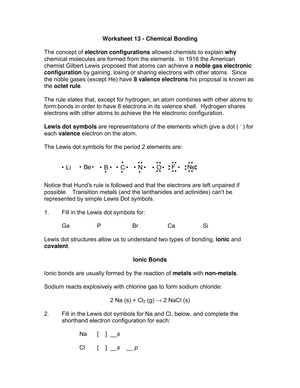
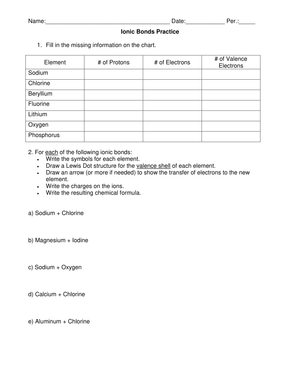
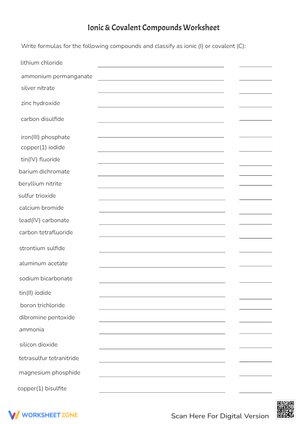
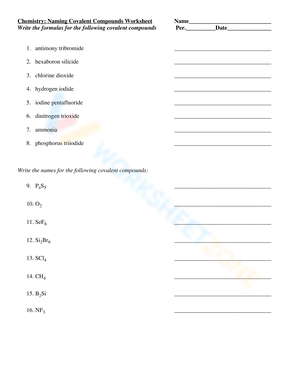
Students walking into a unit on chemical bonding often carry a shaky grasp of valence electrons, and that gap shows up fast once you ask them to classify bonds. Chemical bonding ionic and covalent worksheets give you a low-stakes way to check that foundation before you move into Lewis structures or molecular geometry. If a student cannot place an element's valence electrons on a quick diagram, they will struggle to reason about why sodium gives up an electron to chlorine but two oxygen atoms share a pair instead.
Physical science teachers in grade 8 or 9 typically need worksheets that isolate one skill at a time: identify metal versus nonmetal, count valence electrons, then predict transfer versus sharing. Grade 10 chemistry classes can move faster into electronegativity math and multi-step Lewis structure practice. Building your worksheet sequence around this progression keeps struggling students from feeling lost while still challenging students who are ready for NGSS HS-PS1-1 level reasoning about periodic trends.
Sequencing Worksheets from Valence Electrons to Real Compounds
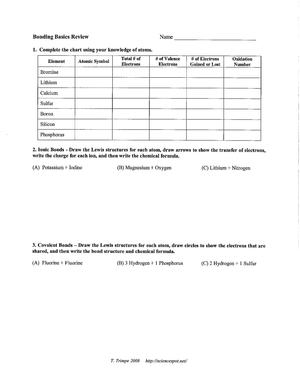
A useful unit sequence starts with electron configuration and dot diagram worksheets, then moves to bond-type sorting tasks, then finishes with worksheets that ask students to draw full Lewis structures for real molecules. Skipping straight to Lewis structures without the sorting step is a common reason students memorize procedures without understanding the underlying logic of electron transfer versus sharing.
Use common example molecules such as H2, H2O, O2, and CH4 for early covalent bonding practice, since these appear across most NGSS-aligned middle school and high school chemistry resources and give students a consistent reference set. Once students can explain why hydrogen forms a single shared pair in H2 and why oxygen forms two shared pairs in O2, they are ready for ionic examples built from common metal-nonmetal pairs like sodium chloride and magnesium oxide.
Formative Assessment: Exit Tickets and Quick Sorting Checks
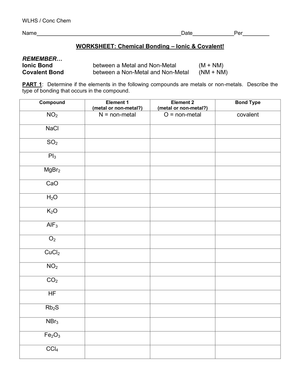
A short exit ticket built around six to eight element pairs works well as a daily formative check during a bonding unit. Ask students to sort the pairs into ionic and covalent categories and briefly justify one answer in a sentence. This format takes under five minutes to complete and gives you a fast read on which students are still relying on memorized rules instead of reasoning from electronegativity or metal-nonmetal position.
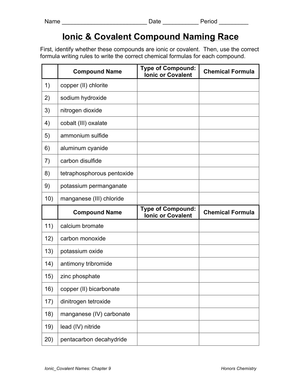
Card-sort worksheets work well for a mid-unit check too. Give students a set of compound names or formulas and ask them to physically group cards into ionic and covalent piles, then swap piles with a partner to check reasoning. This peer-check step often surfaces disagreements that lead to genuine classroom discussion about edge cases, which tends to stick with students far longer than a lecture on the same distinction.
Classroom Implementation
Plan for three to four class periods to move a class from valence electron review through bond-type prediction and into Lewis structure practice, with one additional day reserved for a quiz or performance task. Start each period with a two-minute warm-up worksheet that recaps the prior day's skill before introducing new material, since bonding concepts build heavily on each other.
Pair worksheet practice with hands-on modeling whenever possible. Molecular model kits let students physically build the structures they draw on paper, and this combination reduces the abstraction that makes bonding hard for many students. If model kits are not available, have students draw electron dot diagrams on whiteboards in pairs, then compare their diagrams to a worksheet answer key as a class before moving to independent practice. Keep worksheet packets organized by skill rather than by day, so students who need to revisit valence electron counting can pull that specific sheet during review sessions without digging through an entire unit packet.
Frequently Asked Questions
1. What grade level is appropriate for ionic and covalent bonding worksheets?
Physical science classes in grades 8-9 can use simplified, diagram-based versions, while grade 10 chemistry classes are ready for worksheets that include electronegativity calculations and more complex Lewis structures.
2. How do these worksheets align with NGSS HS-PS1-1?
HS-PS1-1 asks students to use the periodic table as a model to predict relative properties of elements based on valence electron patterns, which is exactly the reasoning skill that ionic and covalent bonding worksheets are designed to build and assess.
3. What is the best way to teach electronegativity for bond-type prediction?
Give students a simple electronegativity difference chart and have them practice on a large bank of element pairs, since repeated application across many examples builds the habit faster than a handful of worked examples.
4. How can teachers use these worksheets for review versus initial instruction?
During initial instruction, use scaffolded worksheets with diagrams and sentence starters; for review, switch to card sorts, exit tickets, or mixed-practice sheets that require students to work without guided prompts.
5. What common mistakes do students make when identifying bond types?
Students often assume any compound with two different elements is ionic and frequently confuse polar covalent bonds with ionic bonds, both of which are addressed by including nonmetal-nonmetal pairs and mid-range electronegativity examples in worksheet practice.