Why reaction-type classification comes first
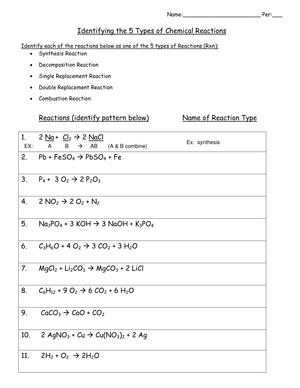
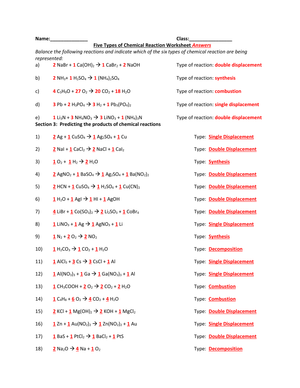
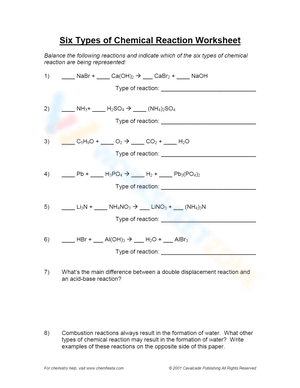
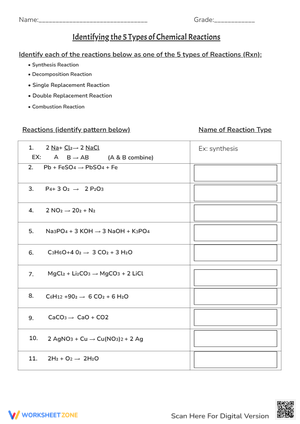
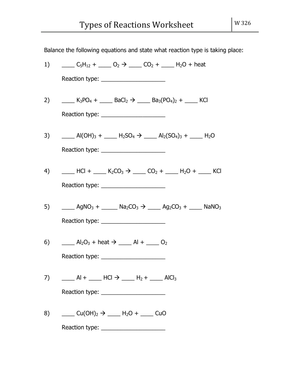
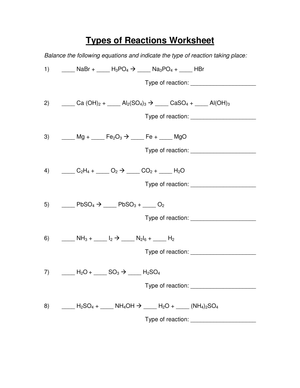
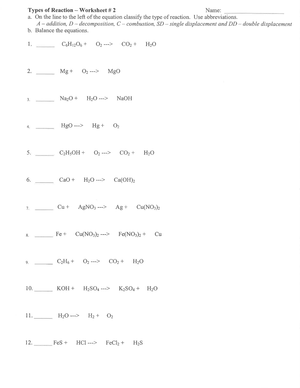
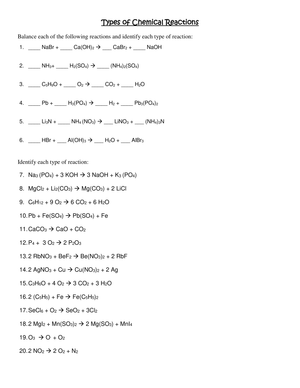
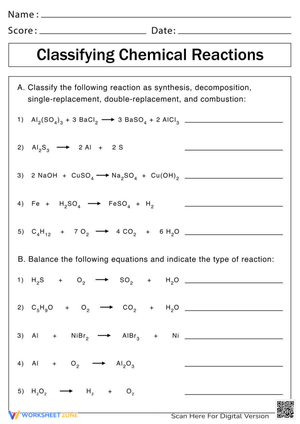
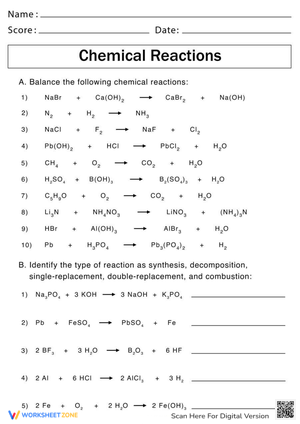
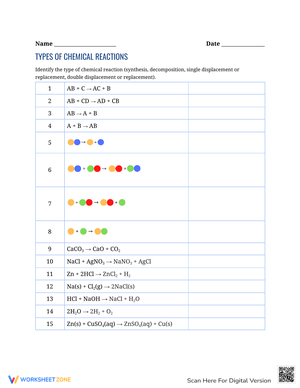
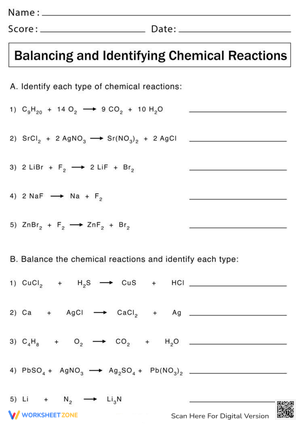
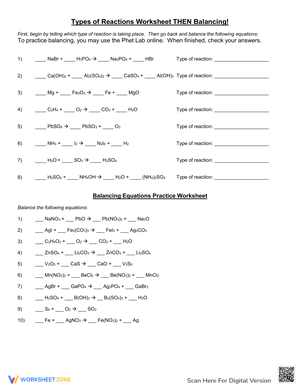
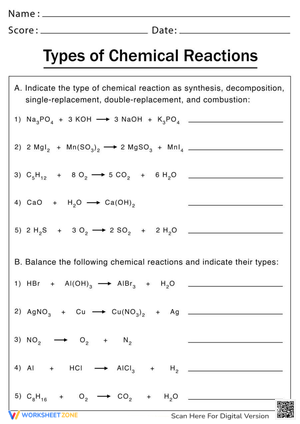
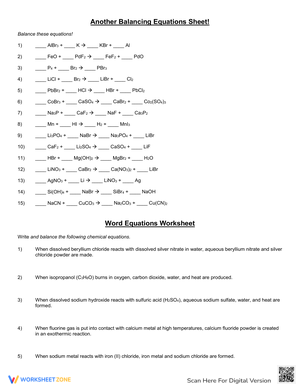
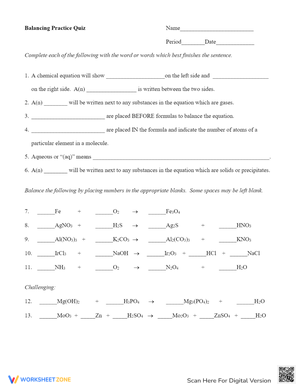
Before students can balance an equation or predict products, they need to recognize what kind of reaction they're looking at. Reaction-type worksheets give chemistry and physical science students repeated, low-stakes practice at exactly that skill. When a student can label a reaction as synthesis, decomposition, single replacement, double replacement, or combustion, the steps that follow—counting atoms, balancing coefficients, and predicting products—stop feeling random and start following a pattern the student can name.
That's why classification usually belongs early in a chemical reactions unit. It's the scaffold that makes everything after it easier. Teachers who front-load identification tend to spend less time re-teaching balancing later, because students already have a mental filing system for the reactions they meet. A worksheet built around the five types turns an abstract topic into something students can sort, check, and self-correct.
The five reaction types your students need to identify
US high school chemistry courses lean on five classic reaction types, and a good worksheet covers all of them:
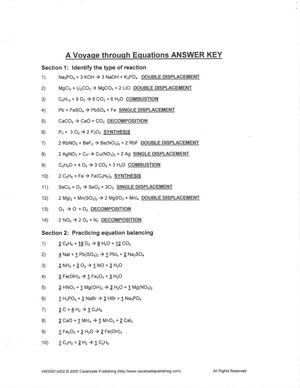
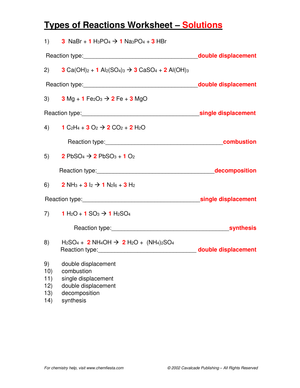
- Synthesis (combination): two or more reactants combine into a single product, as in A + B → AB.
- Decomposition: a single compound breaks apart into two or more simpler substances.
- Single replacement: one element swaps into a compound and displaces another element.
- Double replacement: two compounds exchange ions, often producing a precipitate, gas, or water.
- Combustion: a fuel reacts with oxygen to release energy, typically producing carbon dioxide and water.
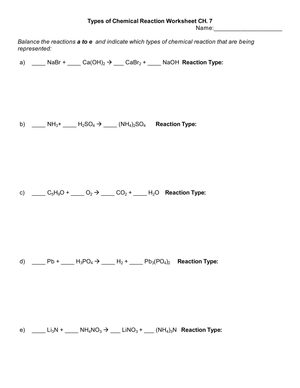
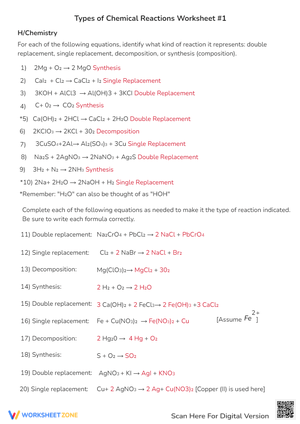
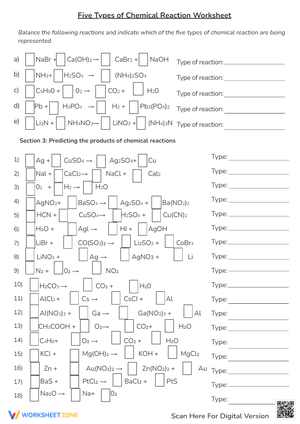
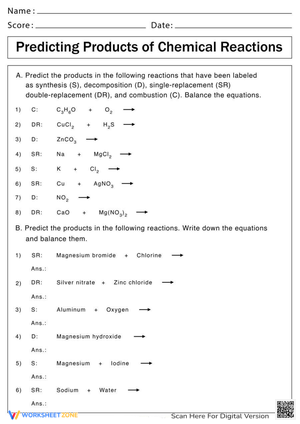
The distinction students trip over most is single versus double replacement. A worksheet that groups those two side by side, with contrasting examples, forces the comparison instead of leaving it to chance. A strong set doesn't just ask for a label, either. It mixes in a few reactions where students predict the products, so identification and prediction reinforce each other, and a single "name the type, then complete the equation" column raises the rigor without overwhelming students who are still learning the categories.
Aligning practice with NGSS HS-PS1
Reaction-type practice maps directly onto the Matter and Its Interactions performance expectations. As students classify reactions and track atoms across the arrow, they build toward the modeling and explanation skills those standards ask for.
The NGSS assessment boundaries for HS-PS1-1 and HS-PS1-2 limit the content to main group elements and combustion reactions. That's a practical gift for worksheet design: you can keep transition-metal edge cases out of introductory sets and concentrate practice on the reactions students will actually be assessed on, which tightens the feedback loop between daily practice and the end-of-course exam.
According to the Next Generation Science Standards, HS-PS1-1 requires students to use a model showing that the total number of atoms does not change in a chemical reaction, so mass is conserved; classifying the five reaction types gives students the pattern recognition that makes this conservation principle visible in practice.
Classroom Implementation
There are several practical ways to fit reaction-type worksheets into a chemistry unit. Use them as guided practice right after you introduce each type, working the first few problems together under a document camera so students hear your reasoning out loud, then release the rest for independent or partner work. A short set of six to ten reactions makes a clean exit ticket: students classify each one, and you get an instant read on who can distinguish the types before you move on to balancing.
For homework, keep the sets mixed so students can't rely on the day's topic as a crutch. Mixed practice forces genuine discrimination between types, which is closer to what an end-of-course exam demands. When you review answers, ask students to justify the label, not just state it—"how do you know this is decomposition and not single replacement?"—so the worksheet becomes a talking point instead of a fill-in-the-blank exercise. Keep completed sheets in student folders as a running record you can revisit during review week.
Pairing worksheets with lab demonstrations
Classification sticks better when students have seen the chemistry happen. Pair a combustion worksheet with a quick candle or steel-wool demonstration, and pair double replacement with a precipitate demo where two clear solutions produce a solid. After the demo, hand out a worksheet that includes the reaction students just watched, so they connect the physical evidence—light, heat, a color change, a precipitate—to the category on the page.
You can run this in reverse, too. Give students a worksheet first, ask them to predict what they'd observe for each reaction type, then show a demonstration and have them check their predictions. Either order builds the habit of reading a reaction as both a symbolic equation and a real event, which is exactly the dual fluency high school chemistry is trying to develop.
Frequently Asked Questions
1. What are the main types of chemical reactions students need to identify?
Most US high school chemistry courses focus on five: synthesis, decomposition, single replacement, double replacement, and combustion. Reaction-type worksheets give students practice recognizing all five, with extra attention to the single-versus-double replacement distinction that trips up the most students.
2. How do these worksheets align with NGSS HS-PS1 standards?
Classifying reactions supports HS-PS1-1, which asks students to model how the number of atoms stays constant so mass is conserved, and HS-PS1-2, which asks them to explain reaction outcomes from periodic trends. Sorting reactions by type builds the pattern recognition both expectations rely on.
3. What grade level is types of reaction practice typically taught at?
Reaction classification usually appears in a first-year high school chemistry course, most often in grades 10 or 11, and sometimes in an honors physical science class in grade 9. The five-type framework is standard across most US chemistry curricula.
4. How can teachers use these worksheets for review before a unit test?
Mixed sets make strong review tools. Assign a worksheet that blends all five types with no topic labels, then have students justify each classification aloud. This mirrors test conditions and surfaces lingering confusion between reaction types before the exam rather than after it.
5. What prerequisite skills do students need before starting?
Students should be able to read chemical formulas, tell elements from compounds, and recognize a chemical equation's reactant and product sides. With those basics in place, reaction-type worksheets become the bridge to balancing equations and predicting products later in the unit.