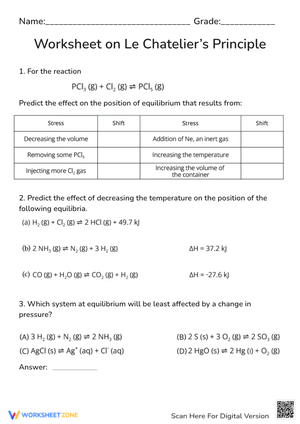
What Le Chatelier's Principle Worksheets Should Cover
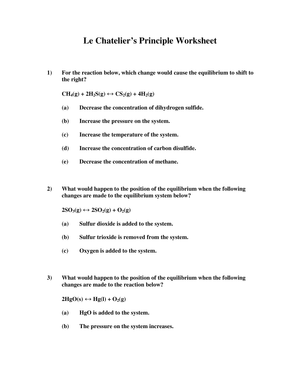
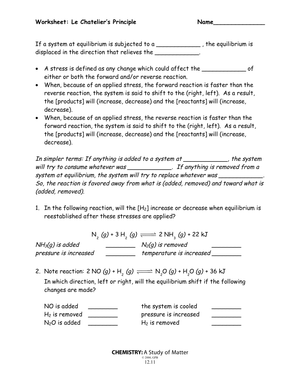
Equilibrium is where a lot of chemistry students hit a wall. They can balance an equation and calculate a K value, then freeze the moment you ask which way a reaction shifts when you heat it. Good Le Chatelier's Principle worksheets close that gap by turning an abstract rule into repeatable practice. The core idea is easy to state: a system at equilibrium responds to an imposed change in concentration, temperature, pressure, or volume by shifting to counteract that change. Applying it fluently under exam conditions is the hard part, and that's exactly what targeted practice sets are for.
When you're screening worksheets for an equilibrium unit, look for problems that force a prediction and a justification, not just a circled answer. A worksheet that asks students to state the shift direction and explain why builds the reasoning your state test and any AP-style free response will demand. That combination of prediction plus rationale is the difference between recall and understanding.
Building Toward NGSS HS-PS1-6
If your instruction is standards-aligned, Le Chatelier practice maps cleanly onto one performance expectation. HS-PS1-6 asks students to refine a chemical system design by specifying a condition change that increases the amount of product at equilibrium. That is Le Chatelier's Principle applied with intent: don't just predict a shift, engineer one.
Here's the shift in framing that matters. Most worksheets stop at "which way does it go?" but HS-PS1-6 is a design task, so the strongest practice sets ask the reverse question: "You want more product. Name the change that gets it and defend the choice." That inversion is what separates a worksheet that builds recall from one that builds the engineering reasoning the standard actually assesses, and it's the single most common gap I see in off-the-shelf equilibrium packets.
According to the Next Generation Science Standards, HS-PS1-6 requires students to "refine the design of a chemical system by specifying a change in conditions that would produce increased amounts of products at equilibrium." The standard explicitly links macroscopic moves, like adding a reactant or removing a product, to molecular-level changes in equilibrium position, so worksheet problems that connect both scales carry real instructional weight.
Structuring Practice Around the Four Stress Types
The cleanest way to organize a practice set is by the four stresses students will be tested on. Sequencing them deliberately keeps the cognitive load manageable and surfaces misconceptions one at a time.
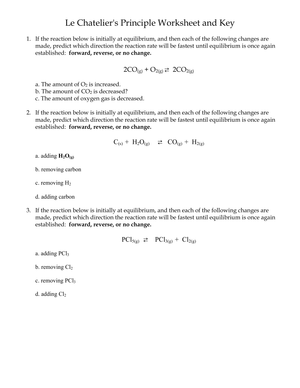
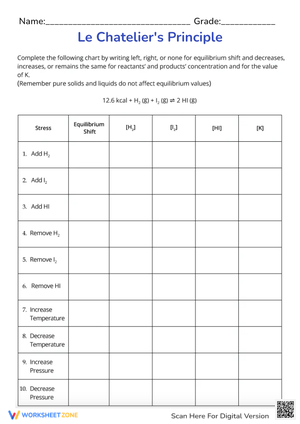
- Concentration: Add or remove a reactant or product and predict the shift. These are the most intuitive, so they make a strong entry point.
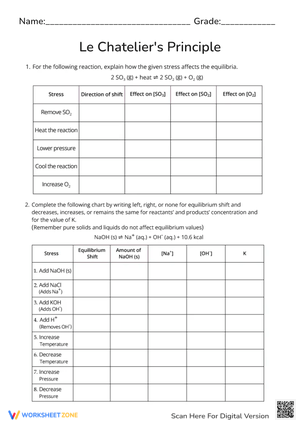
- Temperature: Treat heat as a reactant or product depending on whether the reaction is exothermic or endothermic. This is where K actually changes value, and students routinely miss that distinction.
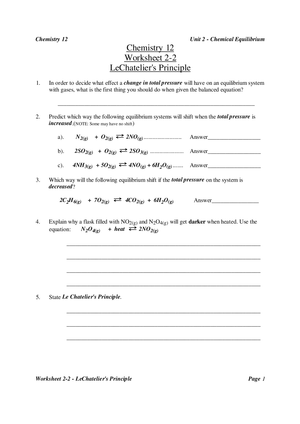
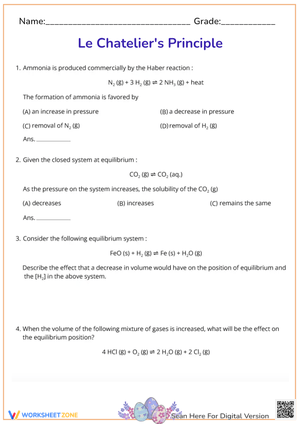
- Pressure and volume: For gas-phase equilibria, compare moles of gas on each side. Decreasing volume shifts toward the side with fewer gas moles.
- Catalysts and inert gases: Include a few no-shift traps. A catalyst speeds both directions equally and does not move the equilibrium position, and adding an inert gas at constant volume changes nothing.
Those no-shift items matter more than their count suggests. Students who only see problems that shift start assuming every change moves the system, and the trap questions retrain that reflex.
Pairing Worksheets With ICE Tables and Equilibrium Expressions
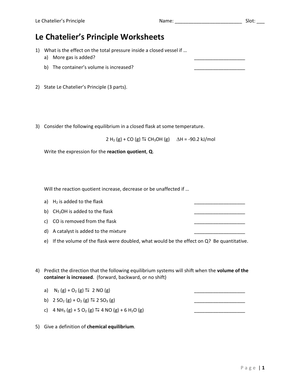
Le Chatelier reasoning gets sturdier when it sits next to quantitative tools. Have students write the equilibrium expression before they predict a qualitative shift, so the reaction quotient Q becomes the bridge between the two. When a stress makes Q less than K, the reaction moves forward; when Q exceeds K, it moves back. Worksheets that ask for this Q-versus-K comparison give students a fallback when their intuition stalls.
ICE tables reinforce the same logic from a different angle. A short mixed set, where some problems are purely qualitative and others require an ICE table to recalculate concentrations after a disturbance, keeps the conceptual and computational threads tied together instead of teaching them as separate skills. Khan Academy's Le Chatelier's Principle video is a useful pre-teaching anchor if you want students to arrive with the vocabulary already loaded.
Classroom Implementation
Placement inside the unit is what makes or breaks these worksheets. Introduce Le Chatelier practice after students are comfortable writing equilibrium expressions but before the summative test, so the sheets function as formative assessment rather than last-minute cramming. A ten-minute warm-up of four prediction problems, one per stress type, gives you a fast read on who has it.
For pacing, run a worked example under the document camera, then release a short set for partners, then close with an independent exit slip. Collect the exit slips and sort them into three piles: solid, shaky on temperature, and shaky on pressure. Those two shaky piles almost always define your next day's small-group targets.
Differentiation is straightforward with a well-built packet. For intervention groups, strip problems down to concentration and temperature only, and provide a shift-direction sentence frame. For enrichment, hand students the HS-PS1-6 design prompt: give them a target product and ask them to specify and defend a condition change, including any tradeoffs like cost or the effect of temperature on K. Same standard, two very different entry points.
Targeting Common Equilibrium Misconceptions
The best reason to use worksheets here is that equilibrium attracts predictable, sticky misconceptions, and practice is how you flush them out. Watch for these:
- Believing equilibrium means equal concentrations of reactants and products, rather than constant concentrations.
- Thinking a catalyst shifts the position of equilibrium instead of only reaching it faster.
- Assuming temperature changes leave K untouched, the way concentration changes do.
- Forgetting to count moles of gas when predicting a pressure or volume shift, and instead guessing.
Build a worksheet section that deliberately targets each one, then revisit the same misconception a week later in a spiral review. Spacing the practice is what moves the correction from short-term to durable.
Frequently Asked Questions
1. What grade level or course covers Le Chatelier's Principle?
It's a high school chemistry topic, usually in first-year chemistry or an honors or AP-level course, taught within the chemical equilibrium unit. Students typically need a working grasp of reaction rates and equilibrium expressions first.
2. How should teachers sequence Le Chatelier's worksheets in the unit?
Introduce them after equilibrium expressions and K are established, but before the unit test. Used mid-unit, they work as formative checks and reveal which stress types need reteaching before the summative assessment.
3. What stress variables should practice problems include?
Cover all four: concentration, temperature, pressure, and volume. Add a few catalyst and inert-gas items as no-shift traps, since those expose whether students truly understand what moves an equilibrium and what does not.
4. How do these worksheets support NGSS-aligned instruction?
They build toward HS-PS1-6, which asks students to specify a condition change that increases product amounts at equilibrium. Problems that ask students to design a shift, not just predict one, match the standard directly.
5. How can teachers use these worksheets for review or small-group intervention?
Use short exit-slip sets to sort students by which stress type they miss, then pull targeted small groups. For intervention, limit problems to concentration and temperature with a sentence frame; for review, spiral one or two items into later warm-ups.