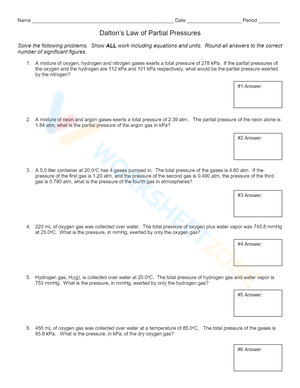
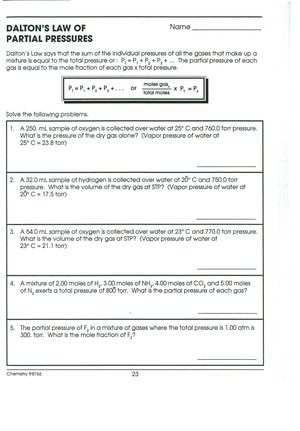
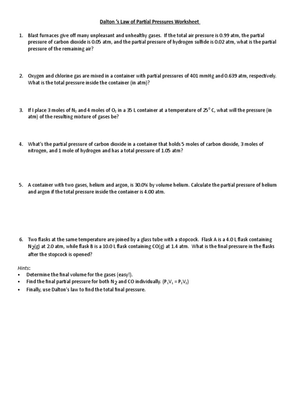
What Dalton's Law of Partial Pressure Worksheets Cover
When your gas laws unit reaches mixtures, students need repetition with the numbers before the concept sticks. Dalton's Law of Partial Pressure worksheets give ninth through twelfth graders structured practice adding component pressures, isolating a single gas from a mixture, and reading real lab data. Most sets move from single-step addition problems to multi-step scenarios that fold in mole fraction and the ideal gas law, so you can assign the same page to a standard section and an honors section with different expectations.
The goal is not memorizing one equation. It is getting students comfortable with the idea that each gas in a sealed container pushes on the walls independently, and that those pushes add up to the pressure a gauge actually reads. A good worksheet keeps that mental model visible while the arithmetic gets harder.
The Core Formula Students Practice
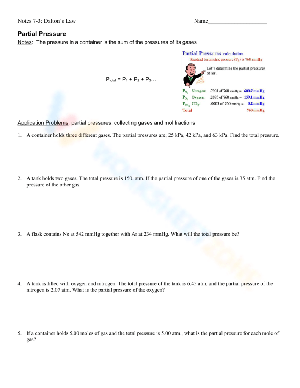
Every problem on these pages traces back to one relationship: the total pressure of a gas mixture equals the sum of the partial pressures of its parts, or Ptotal = P1 + P2 + P3 and so on. The law assumes each gas behaves as if the others were not there, which is the same ideal-gas assumption students already met earlier in the unit. That continuity is worth pointing out, because it tells students they are extending a model, not learning a disconnected rule.
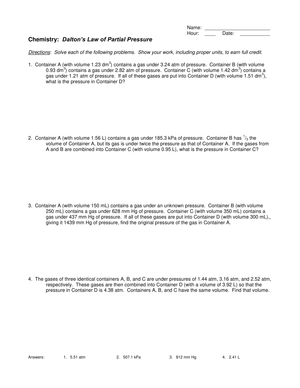
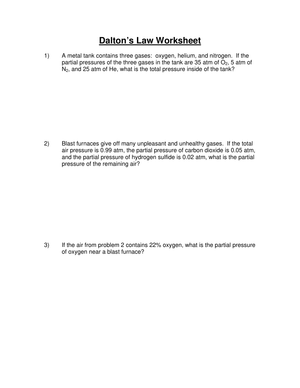
Well-built worksheets rotate the unknown. Sometimes students add three known partial pressures to find the total. Other times they get the total and two components and solve for the third by subtraction. Mixing the direction of the calculation keeps students from pattern-matching and pushes them to reason about what the container actually holds.
A Worked Example You Can Model on the Board
Guided practice works best when students see one full solution before they try their own. Suppose a sealed flask holds nitrogen at 0.60 atm, oxygen at 0.25 atm, and carbon dioxide at 0.15 atm. Students add the three values to get a total pressure of 1.00 atm, then you flip the question: if the total were 1.00 atm and nitrogen and oxygen accounted for 0.85 atm, what is the carbon dioxide pressure? Subtraction gives 0.15 atm, and students see the same numbers from two directions.
Next, extend the example into mole fraction. With a total of 1.00 atm, nitrogen's mole fraction is 0.60, oxygen's is 0.25, and carbon dioxide's is 0.15, and those fractions sum to exactly 1. Walking students from the additive form to the fractional form in a single problem shows them the two representations describe one physical situation, which is the connection AP graders expect them to make.
Gas Collected Over Water: The Lab Connection
The single most useful application on any Dalton's Law worksheet is the gas-collected-over-water scenario, a staple demonstration in US high school chemistry. When a student collects hydrogen or oxygen by displacing water, the gas that bubbles up is mixed with water vapor. The pressure gauge reads both, so the dry gas pressure only appears after you subtract the water vapor pressure at that temperature.
According to Chemistry LibreTexts, Dalton's Law states the total pressure of a mixture equals the sum of the partial pressures of its individual gases, so a gas collected over water at 760 mmHg total, with a water vapor pressure of 24 mmHg at 25 degrees Celsius, has a dry gas partial pressure of 736 mmHg.
On a worksheet, this scenario usually gives students a table of water vapor pressures at several temperatures. The skill you are assessing is whether they select the right value for the recorded temperature and subtract it before doing anything else. Students who skip that step report a hydrogen or oxygen pressure that is a few percent too high, and the error compounds if they then use the wrong pressure in an ideal gas law calculation.
Connecting Dalton's Law to Mole Fraction and AP Chemistry
For AP Chemistry sections, partial pressure is also a doorway to mole fraction. The partial pressure of any gas equals its mole fraction multiplied by the total pressure, or Pi = Xi x Ptotal. This version rewards students who already understand that pressure tracks the number of particles, not the identity of the gas. Worksheets aimed at AP review usually pair a mole-fraction item with an ideal gas law setup, so students calculate moles first, then convert to a partial pressure.
Using These Worksheets In Real Classes
Slot these worksheets in as formative checks, not just homework. A short version works well as a warm-up the day after the gas-collected-over-water lab, while a longer multi-step set fits a review day before the unit test or lab practical. Because the same page can carry both single-step and multi-step problems, you can differentiate by assigning which items each group completes rather than printing separate sheets.
- Open with two addition-only problems so every student gets an early win.
- Include one gas-over-water item tied to the exact water vapor values your class recorded.
- Reserve the final questions for mole fraction and ideal-gas combinations for honors or AP groups.
- Use a quick exit ticket asking students to explain, in words, why water vapor gets subtracted.
Pairing the worksheet with a short whole-class review of one worked example keeps students from copying a procedure they cannot explain. When students narrate their reasoning aloud, you catch the concentration-versus-pressure mix-up faster than any answer key will.
Frequently Asked Questions
1. What course usually teaches Dalton's Law of Partial Pressures?
It appears in the gas laws unit of general high school chemistry, typically grades 10 through 12, and again in AP Chemistry. Standard sections focus on the additive form, while AP sections extend it to mole fraction and the ideal gas law.
2. How do these worksheets support a gas-collected-over-water lab?
They give students practice subtracting water vapor pressure from total pressure to find the dry gas pressure, the exact calculation the lab requires. Assign a worksheet item using the same temperature and pressure values your class measured.
3. What is the difference between partial and total pressure problems?
Total pressure problems ask students to add known component pressures, while partial pressure problems give the total and ask students to solve for one missing gas by subtraction or by using its mole fraction.
4. How does Dalton's Law connect to mole fraction in AP Chemistry?
The partial pressure of a gas equals its mole fraction times the total pressure, Pi = Xi x Ptotal. AP worksheets often ask students to find moles first, then convert to a partial pressure, linking the two ideas in one problem.
5. What errors should teachers watch for when grading?
Watch for students confusing partial pressure with concentration, skipping the water vapor correction, and assuming heavier gases automatically contribute more pressure. Each mistake points to a specific concept worth reteaching before the unit exam.