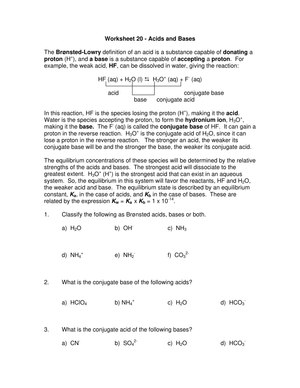
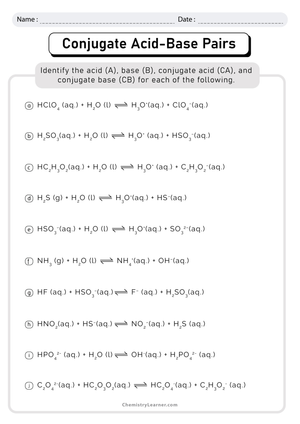
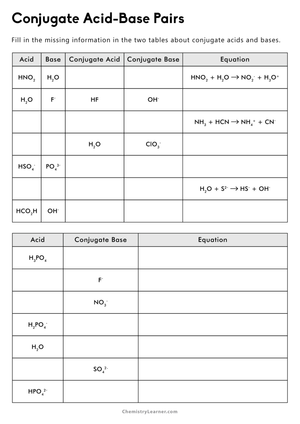
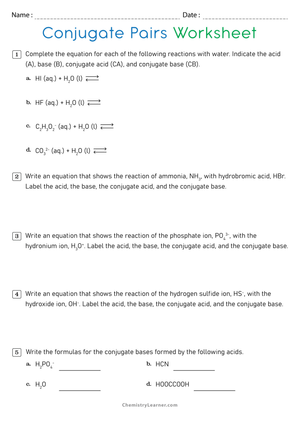
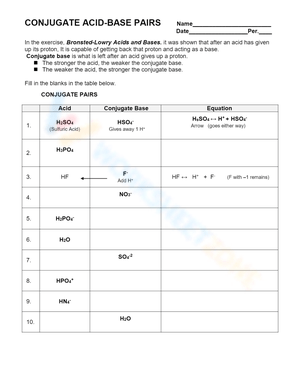
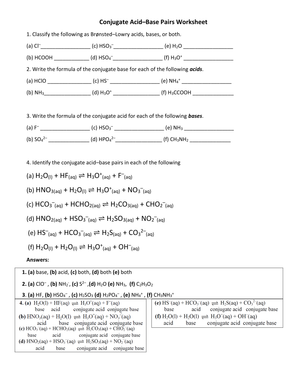
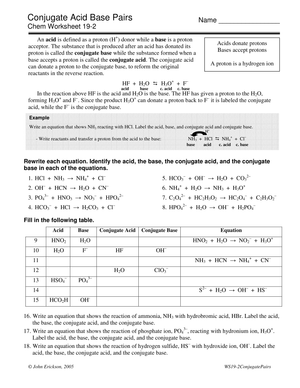
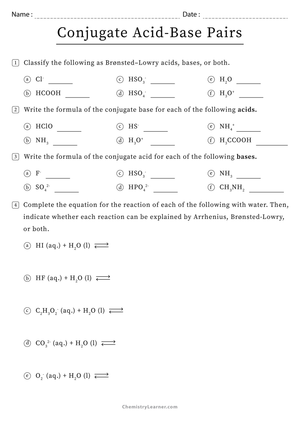
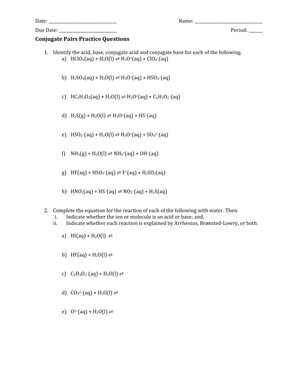
Under Bronsted-Lowry theory, acids are proton donors and bases are proton acceptors. When an acid donates a proton, it becomes its conjugate base. When a base accepts a proton, it becomes its conjugate acid. Every conjugate pair problem your students see is really just this donor-acceptor relationship written out in formula form, and grounding practice in that framework helps students see the pattern rather than guessing at each new equation.
Worksheets that consistently label reactants and products as acid, base, conjugate acid, or conjugate base give students a repeatable process: find the proton that moved, then find its two homes. Once students internalize that process, they can apply it to any equation, not just the ones they memorized in class.
Using Water as a Recurring Example Across Problem Sets
Water is amphoteric, meaning it can act as either an acid or a base depending on what it reacts with. This gives it two conjugate pairs of its own: H3O+ and H2O form one pair, while H2O and OH- form the other. Because water shows up in so many acid-base reactions, it is a natural anchor point for worksheet design. Seeing water play both roles across different problems helps students understand that a single molecule is not fixed as an acid or a base; its role depends on the reaction partner.
Teachers can sequence worksheet problems so water appears first as a base accepting a proton from a strong acid, then later as an acid donating a proton to a stronger base. That contrast reinforces the idea that acid-base behavior is relative to the reaction, not an inherent property of the molecule.
Classroom Implementation
Conjugate acid base pairs worksheets work well at several points in an acid-base unit. Early on, a short set of matching or labeling problems serves as a formative check before moving into pH and equilibrium content. Mid-unit, longer worksheets with full equations let students practice the complete labeling process independently or in pairs. Near the end of the unit, a mixed review worksheet that combines conjugate pair identification with strength comparisons can double as a low-stakes quiz.
For small-group intervention, pull students who consistently mislabel which species is the acid versus the conjugate acid. This mix-up is common and usually traces back to students focusing on the formula alone rather than tracking the direction of proton transfer. A worksheet with fewer problems but more scaffolding, such as pre-labeled proton arrows, can help these students rebuild the process step by step.
Connecting Practice to NGSS PS1.B
Conjugate acid-base pair identification connects directly to NGSS disciplinary core idea PS1.B, Chemical Reactions, which addresses how atoms rearrange and bonds break or form during chemical processes. Proton transfer in Bronsted-Lowry reactions is a clear, concrete example of this idea in action: a single bond breaks on the acid, and a new bond forms on the base. Framing conjugate pair worksheets as PS1.B-aligned practice can help when documenting standards coverage in lesson plans or department curriculum maps.
According to the LibreTexts Chemistry resource on conjugate acid-base pairs, the concept is taught as a direct extension of the Bronsted-Lowry acid-base definition, where every acid-base reaction can be described as an equilibrium between two conjugate pairs differing by a single proton. That framing is a useful anchor for teachers building worksheet sequences, since it keeps every problem tied back to the same core proton-transfer logic rather than treating each equation as a new rule to learn.
Frequently Asked Questions
1. How do you identify a conjugate acid-base pair in a chemical equation?
Look for two species in the equation that differ by exactly one proton, H+. Track which reactant donated a proton to become a product, and which reactant accepted a proton to become a different product. Those two donor-acceptor relationships are your conjugate pairs.
2. What grade level or course typically covers conjugate acid-base pairs?
This topic is typically introduced in high school chemistry, often within an acid-base unit that follows atomic structure and bonding. It commonly appears in grades 9 through 12, depending on when a school sequences its chemistry course.
3. Why does a strong acid have a weak conjugate base?
Strong acids donate protons readily, which means their conjugate base has little tendency to reaccept a proton and reform the acid. That low tendency to hold onto a proton is what makes the conjugate base weak, creating the inverse relationship between acid strength and conjugate base strength.
4. How can teachers use conjugate acid-base pair worksheets for review versus formative assessment?
For review, use longer worksheets with varied equations that students complete independently or in pairs to reinforce the labeling process. For formative assessment, use a short, focused set of five to eight problems near the start of class to quickly check whether students can identify pairs before moving into new content like pH calculations.
5. What common student misconceptions do these worksheets help correct?
Worksheets help correct the assumption that acid-base strength transfers directly to the conjugate species, as well as confusion between the original acid and its conjugate acid. Repeated practice with labeled proton transfer also helps students stop treating water as fixed to one role, reinforcing that its behavior depends on the reaction partner.