


























Views
Downloads



Printable Electron Structure Worksheet | Grade 11 Chemistry
Paste this activity's link or code into your existing LMS (Google Classroom, Canvas, Teams, Schoology, Moodle, etc.).
Students can open and work on the activity right away, with no student login required.
You'll still be able to track student progress and results from your teacher account.
This worksheet teaches Grade 11 chemistry students to defend a periodic-trend comparison with a claim, numerical evidence, and an electron-structure mechanism. Students decide which atom or ion has the greater ionization energy or radius, cite values with units, and explain why using effective nuclear charge, shielding, and orbital repulsion.
At a Glance
- Grade: 11 · Subject: Chemistry
- Standard: Periodic trends — explain ionization energy and size comparisons using electron structure.
- Skill Focus: Defend a comparison using electron structure
- Format: 5 pages · 8 problems · Answer key included · PDF
- Best For: Evidence-based periodic trends reasoning practice
- Time: 40–50 minutes
What's Inside
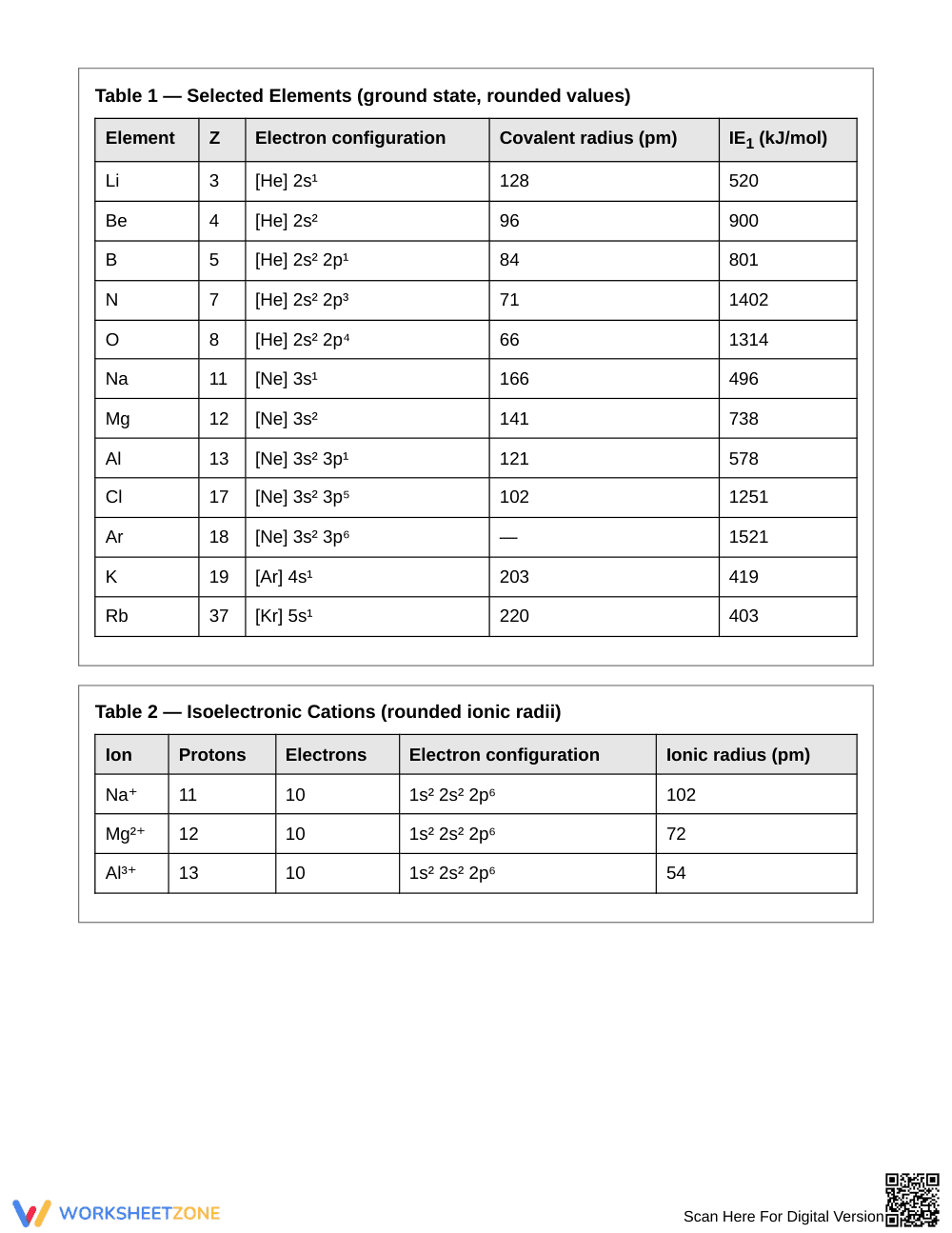
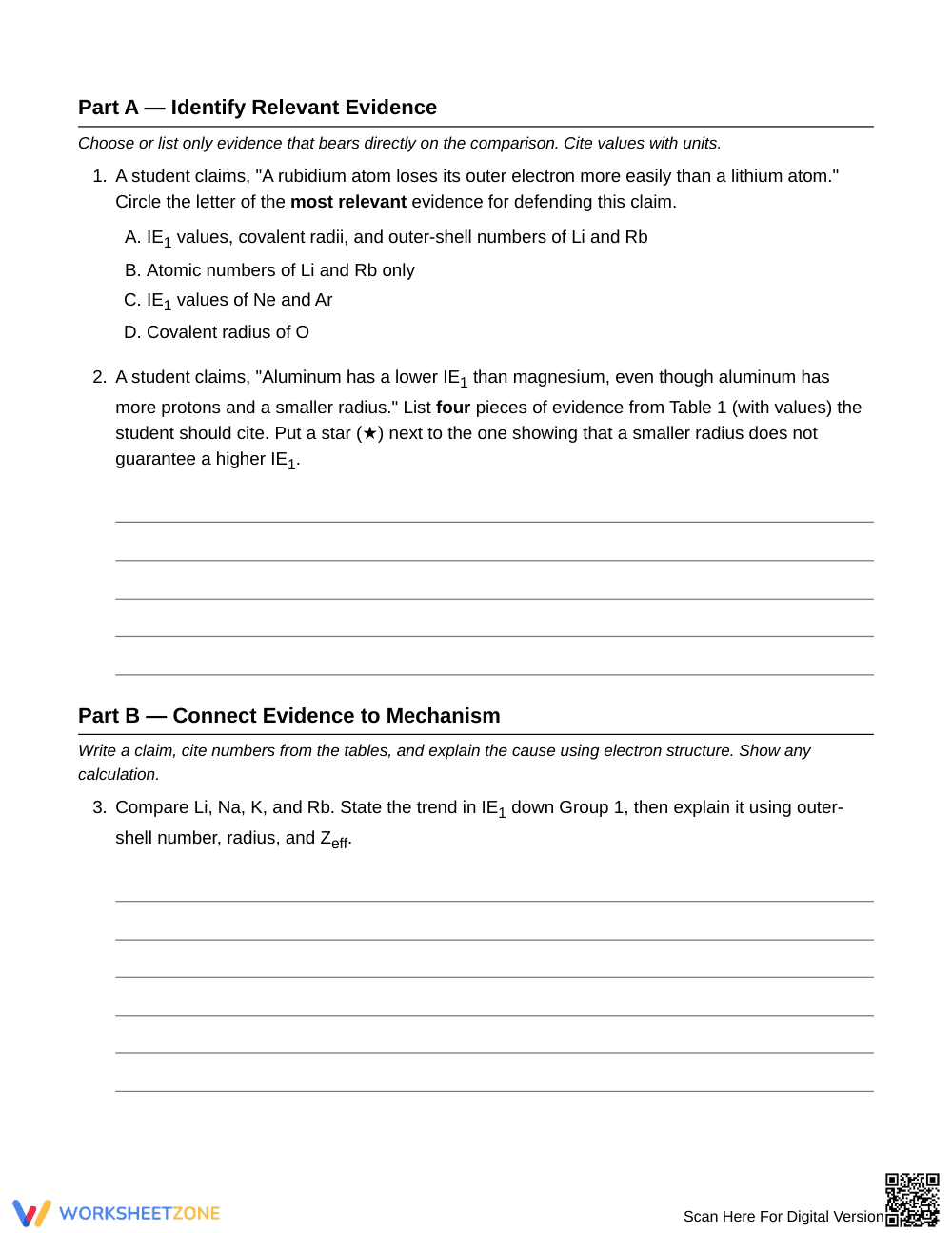
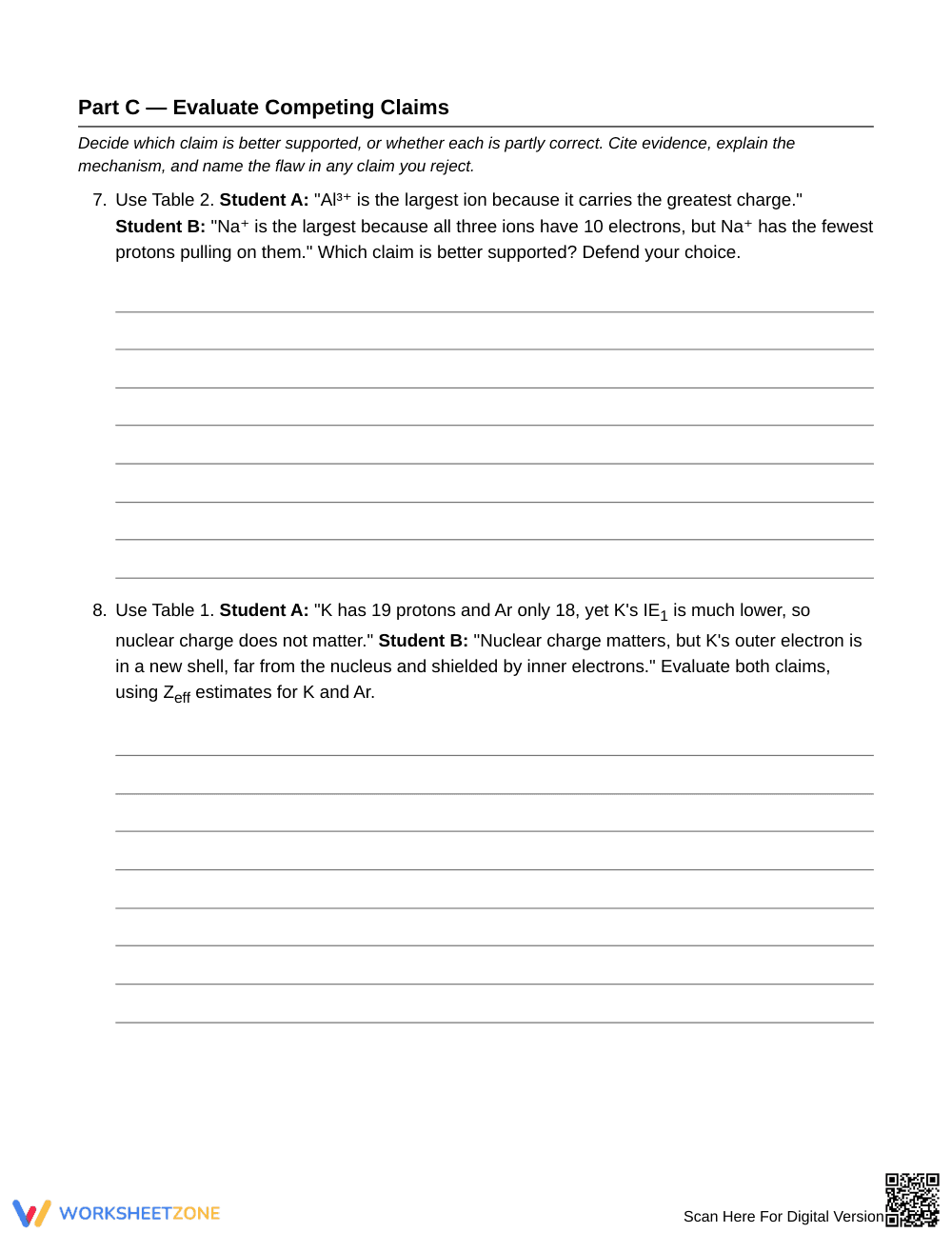
Five pages hold a reasoning frame, two data tables (twelve atoms and three isoelectronic cations), and eight tasks in three parts. Students circle evidence, list values, write claim-evidence-mechanism explanations, and judge competing student claims. A 3-page answer key follows with model reasoning.
Skill Progression
- Guided practice: Part A, 2 tasks. Students select and list relevant evidence with the reasoning frame in view.
- Supported practice: Part B, 4 tasks. Students write full explanations using table data, including Zeff estimates and the Be-to-B and N-to-O exceptions.
- Independent practice: Part C, 2 tasks. Students evaluate competing claims and name the flaw in any claim they reject.
The sequence follows gradual release (I Do, We Do, You Do): model the frame, work Part B together, then let students finish Part C alone.
Standards Alignment
This worksheet was not assigned a standard code, so none is listed here. It targets high school chemistry reasoning about periodic trends: using electron configurations, effective nuclear charge, and shielding to explain patterns in ionization energy and atomic size. Add your state or district code when copying this description into lesson plans, IEP goals, or curriculum mapping tools.
How to Use It
Assign it as classwork after direct instruction on Zeff and shielding, or use it as a review before the unit test. While students work, watch whether they cite numbers with units before they explain; that habit separates strong arguments from restated trends. Expect 40–50 minutes.
Who It's For
Grade 11 chemistry students in a periodic trends unit. Students who need support can complete Part A and two Part B tasks; advanced students can add Part C. Pair it with an anchor chart on shielding and subshell energy.
The Grade 11 Chemistry worksheet “Defend a Comparison Using Electron Structure” teaches students to justify periodic-trend comparisons with a claim, cited evidence, and an electron-structure mechanism. Across 8 tasks and 5 pages, students use two data tables to compare first ionization energy and radius for atoms and isoelectronic ions, estimate effective nuclear charge as Z minus inner-shell electrons, and explain exceptions such as Be to B and N to O through subshell and electron-repulsion arguments. The sequence moves from identifying relevant evidence to writing mechanisms to evaluating competing student claims, matching the gradual-release model described by Fisher & Frey (2014), in which teachers shift responsibility from modeled to independent work. A 3-page answer key supports quick scoring. The worksheet fits periodic-trends units where students need practice moving beyond memorized trends toward evidence-based scientific explanation.


