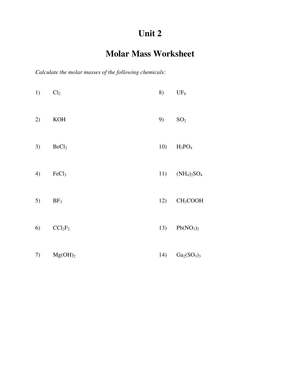
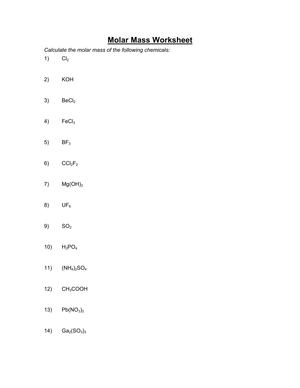
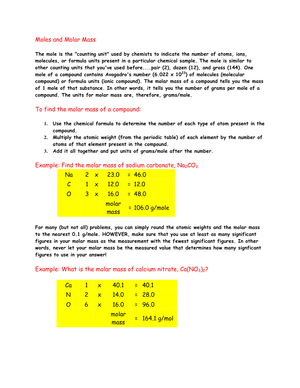
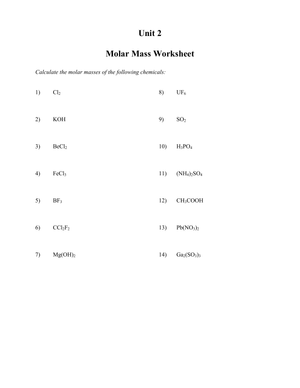
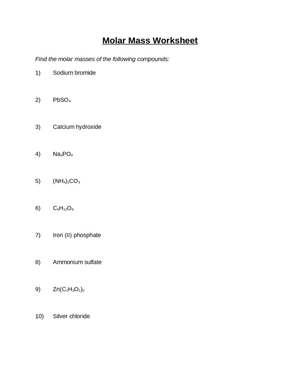
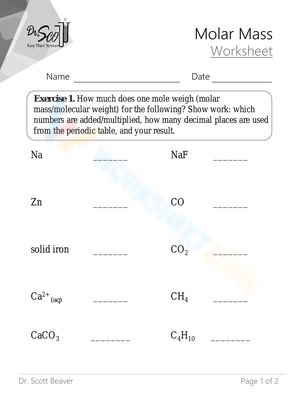
Molar mass is one of those chemistry skills that looks small at first, then suddenly appears everywhere. Students need it when converting grams to moles, solving stoichiometry problems, identifying formulas, and understanding chemical reactions. Molar mass worksheets give learners a steady way to practice this essential skill before it becomes part of larger, multi-step chemistry problems. By working through examples with elements, compounds, and formulas, students learn how to use the periodic table with more confidence and accuracy.
The process begins with a simple idea: every element has an atomic mass, and compounds have a total molar mass based on all the atoms in the formula. A student calculating the molar mass of H2O must count two hydrogen atoms and one oxygen atom, then add their masses together. That same thinking grows into more complex formulas like Ca(OH)2, Al2(SO4)3, or C6H12O6. Molar mass worksheets help students slow down, count atoms correctly, handle parentheses, and avoid common mistakes when formulas become more detailed.
These worksheets are especially valuable because they connect basic periodic table skills to advanced chemistry work. Students who can calculate molar mass accurately are better prepared for mole conversions, percent composition, empirical formulas, molecular formulas, and reaction calculations. Once learners feel comfortable finding molar mass, they can move into related topics such as this empirical and molecular formula practice set, where formula analysis becomes even more important.
In the classroom, molar mass worksheets can be used as warm-ups, guided examples, homework, quiz review, lab preparation, or small-group support. Some students may need extra practice reading chemical formulas, while others may struggle with multiplication inside parentheses or rounding atomic masses. Teachers can use these worksheets to spot exactly where errors happen and reteach with targeted examples. For students who feel overwhelmed by chemistry calculations, this guide to handling difficult chemistry assignments can offer helpful strategies for staying organized and building confidence.
Worksheetzone’s molar mass worksheets are designed to make chemistry practice more manageable and less intimidating. Students can begin with simple element and compound calculations, then gradually work toward more challenging formulas and applied problems. With consistent practice, learners become faster at using the periodic table, more careful with subscripts, and more confident when molar mass appears in larger chemistry units. Whether used for first-time instruction or review before a test, these worksheets give students a reliable foundation for success in chemistry.
Frequently Asked Questions
Question 1: What do students practice in molar mass worksheets?
Students practice using the periodic table to find atomic masses, counting atoms in chemical formulas, multiplying by subscripts, handling parentheses, and adding values to find the total molar mass of a compound. Some worksheets also include unit labels, rounding practice, and multi-step chemistry problems.
Question 2: What grade levels are molar mass worksheets best for?
Molar mass worksheets are most useful for high school chemistry students, usually grades 9 through 12. They can also support middle school students in advanced physical science courses and introductory college learners who need review before working with mole conversions or stoichiometry.
Question 3: Why do students often make mistakes with molar mass?
Common mistakes include forgetting to multiply by subscripts, misreading parentheses, using atomic numbers instead of atomic masses, or rounding too early. Structured worksheet practice helps students develop a careful step-by-step routine so they can check formulas before adding the final mass.
Question 4: How can teachers use molar mass worksheets in class?
Teachers can use them for direct instruction, independent practice, homework, lab preparation, quiz review, or small-group intervention. They are especially helpful before lessons on moles, percent composition, empirical formulas, molecular formulas, and stoichiometry because molar mass is a key prerequisite skill.