What Macromolecule Worksheets Actually Cover
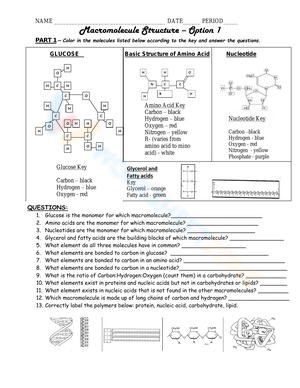
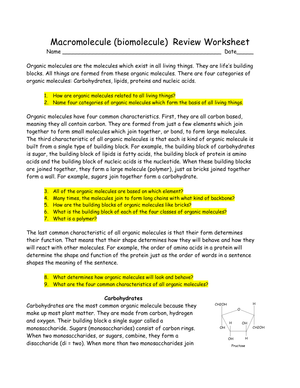
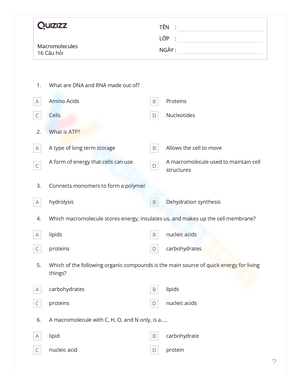
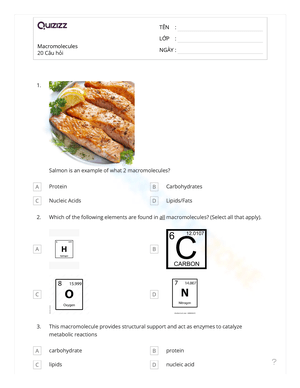
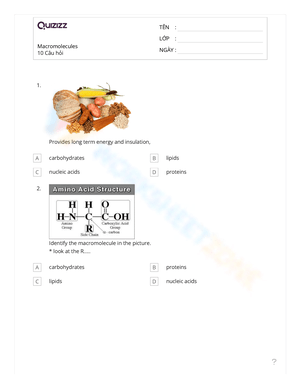
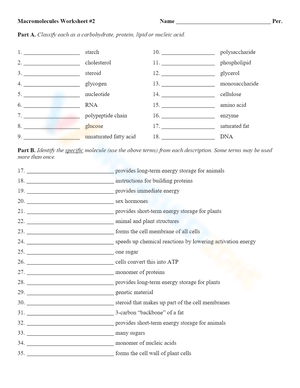
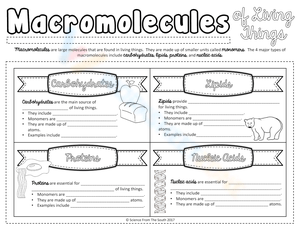
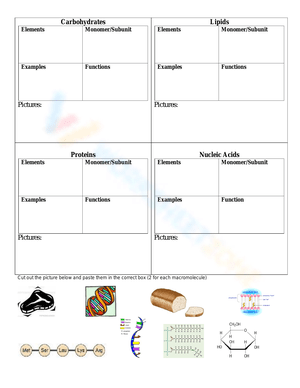
Macromolecule worksheets give your biology or chemistry students structured practice on the four classes of biological molecules: carbohydrates, lipids, proteins, and nucleic acids. Instead of rereading a textbook chapter, students work through labeling tasks, monomer-to-polymer diagrams, and structure-function matching that push them to apply the vocabulary rather than just recognize it. For US high school classrooms, that hands-on practice is where the concepts actually stick.
A strong worksheet set covers each class from two directions at once: the building blocks that assemble each polymer, and the job that polymer does inside a living cell. That dual framing matters because assessments rarely ask students to simply define a carbohydrate. They ask why a cell stores energy as starch, why a phospholipid forms a membrane, or why the order of amino acids changes a protein's shape.
Aligning Practice to HS-LS1-6
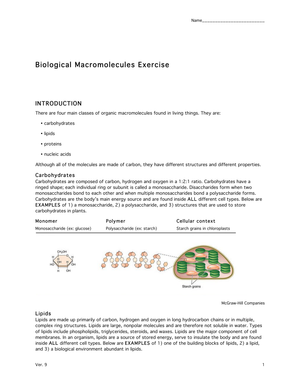
Macromolecule worksheets align directly with HS-LS1-6, which asks students to construct and revise explanations for how carbon-based molecules — carbohydrates, lipids, proteins, and nucleic acids — form from smaller monomers as matter and energy move through living systems. Worksheets support that standard by breaking a large explanation task into smaller, checkable steps. Students first identify the monomers (monosaccharides, fatty acids and glycerol, amino acids, and nucleotides), then trace how dehydration synthesis links those units into polymers. By the time they write a full explanation, they've already rehearsed each piece. That scaffolding is hard to build on the fly during a lecture, which is why a printable practice set earns its place in the unit.
Building Structure-Function Understanding
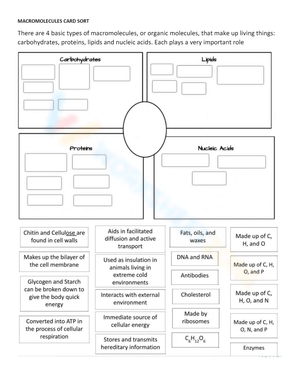
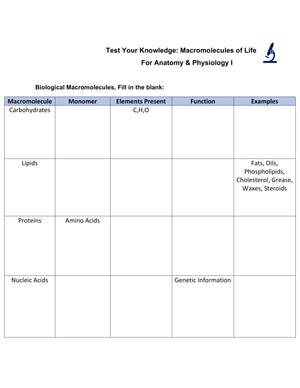
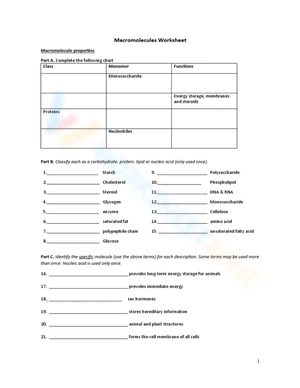
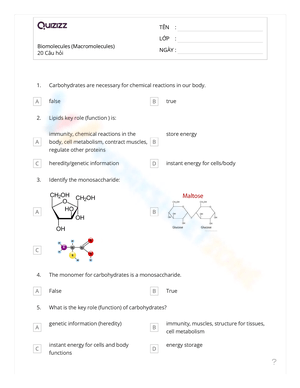
The recurring assessment theme across biology courses is structure and function: carbohydrates for quick energy, lipids for long-term storage and insulation, proteins for enzymatic and structural roles, and nucleic acids for storing genetic information. Worksheets that use matching grids or two-column sorts make those pairings explicit and repeatable.
According to the College Board's AP Biology unit guides, Unit 1: Chemistry of Life carries 8-11% of the exam's weighting, and macromolecule structure-function reasoning sits at the center of it. Worksheets that ask students to match each polymer to its cellular role rehearse exactly the kind of thinking that unit rewards on test day.
Monomers and Polymers: Where Students Get Stuck
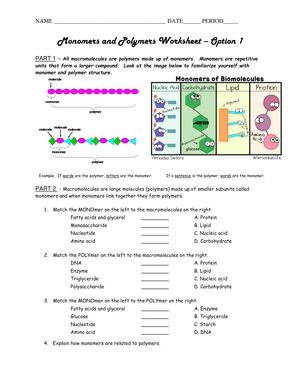
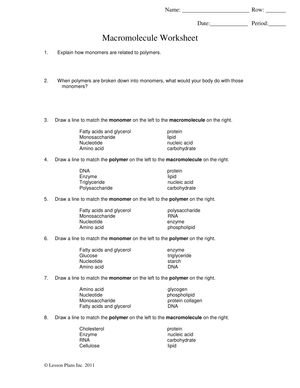
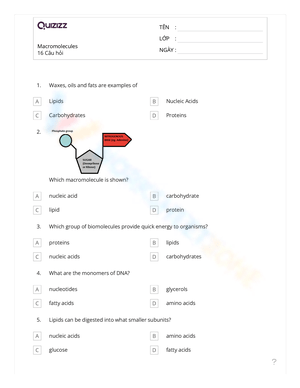
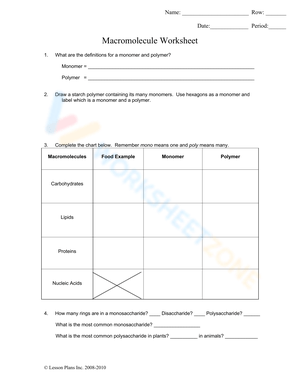
In practice, the most common error on macromolecule assessments isn't naming the four classes — most students memorize carbohydrates, lipids, proteins, and nucleic acids within a day. The breakdown happens one level down, at the monomer. A student who can label a nucleotide diagram will still hesitate when asked which monomer builds a protein, because the four monomer types and four polymer classes get stored as two separate lists instead of four linked pairs. Worksheets that force students to draw the arrow from monomer to polymer — nucleotide to nucleic acid, amino acid to protein — repair that gap far better than a definitions quiz, and they surface the misconception early enough to reteach before the unit test.
Pairing Worksheets with Macromolecule Lab Tests
Many biology teachers run indicator labs — Benedict's solution for reducing sugars, iodine for starch, and the biuret test for proteins. Worksheets work as both pre-lab and post-lab tools. Before the lab, a worksheet primes students on which macromolecule each indicator detects and what a positive result looks like. After the lab, a follow-up page asks students to connect their color-change observations back to molecular structure.
That before-and-after pairing turns an isolated lab into a connected learning sequence. Students stop treating the lab as a recipe to follow and start reading it as evidence about the molecules they diagrammed on paper.
Classroom Implementation
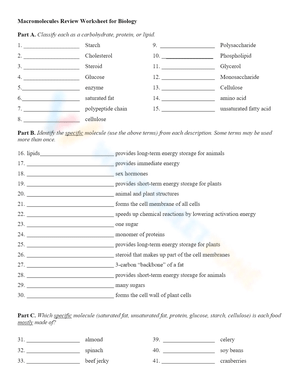
Slot macromolecule worksheets in at three points in your unit. Use one as a formative check the day after introducing the four classes, so you can catch monomer-polymer confusion before it compounds. Pull small groups who miss the structure-function items and reteach with a simplified sorting page while the rest of the class extends into a lab or reading.
For differentiation, offer a scaffolded version with a word bank for students who need support and a blank-diagram version for students ready to work from memory. Keep an answer key visible during peer review so students can self-correct and explain their reasoning to a partner. Close the unit with a cumulative worksheet that mixes all four classes, which mirrors how a real test interleaves the material rather than testing one molecule at a time.
For a content refresher while planning, the Lumen Learning overview comparing biological macromolecules is a reliable summary of the monomer, polymer, and function details you'll want your worksheet answers to reflect.
Frequently Asked Questions
1. What grade level or course uses macromolecule worksheets?
They fit high school biology and chemistry most naturally, and they're a staple of AP Biology Unit 1. Some accelerated middle school life science courses use simplified versions that focus on identifying the four classes without the full monomer chemistry.
2. How do these worksheets align with HS-LS1-6?
HS-LS1-6 asks students to explain how carbohydrates, lipids, proteins, and nucleic acids form from monomers. Worksheets break that explanation into identify-the-monomer and trace-the-polymer steps, giving students structured reps before they write a full standards-aligned explanation.
3. What skills do macromolecule worksheets build?
They build monomer and polymer identification, structure-function matching, and diagram labeling. Stronger sets also ask students to justify why a given structure suits its cellular job, which pushes past recall into the reasoning assessments reward.
4. How can I use them for formative assessment or small-group review?
Assign a short version the day after your first macromolecule lesson, then sort students by which items they miss. Students confusing monomers and polymers get a targeted reteach, while others move on to lab work or enrichment.
5. Do these worksheets help with AP Biology exam prep?
Yes. Unit 1 accounts for 8-11% of the AP Biology exam, and macromolecule structure-function questions are common. Short, timed worksheet reviews build the recall speed and precision the multiple-choice section demands.