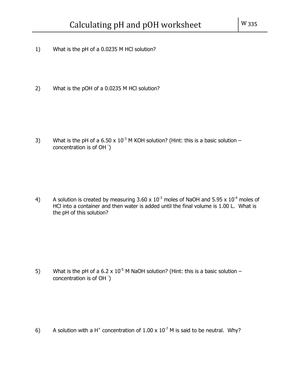
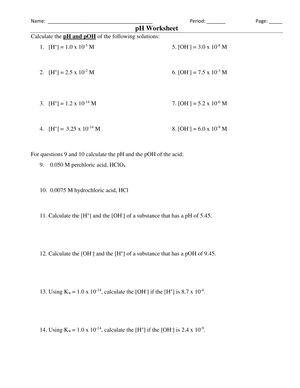
Use pH and pOH calculations worksheets for repeated chemistry practice
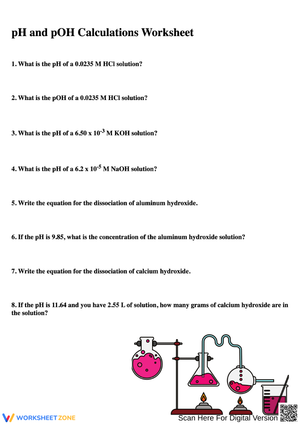
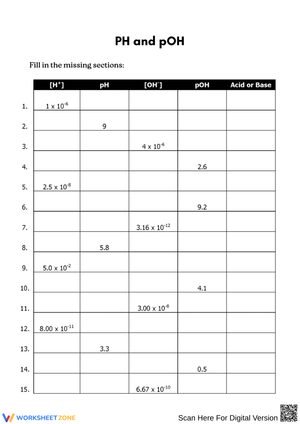
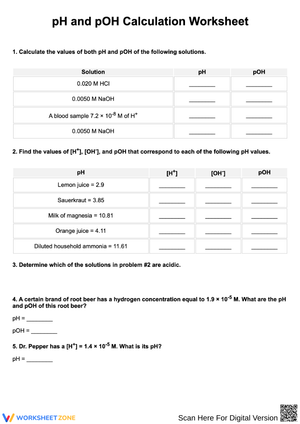
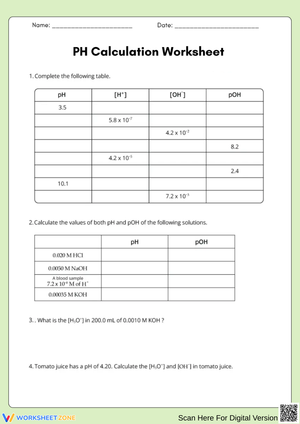
Worksheetzone gives teachers a straightforward way to assign pH and pOH calculations worksheets that focus on the exact conversions students need in an acid-base unit. Instead of leaning on long theory passages, these practice sets keep attention on the recurring tasks students see in class: finding pH from hydronium concentration, finding pOH from hydroxide concentration, and moving back and forth between pH, pOH, [H3O+], and [OH-]. That makes the resource useful when your goal is fluency, not a full reteach.
For many chemistry classes, this kind of worksheet fills the gap between direct instruction and a graded assessment. Students often understand the formula during a modeled example, then lose accuracy when signs, exponents, or inverse relationships appear in independent work. A clean set of targeted problems gives them enough repetition to catch those errors early. Teachers can use the page for classwork, station work, homework, or a short review before a quiz without building a new packet from scratch.
The resource also fits the way teachers usually search for this topic. When teachers look for pH and pOH calculations worksheets, they are usually trying to find printable or digital practice they can assign quickly, with student-friendly difficulty and a clear answer-checking path. That practical focus is what makes a worksheet page more valuable than a general article on acids and bases.
What students actually practice on these worksheets
The strongest pH and pOH calculations worksheets do not treat every acid-base idea as equal. They narrow in on the calculations students are expected to perform reliably in introductory chemistry. That usually includes identifying whether a value represents acidity or basicity, choosing the correct relationship, and solving with careful attention to powers of ten.
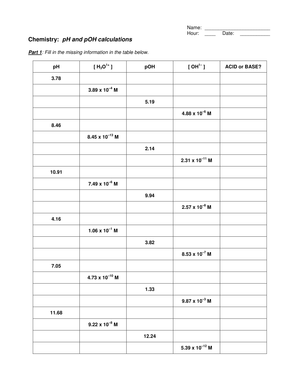
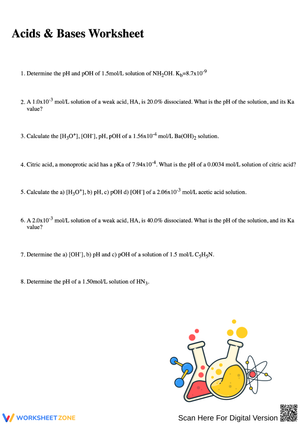
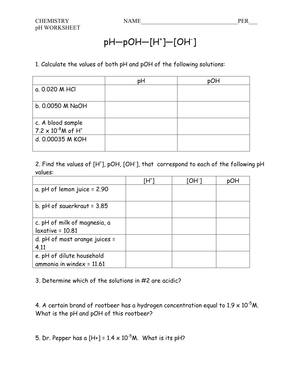
- Calculate pH from a given hydronium concentration using pH = -log[H3O+].
- Calculate pOH from a given hydroxide concentration using pOH = -log[OH-].
- Use the relationship pH + pOH = 14 for dilute aqueous solutions at 25 C.
- Convert from pH to [H3O+] or from pOH to [OH-] when students work backward from a logarithmic value.
- Check whether a solution is acidic, basic, or neutral after solving.
Those tasks matter because the mistakes are predictable. Students may confuse hydronium and hydroxide, drop a negative sign, or forget that a lower pH means a higher hydronium concentration. A worksheet sequence that mixes direct calculation with reverse calculation helps teachers see whether the issue is conceptual understanding, calculator use, or notation.
Why this topic deserves focused worksheet time
pH and pOH calculations look short on paper, but they demand several layers of precision at once. Students need to interpret scientific notation, understand logarithms at a practical level, and remember when water relationships apply. In a live lesson, some students can imitate the procedure without understanding why the answer makes sense. A targeted worksheet slows the process down just enough for them to build a pattern they can trust.
A useful instructional move is to compare paired problems that start with the same solution but ask for different outputs, such as pH in one item and [OH-] in the next. That side-by-side structure shows whether students truly understand the relationship among quantities or are only following a memorized button sequence on a calculator.
Teachers also benefit from worksheets because the topic is easy to spiral. A short set can appear during an equilibrium unit, a review week, or a warm-up before titration content. Since the calculations rely on repeated relationships, students improve when the practice is distributed over time rather than assigned once and left behind.
What the chemistry content should reinforce
These worksheets work best when they reinforce a small number of high-value ideas. Students should leave the assignment knowing that pH is defined as the negative logarithm of hydronium concentration and pOH is defined as the negative logarithm of hydroxide concentration. They also need repeated exposure to the water relationship that connects both values in dilute aqueous solutions at 25 C.
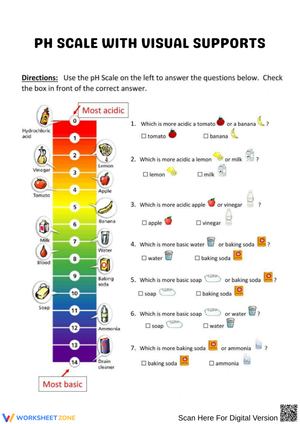
According to Chemistry LibreTexts, the pH and pOH scales express acidity and basicity through logarithmic relationships, and at 25 C a neutral aqueous solution has pH 7 and pOH 7. That single benchmark gives students a fast reasonableness check before they submit work.
That benchmark matters in classroom practice. If a student calculates a pH above 7 for a sample they identified as acidic, the worksheet itself becomes a diagnostic tool. When you build or assign a set that mixes neutral, acidic, and basic examples, students can compare their numerical answer to the expected category and correct errors independently before you collect the work.
A second chemistry idea worth reinforcing is the meaning of Kw. Students do not need a full equilibrium lecture each time they practice pH and pOH, but they do need to remember that water links hydronium and hydroxide concentrations. Once they understand that relationship, the formulas stop looking like isolated rules and begin to feel like connected parts of one system.
How Worksheetzone fits daily instruction
Worksheetzone is especially useful when you need a resource that drops into a lesson without extra setup. In many classrooms, the best worksheet is not the most elaborate one. It is the one students can start immediately, the teacher can explain in under two minutes, and the class can review efficiently afterward. That makes this page a practical option for upper middle school enrichment, high school chemistry review, tutoring sessions, or independent catch-up work.
The format also supports different pacing needs. A teacher can assign the full set to a class, pull selected items for a small intervention group, or use several problems as a quick entrance task. Because the topic depends on practice volume, a ready-to-use worksheet saves prep time while still giving students enough repetition to improve accuracy.
Classroom Implementation
You can use pH and pOH calculations worksheets in several efficient ways, depending on where your class is in the unit. Early in instruction, assign a small batch of direct conversions only, so students stabilize the formula choices. In the middle of the unit, mix direct and reverse problems to push them beyond pattern matching. Near assessment time, use a blended set that includes pH, pOH, [H3O+], and [OH-] in one practice block.
- Bell work: 2 or 3 short items that review formulas from the previous lesson.
- Guided practice: solve one example together, then release students to finish a similar set.
- Homework: assign a moderate set for independent calculator practice and notation review.
- Quiz prep: mix problem types so students decide which relationship applies before solving.
- Intervention: pull only the items that reveal confusion between pH, pOH, and concentration.
For stronger results, ask students to annotate each item with the quantity they were given and the quantity they need to find before they touch the calculator. That one habit reduces random formula selection and makes mistakes easier to discuss during review. It also gives teachers a clearer way to separate conceptual confusion from arithmetic slips.
Why the source-backed chemistry details matter
Chemistry LibreTexts explains that the autoionization of water supports the relationship Kw = [H3O+][OH-] = 1.0 x 10^-14 at 25 C. For teachers, that matters because it justifies the classroom shortcut that students use when moving between pH and pOH instead of treating the rule as something to memorize blindly.
This is the kind of detail that improves worksheet design. When teachers know which relationship sits underneath the calculation, they can choose practice items with better intent. A mixed worksheet can include straightforward conversions, neutral-solution checks, and backward problems that require students to infer concentration from a pH value. That balance gives you a truer read on mastery than a page of nearly identical items.
It also helps with correction. If students miss several items, you can sort their errors into categories: formula confusion, exponent handling, or misunderstanding of acid-base meaning. Once those categories are visible, the worksheet becomes more than busy practice. It becomes a fast formative assessment that points to the next instructional move.
Frequently Asked Questions
1. What do students practice on pH and pOH calculation worksheets?
Students usually practice converting among pH, pOH, hydronium concentration, and hydroxide concentration. They may also classify a solution as acidic, basic, or neutral and use the 25 C relationship between pH and pOH to check whether an answer is reasonable.
2. How are pH and pOH related in chemistry problems?
For dilute aqueous solutions at 25 C, students use the relationship pH + pOH = 14. That lets them find one value from the other and connects the calculation work to the water relationship that links hydronium and hydroxide concentrations.
3. Are these worksheets suitable for high school chemistry review?
Yes. They fit high school chemistry review especially well because students need repeated practice with logs, scientific notation, and acid-base vocabulary. They can also support upper middle school enrichment when the class is ready for structured calculation work.
4. Can teachers use these worksheets for homework or quiz prep?
Yes. Teachers can use them for homework, bell work, guided practice, reteaching, or quiz prep. The format is most helpful when students need focused repetition on a narrow chemistry skill rather than a broad reading assignment on acid-base theory.












 Interactive Worksheet Maker
 Quiz Maker
 Word Search Maker
 Crossword Puzzle Maker
 Word Scramble Generator
 Sentence Scramble Generator
 Handwriting Worksheet Generator
 Name Tracing Generator
 Fill In The Blank Generator