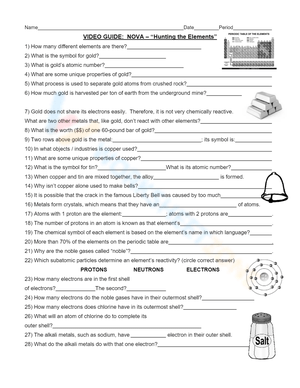
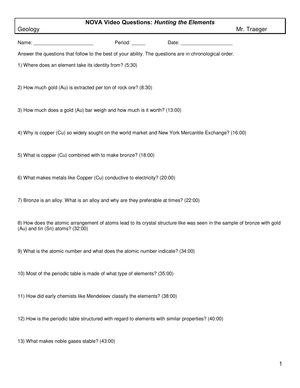
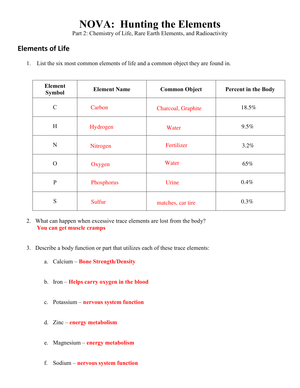
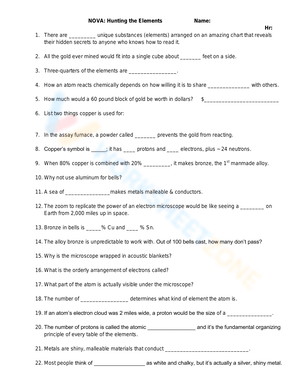
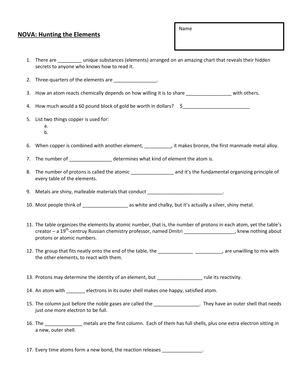
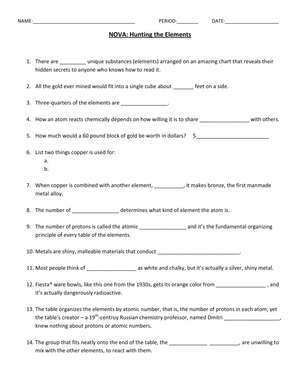
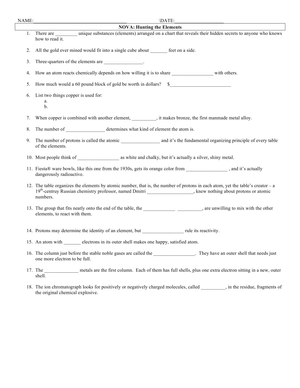
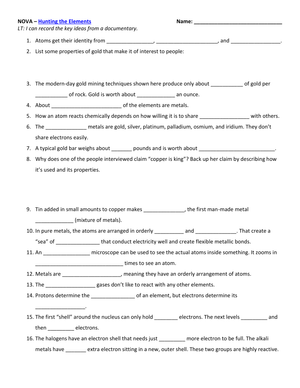
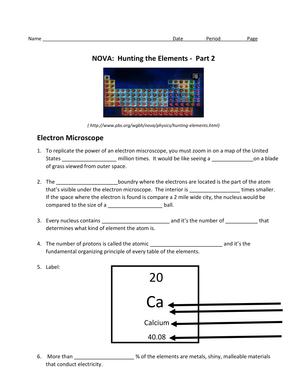
Attention young scientists: a new investigation has landed on your desk, and the periodic table is the crime scene. The NOVA Hunting the Elements worksheets invite you to step into the role of a chemistry detective, tracing how atoms come together to build everything around you. Each clue you uncover brings you closer to understanding the building blocks of matter, from the lightest gas in a balloon to the densest metal in a vault.
As you work through the printable activity, you will face a sequence of questions that follow the famous PBS documentary scene by scene. The NOVA Hunting the Elements worksheets prompt you to record atomic numbers, identify rare earth metals, and explain how chemists separate one element from another. Sharp observation and careful note-taking are your most powerful tools, because every blank you fill in is another piece of the puzzle.
The thrill grows as the mystery deepens. You will explore why gold resists corrosion, how copper carries electricity, and what makes carbon the backbone of life. By pairing the documentary footage with structured questions, the worksheet turns passive viewing into active discovery. Curious learners can extend the journey by visiting the classroom-tested periodic table guide for hands-on extensions and games that reinforce each finding.
For teachers, framing chemistry as an investigation transforms how students engage with abstract concepts. Worksheetzone designed this lesson plan to support classroom screenings, flipped lessons, and homework review. Pair it with the atoms, isotopes, and ions practice set so students can connect documentary content to formal atomic structure vocabulary, building deeper retention through repeated exposure.
Are you ready to crack the code of the periodic table and graduate from observer to investigator? Download the NOVA Hunting the Elements worksheets, sharpen your pencil, and start tracking down the science that built our world. Each completed page is one more case closed, and one more reason that students, parents, and teachers turn to Worksheetzone printable resources for chemistry learning.
Frequently Asked Questions
Question 1: What grade level are the NOVA Hunting the Elements worksheets best suited for?
These printable worksheets are best suited for middle school and high school chemistry students, typically grades seven through twelve. The questions follow the PBS documentary closely and reinforce vocabulary like atomic number, isotopes, and chemical bonding, making them useful for introductory chemistry units, honors review sessions, and classroom screenings where teachers want guided viewing rather than passive watching.
Question 2: How long does it take students to complete the worksheet?
Most students complete the printable activity in roughly the same time as the documentary itself, which is around two hours. Many teachers split the viewing across two class periods and assign matching worksheet sections after each segment. This pacing keeps students focused, allows time for class discussion, and ensures that every clue gathered during the screening is recorded and reviewed before the next investigation begins.
Question 3: Can parents use these worksheets for homeschool chemistry lessons?
Absolutely. Parents teaching chemistry at home can use this worksheet alongside the documentary to give their learners structured practice that mirrors a classroom experience. The worksheet includes vocabulary review, recall questions, and short-answer prompts that guide independent study. Pairing it with periodic table reference charts and atomic structure activities gives homeschool students a complete unit on how elements shape the physical world.
Question 4: What learning objectives do these worksheets cover?
The worksheet targets several core chemistry objectives, including identifying elements on the periodic table, describing how atoms differ from one another, explaining the role of electrons in bonding, and recognizing real-world uses of metals and nonmetals. By the end of the activity, students should be able to articulate why specific elements behave the way they do and connect that behavior to everyday materials they encounter.