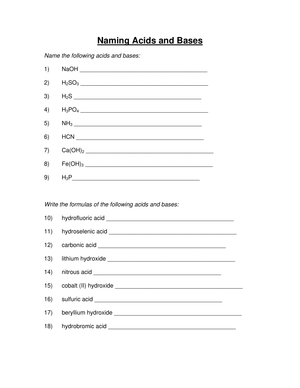
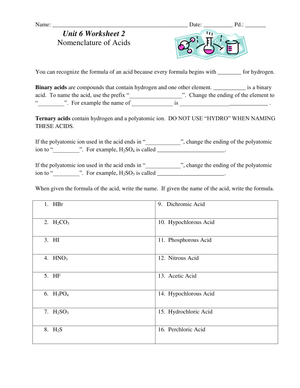
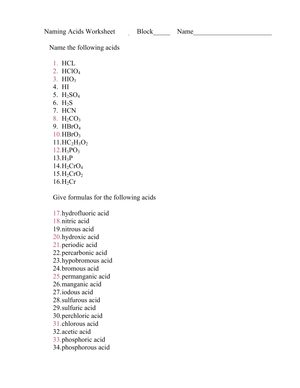
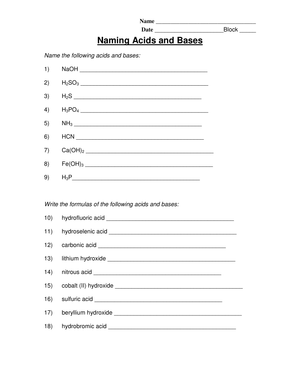
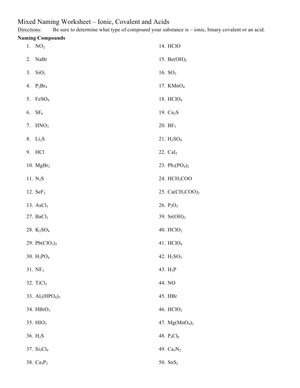
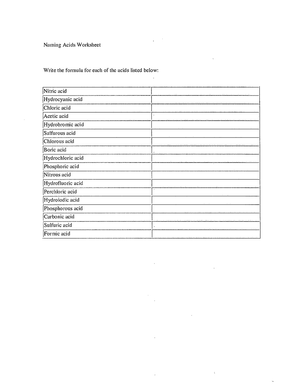
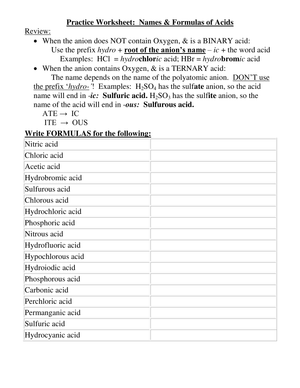
By the time a nomenclature unit reaches acids, most students have already worked through ionic and molecular compound names. Acid naming worksheets are the bridge that connects those two skill sets, since students must recognize whether a formula behaves like a binary compound or like an oxyanion attached to hydrogen before they can name it correctly. Without focused practice at this stage, students carry small mix-ups into lab write-ups and unit tests where precise labeling matters.
Binary Acids: The Hydro- -ic Foundation
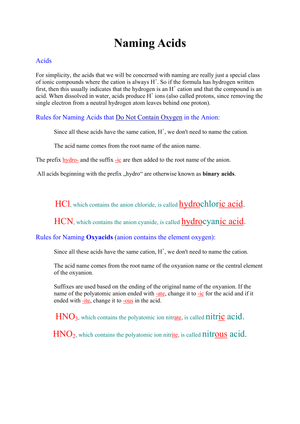
Binary acids are the simplest starting point because the rule is consistent: hydrogen paired with one other element takes the hydro-[stem]-ic acid pattern. HCl becomes hydrochloric acid, and HBr becomes hydrobromic acid. Worksheets that isolate this single rule let students build automaticity before any oxyanion vocabulary enters the picture. Students who can name five or six binary acids without hesitation are ready to move to the next tier of practice.
Oxyacids and the -ate/-ic, -ite/-ous Pattern
Oxyacids are named from their parent oxyanion rather than from the elements alone, and this is where many students stumble. An -ate ion becomes an -ic acid, so sulfate becomes sulfuric acid, while an -ite ion becomes an -ous acid, so sulfite becomes sulfurous acid. A worksheet that pairs each oxyanion with its acid side by side gives students a reference pattern they can apply to unfamiliar ions, rather than memorizing every acid name individually.
The recurring error worth flagging to students directly is prefix bleed: learners who just finished binary acid practice often tack hydro- onto an oxyacid name, producing an incorrect form like hydrosulfuric acid for what should simply be sulfuric acid. Worksheets that mix binary and oxyacid formulas in the same set, rather than separating them into isolated blocks, surface this error while there is still time to correct it before a test.
Per- and Hypo- Prefixes for Halogen Oxyacids
Chlorine, bromine, and iodine each form four separate oxyanions, which means their acids require the full per-/hypo- prefix system to stay distinct: hypochlorous acid, chlorous acid, chloric acid, and perchloric acid. This four-tier pattern is usually the last skill introduced in an acid naming sequence, since it depends on students already being confident with the basic -ic/-ous suffix rule. A worksheet section devoted only to halogen oxyacids gives advanced students a clear challenge set once the foundational patterns are solid.
Teacher Tips
Use a short acid naming worksheet as a warm-up on the day after oxyanion nomenclature is introduced, since acids are the most natural next step and the connection is still fresh. Keep an exit ticket version to three or four items that mix a binary acid, a common oxyacid, and one halogen oxyacid, so a single glance at the results tells you which rule needs reteaching before the next class. When students consistently miss the hydro- versus oxyacid distinction, pull a handful of missed items into a two-minute board correction rather than reteaching the entire pattern from scratch. For labs that require acids to be labeled on student-prepared solutions, a quick worksheet review the day before helps students transfer naming accuracy from paper practice to hands-on work.
Frequently Asked Questions
1. What is the difference between naming a binary acid and an oxyacid?
A binary acid contains hydrogen and one other element and follows the hydro-[stem]-ic acid pattern, such as hydrochloric acid. An oxyacid contains hydrogen, oxygen, and a third element, and its name comes from the parent oxyanion rather than a hydro- prefix, following the -ate to -ic or -ite to -ous conversion instead.
2. Why do some acids use hypo- and per- prefixes?
Elements such as chlorine, bromine, and iodine form four related oxyanions rather than just two. The standard -ate/-ite suffix system only distinguishes two forms, so hypo- and per- prefixes are added to name all four acids without ambiguity, ranging from hypochlorous acid to perchloric acid.
3. What grade level or course typically covers acid naming?
Acid naming is usually taught in high school chemistry courses, most often as part of a broader nomenclature unit that also covers ionic and molecular compounds. It typically appears after students have already practiced naming polyatomic ions.
4. How can teachers help students avoid mixing up -ic and -ous acid endings?
Pairing each oxyanion directly with its acid form on the same worksheet, rather than teaching suffixes in isolation, helps students see the pattern concretely. Reviewing missed items in short, targeted corrections right after a quiz or exit ticket also reinforces the distinction before it becomes a habit.
5. Should acid naming be taught before or after oxyanion nomenclature?
Acid naming should follow oxyanion nomenclature, since acid names are built directly from oxyanion names. Introducing acids first removes the reference point students need and tends to produce more naming errors overall.