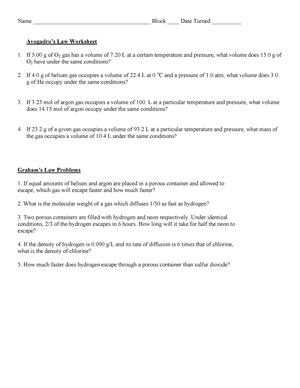
If you teach high school chemistry, you already know that gas laws units live or die on practice volume. Students can memorize a formula in five minutes, but they only get comfortable setting up a ratio problem after working through several examples on their own. Graham's law worksheets give you a focused way to build that fluency without pulling time away from Boyle's law, Charles's law, or the ideal gas law that usually surround it in a unit sequence.
Graham's law compares how quickly two different gases effuse or diffuse under the same conditions. Because the math depends on molar mass rather than pressure or volume, it is a natural stopping point in a gas laws unit where students shift from thinking about a single gas to comparing two gases side by side. A worksheet built around this single skill lets you isolate the ratio setup before students layer it onto more complex multi-step problems later in the unit.
The Formula Students Need to Apply Correctly
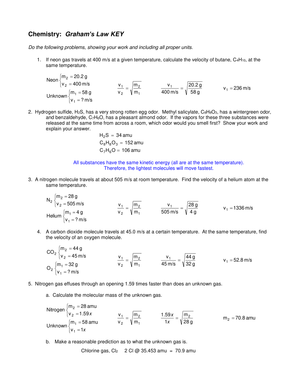
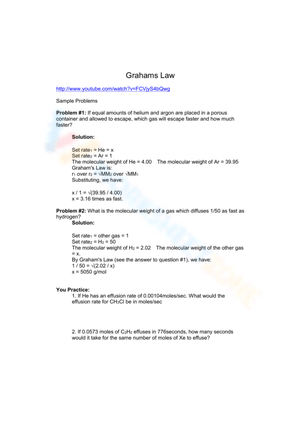
Graham's law states that the rate of effusion of a gas is inversely proportional to the square root of its molar mass. Written as a ratio for two gases, it looks like rate1/rate2 = the square root of (M2/M1). Lighter gas molecules move faster and effuse more quickly than heavier ones under identical conditions, which is the core idea students need to hold onto before they touch a calculator.
One data point worth putting directly on a worksheet or in a mini-lecture: if one gas has four times the molar mass of another, it effuses at only half the rate of the lighter gas. That relationship comes straight from the square root in the formula, and walking students through this specific ratio helps them see why doubling molar mass does not simply cut the rate in half. It is a quick way to expose the nonlinear relationship before students hit it cold in a word problem.
Common Errors to Flag Before Students Start Practicing
Two mistakes show up again and again on Graham's law worksheets, and naming them ahead of time saves grading time later. The first is inverting the ratio, meaning students place the heavier gas's molar mass under the lighter gas's rate instead of setting up the comparison correctly. The second is forgetting the square root altogether and treating the relationship as a simple direct or inverse ratio between molar mass and rate. Both errors are easy to catch if you build one or two check-your-setup questions into the worksheet before the calculation-heavy problems begin.
A short answer key note or a worked example at the top of the page can cut down on both errors significantly. Consider modeling one full problem step by step, then handing students a nearly identical second problem with different gases so they can mirror the process while it is still fresh.
Using Graham's Law Worksheets Across Different Classroom Moments
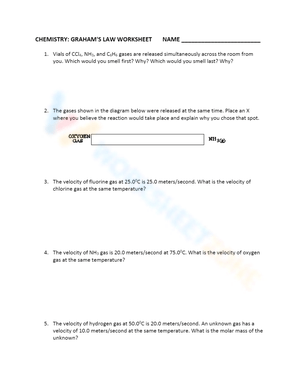
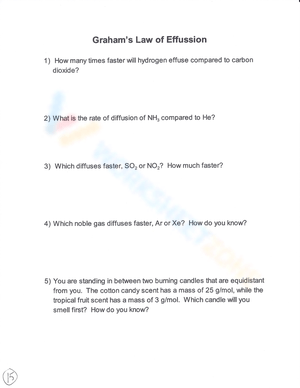
These worksheets are flexible enough to fit several points in your instructional flow. During guided practice, you can walk through the first few problems together and release students to finish the rest independently. As homework, a Graham's law worksheet reinforces the ratio setup without requiring lab equipment or additional class time. As an exit ticket, a single well-chosen problem tells you quickly whether students can identify which gas is heavier, set up the ratio correctly, and interpret what a faster or slower rate means physically.
Because the math itself is fairly short, you have room to add a conceptual question alongside the calculation, such as asking students to explain in one sentence why the lighter gas effuses faster. Combining a numeric answer with a short written justification gives you a quick read on both procedural and conceptual understanding.
Classroom Implementation
Plan for roughly one class period to introduce the concept and work through guided examples, followed by a worksheet assigned as either in-class practice or homework. If your unit already covers Boyle's, Charles's, and the ideal gas law, place Graham's law near the end of the sequence so students have a solid foundation in gas behavior before adding the effusion comparison. Pair the worksheet with a short discussion of the helium balloon or gas leak examples to keep the material grounded in something students can picture.
Before a unit test, a Graham's law worksheet doubles well as a review tool. Mixing in one or two problems that require identifying the correct ratio setup, alongside a conceptual question about why lighter gases effuse faster, gives you a compact review activity that touches both the math and the reasoning behind it.
Frequently Asked Questions
1. What is the formula for Graham's law and how is it applied to a two-gas comparison problem?
The formula is rate1/rate2 = the square root of (M2/M1), where M represents molar mass. Students plug in the molar masses of the two gases being compared, then solve for the rate ratio, keeping careful track of which gas is in the numerator versus the denominator.
2. How do teachers introduce Graham's law before assigning practice worksheets?
Many teachers start with a demonstration or visual example, such as comparing balloon deflation rates, before introducing the formula. Working through one fully solved example on the board, then a second example together as a class, prepares students to move into independent worksheet practice with fewer setup errors.
3. What grade level or course typically covers Graham's law of effusion?
Graham's law is most commonly taught in high school chemistry courses, often within a gas laws unit that also covers Boyle's law, Charles's law, and the ideal gas law. It may also appear in an introductory college chemistry course depending on the curriculum sequence.
4. How can Graham's law worksheets be used for review before a gas laws unit test?
A short worksheet with two or three ratio problems and one conceptual question works well as a review activity. It lets you quickly identify which students still need support with the square root relationship before the test.
5. What real-world examples help students understand effusion versus diffusion?
Helium balloon deflation is a common and relatable example of effusion, since the lighter helium atoms escape through the balloon material faster than the surrounding air enters. Gas leak detection scenarios also illustrate the practical relevance of comparing effusion and diffusion rates between gases of different molar masses.