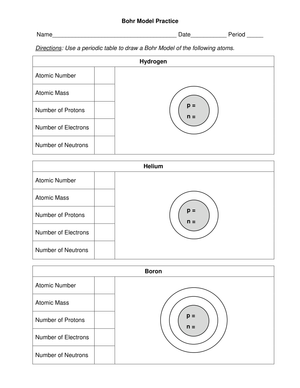
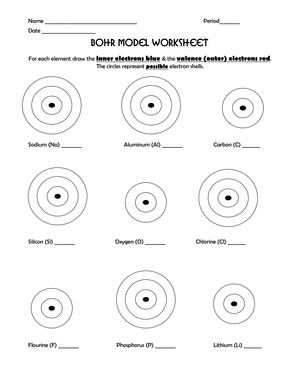
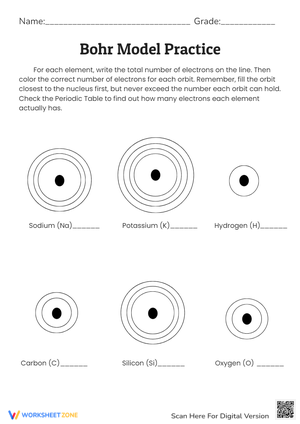
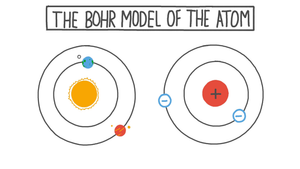
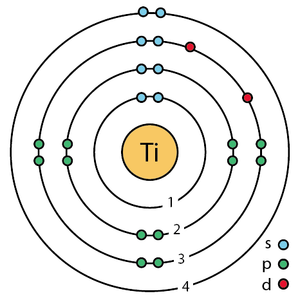
Middle school physical science courses typically introduce the Bohr model as the first visual explanation of atomic structure, well before students are asked to interpret electron configuration notation. Students draw a small nucleus, then add concentric rings for each occupied shell. The first three shells hold a maximum of 2, 8, and 8 electrons respectively, and once students can apply that rule automatically, filling any main-group element's diagram becomes a five-minute task instead of a guessing game.
This matters because the Bohr model is a bridge activity. Students who can accurately place electrons in shells are much better prepared to notice that elements in the same column share the same number of outer-shell electrons, which is the real payoff once periodic table trends enter the unit.
Aligning Bohr Model Practice With NGSS Expectations
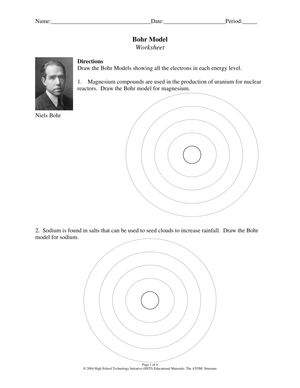
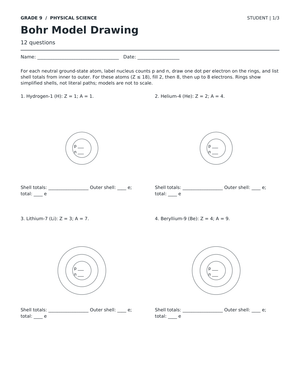
For grades 6-8, Bohr model worksheets support NGSS MS-PS1-1, which asks students to develop models describing the atomic composition of simple molecules and extended structures. A worksheet where students construct diagrams for several elements and then compare shell patterns is a direct, low-prep way to generate that evidence of modeling skill.
In grades 9-10 chemistry, the more relevant standard is NGSS HS-PS1-1, which has students use the periodic table to predict properties based on patterns of electrons in the outermost energy level. Bohr diagrams make that outermost-shell pattern visible before students are asked to reason about it abstractly, so worksheet sets that pair diagram practice with short prediction questions (Will this element form a positive or negative ion? How many bonds can it likely form?) give teachers a natural progression from drawing to reasoning.
Differentiating for Middle School Versus High School
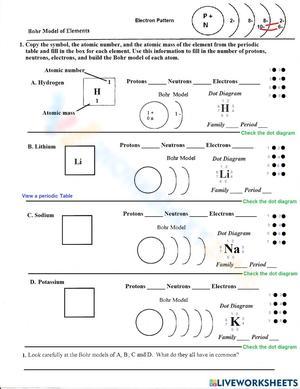
The same worksheet format can serve both grade bands if the demand shifts. For grades 6-8, keep the task concrete: given atomic number and mass number, draw protons, neutrons, and electrons in the correct shells for elements 1 through 20. For grades 9-10, add a layer: after drawing the diagram, students identify the number of valence electrons, predict the ion charge, and connect the diagram to the element's position on the periodic table.
A useful middle school resource for framing this progression is CK-12's introduction to Bohr's atomic model, which walks through the shell-filling rule at a pace appropriate for younger students before chemistry classes revisit the same model alongside atomic spectra.
Pairing Bohr Diagrams With Valence Electron and Lewis Dot Practice
Once students are comfortable with full Bohr diagrams, many chemistry teachers shift toward valence-electron-only representations, which sets up Lewis dot structures for the bonding unit. A worksheet sequence that moves from full shell diagrams, to valence-electron counts, to Lewis dot symbols gives students a visible thread connecting atomic structure to chemical bonding, rather than presenting bonding as an unrelated new topic.
This sequencing also helps address a common misconception: students sometimes assume every shell must be full before an atom is stable, when the real driver of bonding behavior is the outermost shell specifically. Worksheets that ask students to circle or shade only the valence electrons, immediately after completing a full diagram, make that distinction concrete.
Classroom Implementation
A typical 45-minute lesson using Bohr model worksheets might open with a two-minute review of proton, neutron, and electron counts using atomic number and mass number, followed by a modeled example on the board. Students then work through 4-6 elements independently or in pairs, with the first two elements checked before students continue to the rest, catching shell-filling errors early rather than after twenty minutes of practice.
For small-group intervention, pull students who struggled with atomic number versus mass number and give them a shortened worksheet limited to the first ten elements, since smaller atomic numbers make the shell-filling pattern easier to internalize before moving to larger, multi-shell atoms. For enrichment, ask advanced students to explain why the third shell can hold up to 8 electrons in the simple Bohr model even though it can hold more electrons in a more complete quantum-mechanical treatment, which previews why the model is a simplification rather than a complete picture of atomic structure.
Frequently Asked Questions
1. What grade level typically covers the Bohr model in US science standards?
Middle school physical science (grades 6-8) introduces the Bohr model under NGSS MS-PS1-1, and high school chemistry (grades 9-10) revisits it in more depth under NGSS HS-PS1-1, connecting shell structure to periodic table patterns.
2. How many electrons can each shell hold in a Bohr model diagram?
In the simple Bohr model used for introductory worksheets, the first shell holds up to 2 electrons, and the second and third shells each hold up to 8 electrons.
3. How do Bohr model worksheets connect to NGSS performance expectations?
They give students direct practice building the kind of atomic models referenced in NGSS MS-PS1-1, and at the high school level they support NGSS HS-PS1-1 by making outer-shell electron patterns visible before students apply them to periodic table predictions.
4. What is the difference between a Bohr model and a Lewis dot structure worksheet?
A Bohr model worksheet has students draw the full atom, including the nucleus and every occupied shell, while a Lewis dot structure worksheet focuses only on the valence electrons, using dots around the element symbol to prepare students for bonding diagrams.
5. How can teachers use Bohr model worksheets for formative assessment or review before a unit test?
Because completed diagrams are fast to check for accuracy, teachers can use a short set of Bohr diagrams as an entrance or exit ticket to quickly identify which students need additional review of atomic number, shell capacity, or valence electrons before a bonding unit test.