Why Conservation of Mass Worksheets Belong in Your Science Block
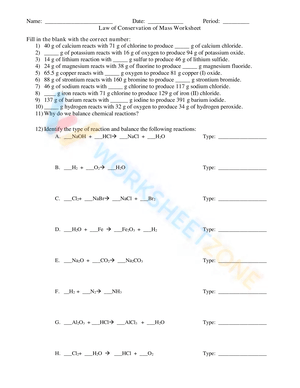
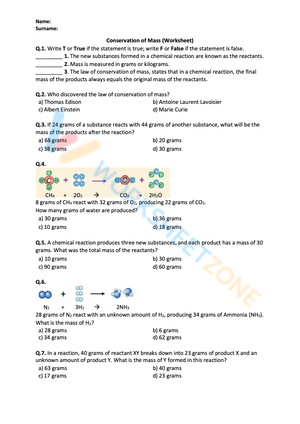
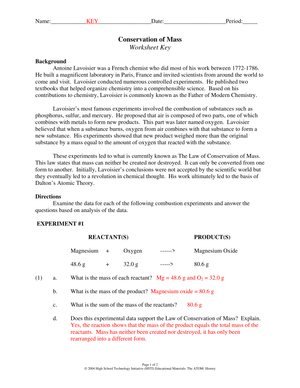
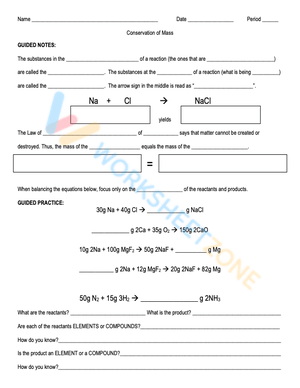
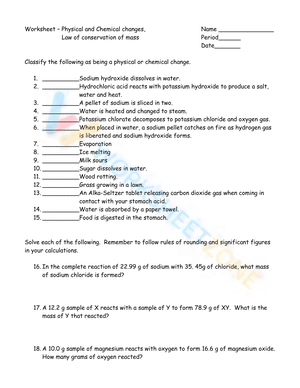
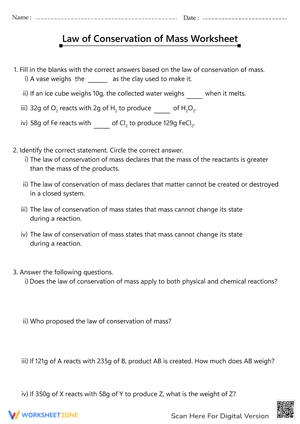
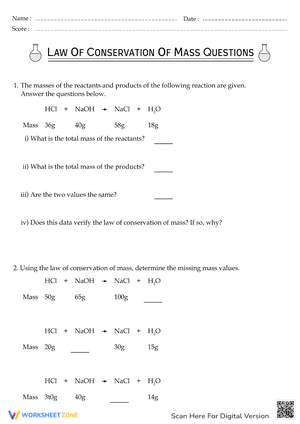
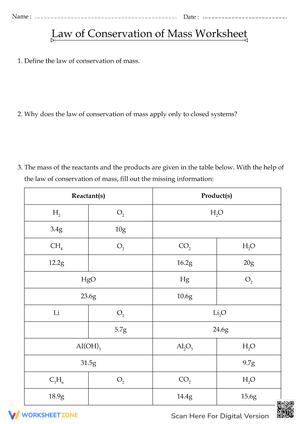
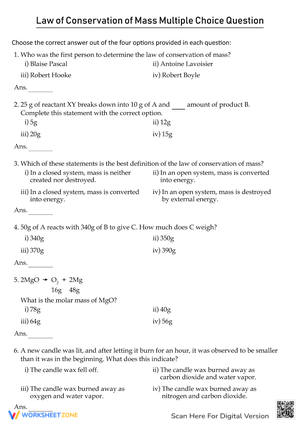
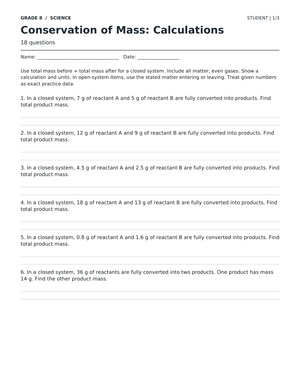
Conservation of mass worksheets give students a structured way to record what a scale actually shows before and after a change, instead of trusting what their eyes seem to report. When an antacid tablet fizzes away or salt vanishes into water, kids assume matter left the room. A good worksheet slows that judgment down. It asks students to write the starting mass, predict the ending mass, and then explain the gap between what they expected and what the balance read.
For US teachers, these sheets do double duty. In fifth grade they carry the measuring and graphing load of a physical science unit. In middle school they work as review, warming up prior knowledge before students ever touch a balanced equation. The same core idea, that mass is conserved, stretches across three or four grade levels, so the sheet you choose has to match the exact thinking your standard expects.
Matching Worksheets to NGSS 5-PS1-2 in Fifth Grade
At the elementary level, the standard is doing more than asking whether mass stays the same. It asks students to build the evidence themselves. That means your worksheets should have space for real measurements, a simple data table, and at least one graph, not just a fill-in-the-blank definition.
According to NGSS performance expectation 5-PS1-2, fifth graders must measure and graph quantities to provide evidence that the total weight of matter is conserved during heating, cooling, or mixing, including phase changes, dissolving, and reactions that form new substances, regardless of whether a gas is produced. A worksheet that only defines the law skips the part the standard cares about most.
Look for sheets that give students two or three trials of the same change so they can compare before-and-after weights and notice that small differences come from spills or measurement error, not from vanishing matter. That repeated structure is what turns a single demonstration into an argument.
Bridging Fifth Grade to MS-PS1-5 in Middle School
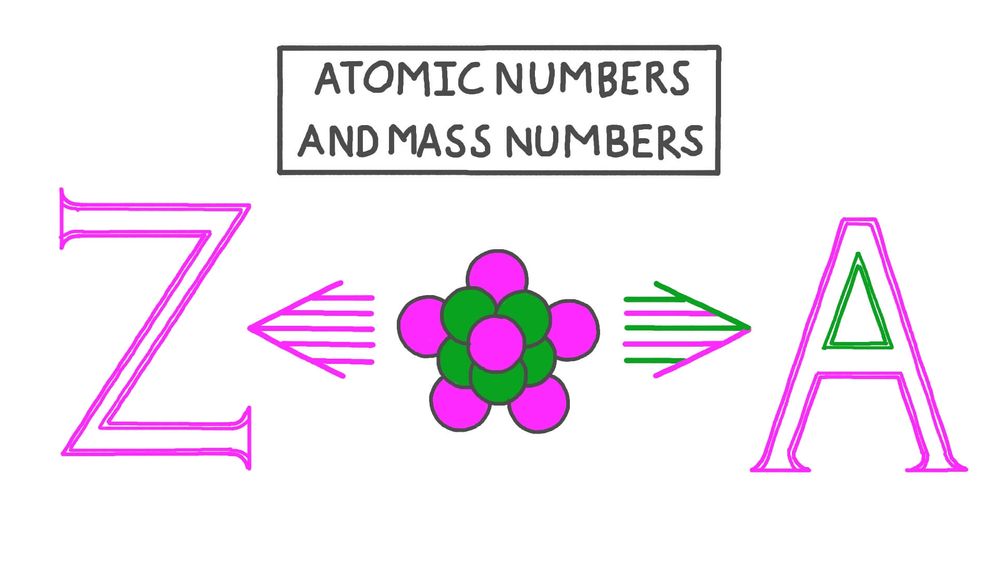
The middle school version of this idea shifts from weighing on a balance to reasoning about atoms. Students stop asking "did the number on the scale change?" and start asking "where did every atom go?" Worksheets built for this transition should include particle diagrams, boxes for counting atoms on each side of a change, and prompts that connect the two grade bands.
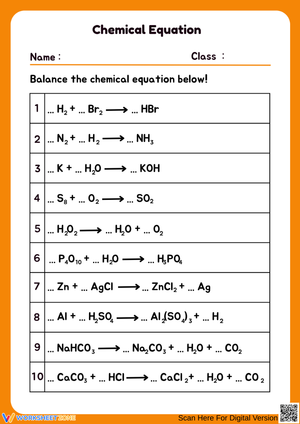
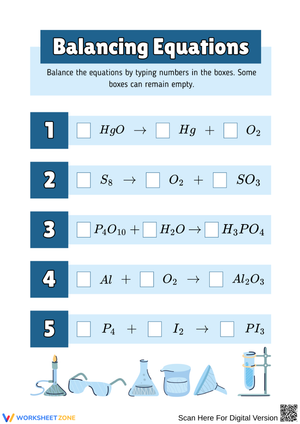
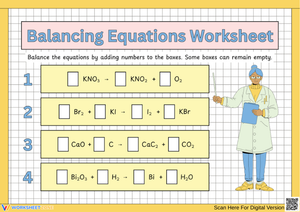
The Next Generation Science Standards frame MS-PS1-5 around using models to show that the total number of atoms does not change in a chemical reaction, which is why mass stays constant. The standard's own assessment boundary excludes atomic mass calculations and balancing symbolic equations, so a middle school worksheet that jumps straight to coefficients is asking for work the standard does not require yet.
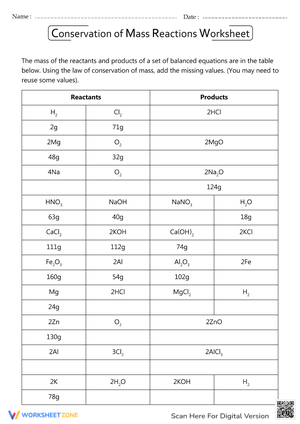
Here is where many units quietly break. Fifth graders leave with a scale-based rule of thumb, and sixth or seventh graders are handed atom-counting tasks with no visible bridge between them. A worksheet that shows the same baking soda and vinegar reaction two ways, once as before-and-after weights and once as an atom inventory of carbon, hydrogen, oxygen, sodium, gives students a single event to reason about from both grade-band angles. That shared anchor is worth more than two disconnected activities.
Using Worksheets to Fix the "Mass Disappears" Misconception
The single most common error these worksheets should target is the belief that mass is lost when a gas forms or a substance seems to disappear. Students watch a tablet dissolve, see bubbles rise, and conclude the matter is gone. Dissolving salt and evaporating water trigger the same wrong conclusion.
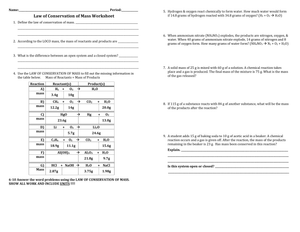
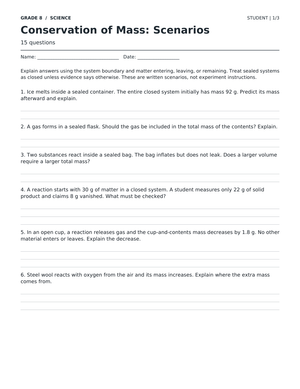
The fix built into a worksheet is the closed system. When students record that an open cup of fizzing liquid loses weight but a sealed bag of the same reaction does not, the gas stops being magic and becomes matter they simply could not hold in an open container. Strong worksheets pair an open-system row with a closed-system row and ask students to explain the difference in writing, not just circle an answer.
Give students sentence starters for that explanation. "The mass looked smaller because..." followed by "but the sealed version stayed the same because..." forces them to name the escaped gas as the culprit. That written reasoning is the part that actually moves a stubborn misconception.
Pairing Worksheets With Closed-System Demonstrations
Worksheets work best clipped to a hands-on event, and a few classic demonstrations map cleanly onto data tables. Sealed baking soda and vinegar in a zip bag or capped flask, weighed before and after, is the workhorse. Dissolving salt in water shows conservation during a physical change. Burning steel wool in a closed container flips the usual expectation, because the mass goes up as the metal combines with oxygen.
The American Chemical Society's Inquiry in Action program, in its fifth grade Lesson 4.1 on conservation of mass, models this exact approach of weighing a reaction in a closed system and comparing before-and-after mass to build the conservation argument with elementary students. Use the worksheet as the record-keeping layer while the demonstration supplies the evidence.
Assign students the role of recorder, timer, or reader within a small group, and let the worksheet define each role's job. When every student has a column to fill, the data table becomes a shared product rather than one child's paper.
Classroom Implementation
Start with prediction. Before any mass is measured, have students commit in writing to what they think the balance will read after the change. A worksheet with a locked prediction box keeps them honest once the real number appears. The surprise between prediction and result is the teachable moment, and it only lands if the prediction was written first.
For pacing, one measured change per class period is plenty in fifth grade. In middle school you can run a physical change and a chemical change back to back, then use the atom-inventory side of the sheet to explain why both conserved mass. Keep a word bank visible with terms like matter, mass, closed system, and reaction so writing stays precise.
Use the sheets flexibly by group. For small-group intervention, shorten the task to a single closed-system trial with pre-filled headings so students spend their energy on reasoning, not setup. For enrichment, ask fast finishers to design a change they think might break the rule, then predict and test it. Collect the written explanations, not just the numbers, as your formative check, since the sentence a student writes reveals the misconception a correct data table can hide.
Frequently Asked Questions
1. What grade level learns conservation of mass, and how do worksheets differ by grade?
It typically starts in fifth grade as a measuring-and-graphing task, then returns in middle school as atom-based modeling. Elementary worksheets center on before-and-after weights and data tables; middle school sheets add particle diagrams and atom counts without asking students to balance symbolic equations.
2. How can teachers use these worksheets alongside labs like baking soda and vinegar?
Run the reaction in a sealed bag, weigh it before and after, and have students record both numbers on the sheet. The worksheet becomes the data log and the reasoning space while the demonstration supplies the evidence that gas is still matter you cannot see.
3. What is the most common misconception these worksheets should address?
Students believe mass is lost when a gas forms or a substance dissolves or evaporates. Pairing an open-system result with a closed-system result on the same page shows that the missing mass escaped as gas rather than disappearing.
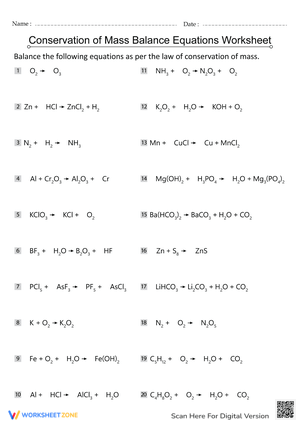
4. How do these worksheets prepare students for balancing chemical equations?
By establishing that atoms are never created or destroyed, they give students the reason balancing works at all. A student who already believes every atom must be accounted for treats coefficients as bookkeeping rather than an arbitrary rule.