


























Views
Downloads


Essential IE Exceptions Worksheet | Grade 11 Chemistry
Paste this activity's link or code into your existing LMS (Google Classroom, Canvas, Teams, Schoology, Moodle, etc.).
Students can open and work on the activity right away, with no student login required.
You'll still be able to track student progress and results from your teacher account.
This worksheet teaches Grade 11 Chemistry students to explain exceptions in first ionization energy using a physical cause and numerical evidence. Students stop reaching for labels like “stable” and instead argue from nuclear charge, distance, and electron–electron repulsion.
At a Glance
- Grade: 11 · Subject: Chemistry
- Standard: Periodic trends in ionization energy — explain an exception using cause and data.
- Skill Focus: Explaining a supplied exception without inventing a rule
- Format: 5 pages · 6 problems · Answer key included · PDF
- Best For: Extension practice in periodic trends
- Time: 40–55 minutes
What’s Inside
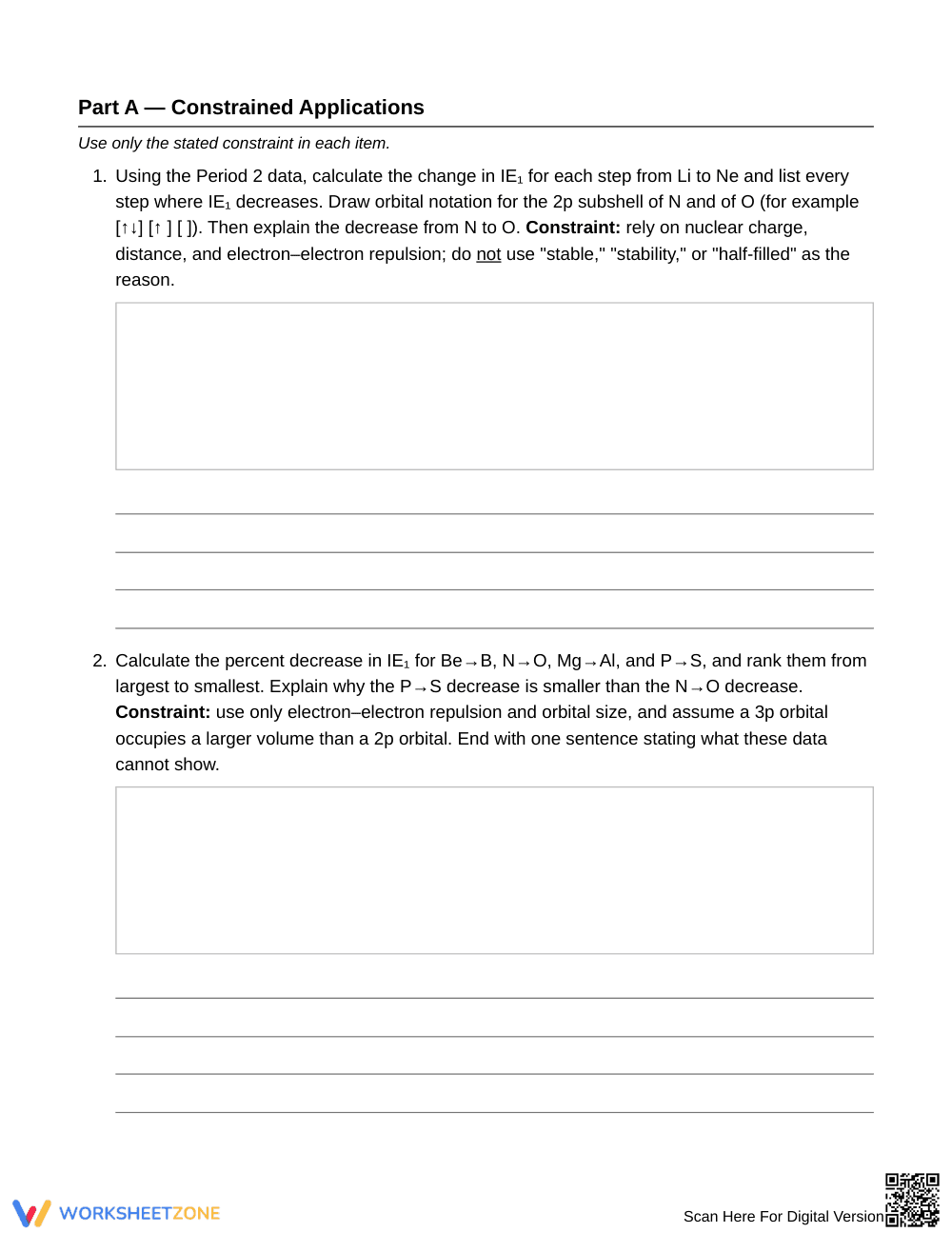
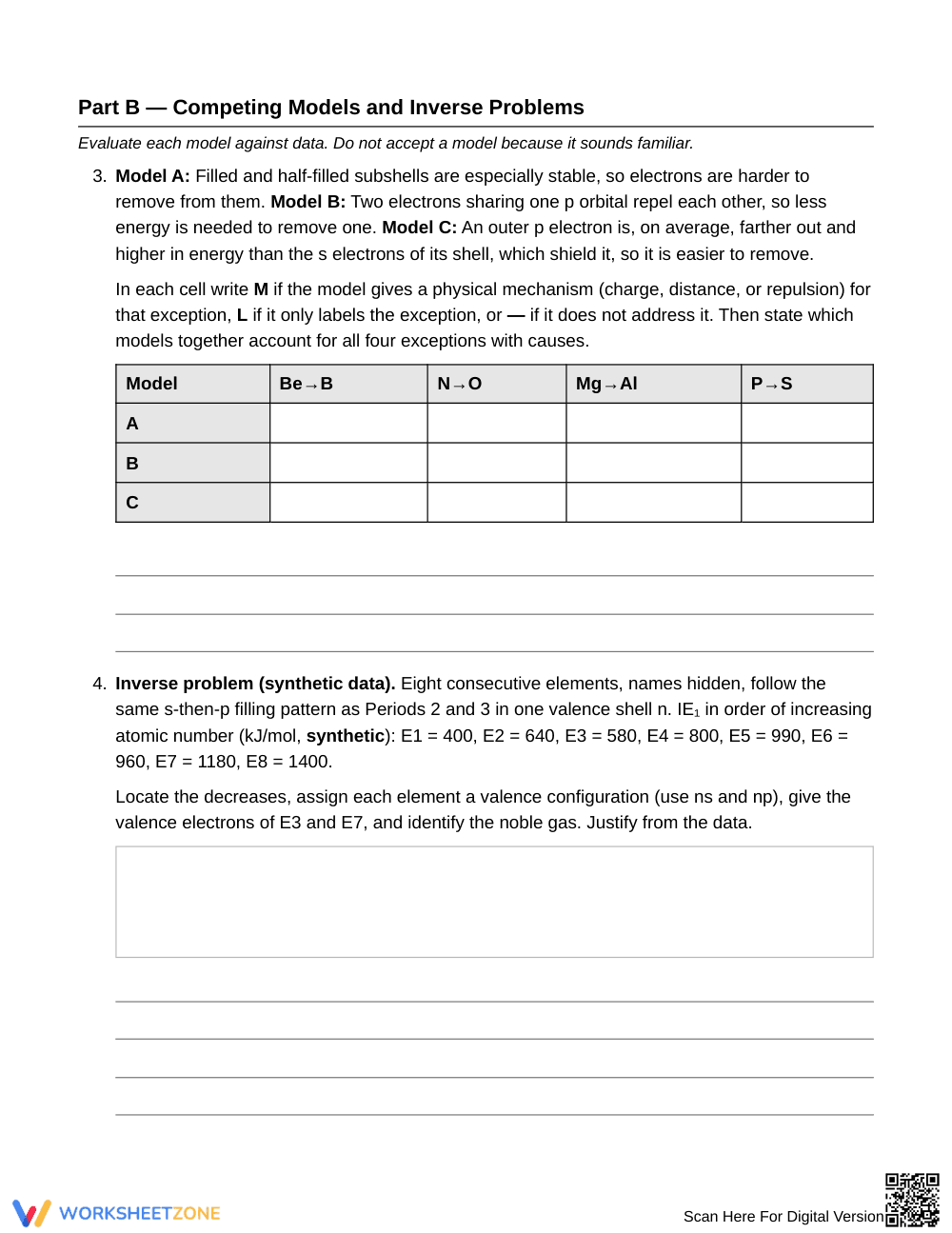
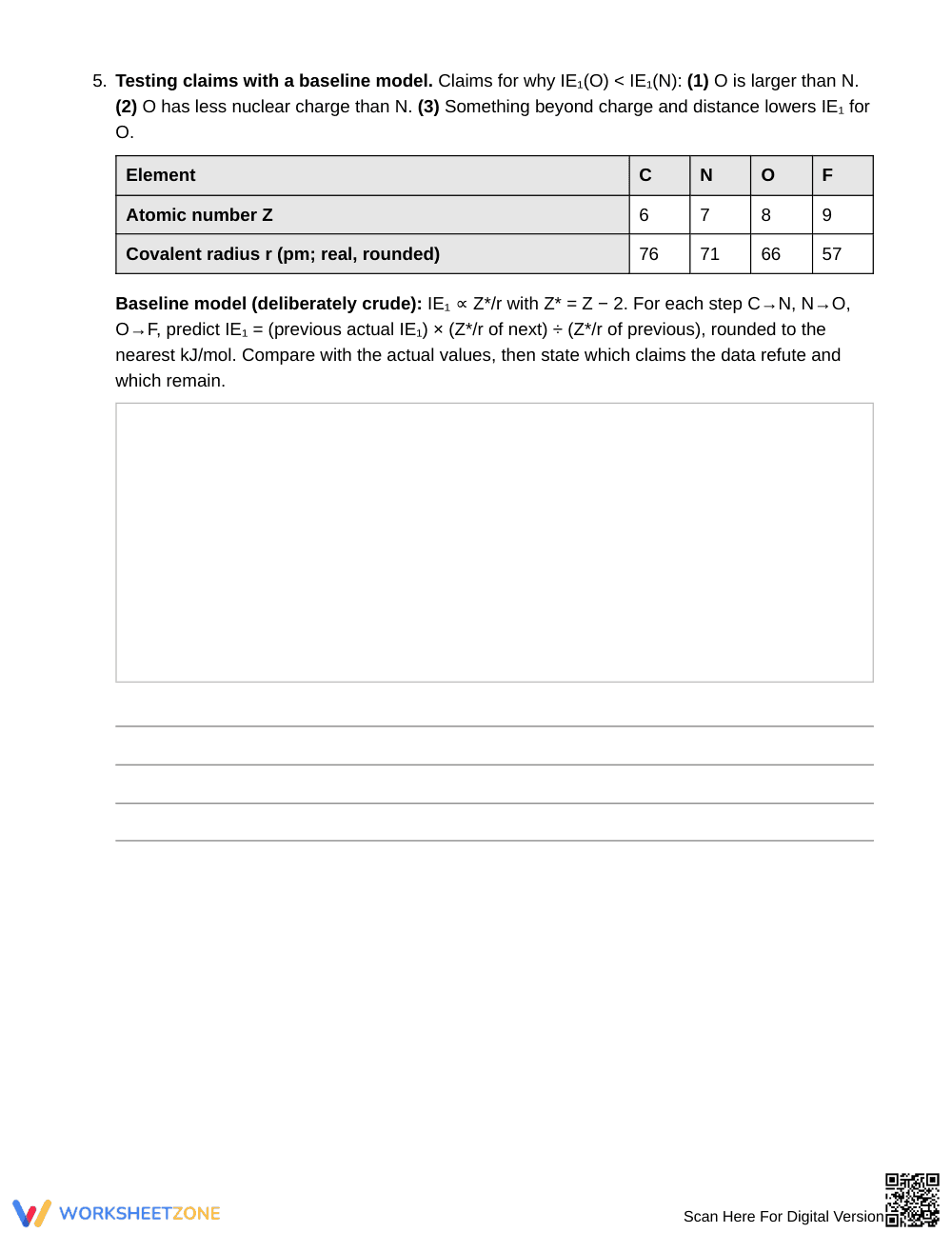
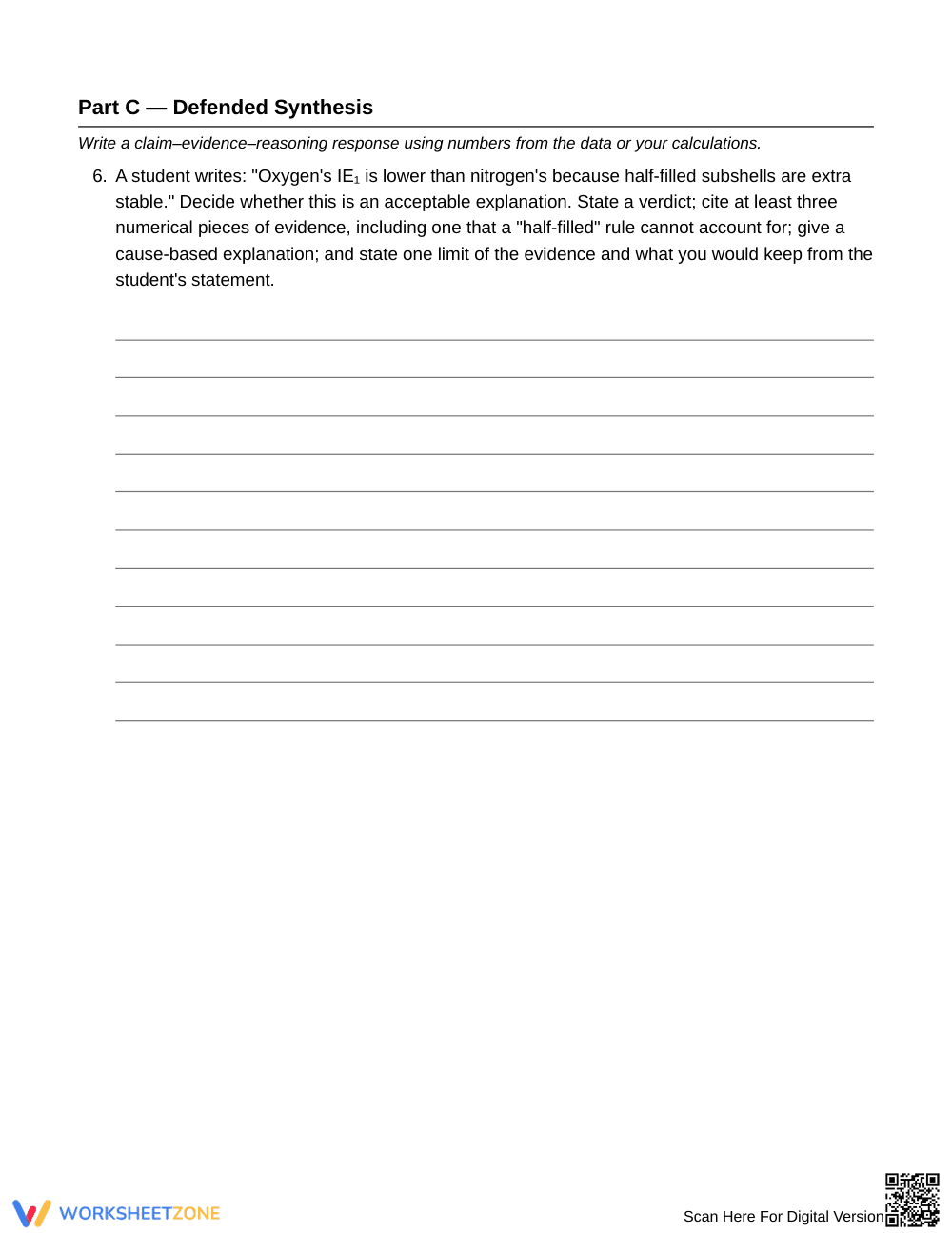
A 5-page student worksheet with a definitions box and real Period 2 and Period 3 IE₁ data tables. Tasks include step-change and percent-decrease calculations, orbital notation, a model-comparison grid, an inverse problem with synthetic data, a baseline Z*/r model, and a claim–evidence–reasoning response. A 4-page answer key is included.
Skill Progression
- Guided practice: 2 constrained applications (Part A) limit which causes students may use, which keeps early explanations focused.
- Supported practice: 3 tasks (Part B) give a model grid, synthetic data, and a baseline calculation to structure the reasoning.
- Independent practice: 1 defended synthesis (Part C) asks for a verdict, three pieces of numerical evidence, and a stated limit.
The sequence follows gradual release: I Do, We Do, You Do.
Standards Alignment
This worksheet supports high school chemistry expectations for using periodic trends and electron configuration to explain patterns in ionization energy, and for supporting claims with evidence and reasoning. No standard code is assigned to this worksheet, so add your own state or district code when mapping it to lesson plans, IEP goals, or curriculum tools.
How to Use It
- After direct instruction on ionization energy trends, assign Parts A and B as extension work in class or for homework.
- As a closing assessment, use Part C alone to check whether students can defend a verdict.
Formative tip: while students work, listen for the words “stable” or “half-filled” used as a reason, then prompt them to name a cause. Expect 40–55 minutes for the full set.
Who It’s For
Grade 11 Chemistry students who have met periodic trends and electron configurations, including honors and early AP-style classes. Students who need support can work Part A first and receive the Part B grid as a group task. Pair it with a direct instruction lesson on effective nuclear charge and shielding.
This Grade 11 Chemistry worksheet targets one skill in periodic trends: explaining a supplied first ionization energy exception using a physical cause and numerical evidence rather than an invented rule. Students work with real Period 2 and Period 3 ionization energy data, calculate step changes and percent decreases, compare three competing models, solve an inverse problem with synthetic data, and test claims against a crude Z*/r baseline. They finish with a claim–evidence–reasoning response that judges the statement that half-filled subshells are extra stable. The task sequence follows the gradual release model described by Fisher & Frey (2014), moving from constrained applications to supported analysis to independent defense of a verdict. The worksheet runs 5 pages with 6 tasks and a 4-page answer key. No standard code is listed for this worksheet, so teachers should map it to their own curriculum framework for periodic trends.


