Metals, nonmetals, and metalloids worksheets make periodic table review more concrete
Teachers usually introduce metals, nonmetals, and metalloids early in a chemistry unit, but students do not always retain the distinctions after a single periodic table lesson. That is where metals nonmetals and metalloids worksheets become practical. Instead of treating the categories as isolated vocabulary, students use repeated classification tasks to connect position on the periodic table with observable properties such as luster, brittleness, and conductivity.
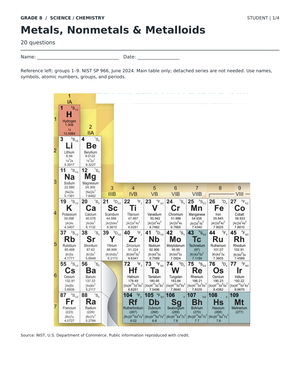
Worksheetzone organizes this topic as printable chemistry practice for classroom use, with materials aimed mainly at grades 6-12 and several options suited to grades 8-12. For a teacher planning a middle school physical science lesson or a high school chemistry review, that range matters. It means the same concept can be revisited as students move from basic identification to more analytical compare-and-contrast work.
Because the topic sits at the center of periodic table understanding, these worksheets also fit multiple points in a unit. You can use them to launch a lesson, support guided practice, assign independent review, or check understanding before moving into bonding, periodic trends, or lab analysis. The value is not simply that students fill in boxes. The value is that the worksheet turns a broad table of elements into a manageable classification task with visible patterns.
Students practice classification, evidence-based comparison, and chemistry vocabulary
Well-designed worksheets in this topic do more than ask students to memorize three labels. They ask learners to sort elements correctly, justify why an element belongs in a category, and compare how physical properties align with that category. In practice, students strengthen chemistry vocabulary while building the habit of using evidence instead of guessing from a familiar element name.
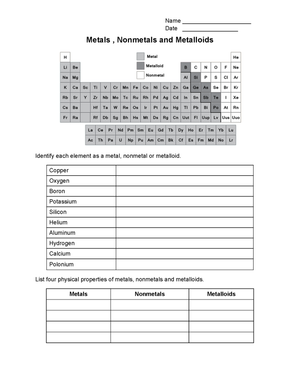
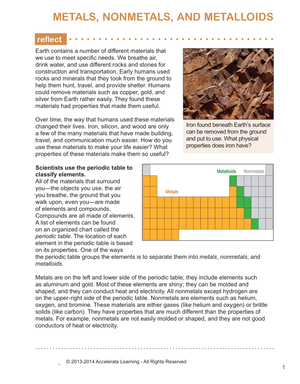
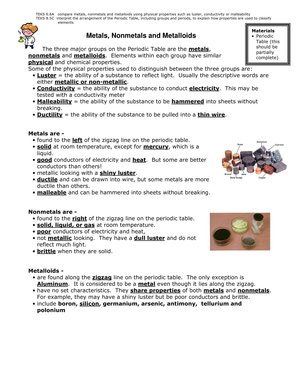
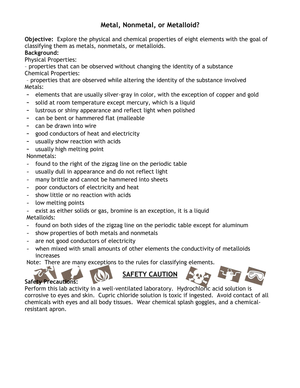
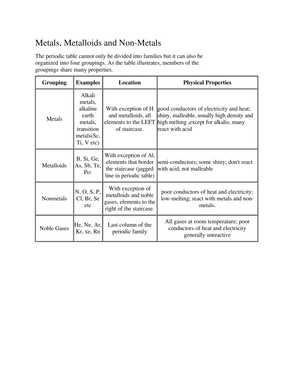
In a typical lesson, students may identify that metals are commonly found on the left and center of the periodic table and are associated with conductivity and luster. They may then contrast those properties with nonmetals, which are mostly on the upper right and often show lower conductivity than metals. Metalloids become the bridge concept, because they sit near the zigzag boundary and show mixed or intermediate behavior. That three-part comparison helps students see why the periodic table is organized as a pattern rather than a list.
- Classification practice: sorting elements into the correct group.
- Property analysis: connecting conductivity, luster, or brittleness to each category.
- Academic language: using terms such as periodic table, element, metalloid, and conductivity accurately.
- Short written reasoning: explaining why one element fits better than another.
For teachers, that combination makes these worksheets useful beyond a single class period. The same page can support direct instruction, small-group correction, or a quick formative check that reveals whether students are relying on memorization or actual chemical reasoning.
Compare-and-contrast tasks help students notice the patterns that matter
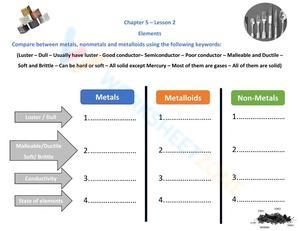
One reason this topic can be difficult is that students often overgeneralize. They may assume every shiny substance is a metal or believe any element near the right side is automatically a nonmetal. Worksheets help slow that process down. By asking students to compare categories side by side, they move beyond one-feature thinking and start weighing several clues at once.
That matters especially for metalloids. Students can usually recall examples of metals and nonmetals, but metalloids require closer attention because their properties are mixed. A worksheet that asks students to classify, compare, and explain makes the ambiguity productive rather than confusing. Instead of treating metalloids as an exception they should memorize, students begin to see them as a meaningful category located near the zigzag boundary for a reason.
Teachers can build this comparison work into class discussion. After students complete a page independently, ask which properties gave them the strongest evidence, which items felt uncertain, and whether periodic table location or material behavior was more helpful. Those questions turn the worksheet into a reasoning task. Students are no longer just labeling categories; they are defending how the classification system works.
Choosing the right worksheet for grades 6-12 depends on the lesson goal
Worksheetzone resources mainly serve grades 6-12, with several worksheets labeled for grades 8-12. Younger learners in that range usually need straightforward identification and property matching, while older students are ready for exceptions, richer vocabulary, and short written explanations.
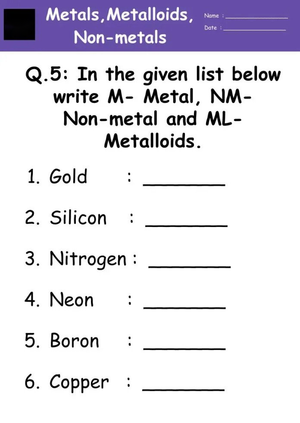
For grade 6 or grade 7 classes, look for pages that keep the focus narrow: identifying metals, nonmetals, and metalloids and matching each group to a short list of properties. Students at that level benefit from repeated exposure and visual pattern recognition. For grades 8-12, the best worksheets usually ask for more precision. They can include compare-and-contrast prompts, periodic table references, or questions that require students to justify how they classified a less familiar element.
Teachers should also match the worksheet format to the timing of the lesson. A short page works well as a bell ringer, while a fuller compare-and-contrast sheet is better for guided practice or homework. If the goal is review, choose a page that mixes location and properties. If the goal is assessment, use a worksheet that requires students to explain decisions so you can see whether the concept is secure.
Classroom Implementation
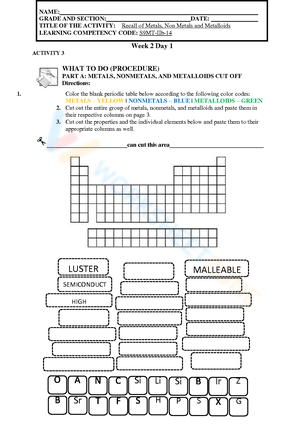
These worksheets are flexible enough to support several common routines without adding prep time. In a whole-group lesson, they can anchor direct instruction after a brief periodic table mini-lesson. In stations, one sheet can focus on identifying categories while another asks students to compare conductivity, luster, and brittleness. In intervention groups, a teacher can target the exact misconception that is blocking progress.
- Bell ringer: classify 5 to 8 elements before the main lesson starts.
- Guided practice: pause after each item and discuss the evidence students used.
- Homework: assign a mixed practice page that revisits vocabulary and properties.
- Exit ticket: use two classification items and one short explanation prompt.
A useful pattern to watch for is this: students who miss these questions often are not confusing the words metal and nonmetal. They are relying on only one clue. If a learner chooses answers by table location alone, metalloids become a problem. If the learner uses only one property, unfamiliar examples become a problem. The strongest classroom use of metals nonmetals and metalloids worksheets is to require at least two pieces of evidence for harder items, because that shifts students from recall to chemical reasoning.
That approach also gives teachers better diagnostic information. When you ask for evidence, you can quickly see whether a wrong answer came from vocabulary weakness, poor interpretation of the periodic table, or incomplete understanding of the properties. The worksheet becomes not just practice, but a short assessment tool that points directly to the next mini-lesson.
This is especially helpful when students move into topics that depend on classification knowledge. Periodic trends, bonding discussions, and material property comparisons all become easier when learners already understand where these groups are found and why their properties differ. A worksheet page may look simple, but it often carries forward into much more complex content later in the term.
These worksheets work well for review, homework, and formative assessment
They also make formative assessment more efficient. A short worksheet can reveal whether students understand the location of each category, whether they can match properties accurately, and whether they can explain edge cases involving metalloids. That information is actionable. If most students can classify correctly but cannot explain why, the next lesson should focus on reasoning and evidence. If they confuse location across the periodic table, the next lesson should return to visual mapping.
For curriculum leads and classroom teachers alike, that flexibility is the main strength of this resource type. The worksheet is printable, focused, and easy to adapt to different pacing needs. It can support first exposure, later review, or a quick check before you move into content that assumes students already know how these element groups differ.
Frequently Asked Questions
1. What grades are metals, nonmetals, and metalloids worksheets best for?
They are best suited to grades 6-12. Simpler identification pages fit the lower end of that range, while compare-and-contrast and written explanation tasks are a stronger match for grades 8-12 chemistry classes.
2. What skills do students practice with these chemistry worksheets?
Students practice classifying elements, comparing physical properties, using periodic table evidence, and explaining why an element belongs to a category. Teachers can also use them to strengthen chemistry vocabulary and short written reasoning.
3. How do worksheets help students distinguish metals, nonmetals, and metalloids?
Worksheets slow the classification process down and make students compare several clues at once. Instead of guessing from a familiar example, they look at periodic table location, conductivity, luster, brittleness, and mixed properties to reach a better-supported answer.
4. Can these worksheets support review, homework, or assessment?
Yes. They work well as bell ringers, guided practice, homework, exit tickets, and formative assessments. Because the topic is foundational, the same kind of worksheet can be reused at different points in a chemistry unit without losing instructional value.