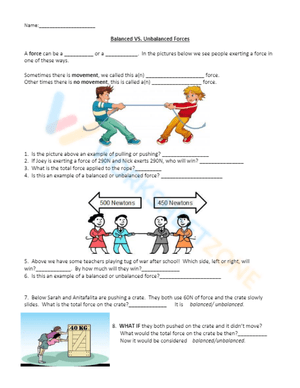
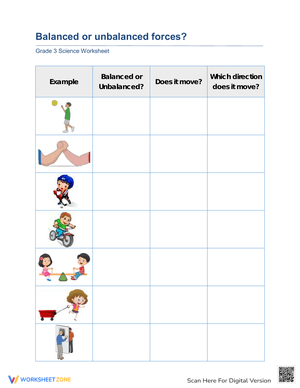
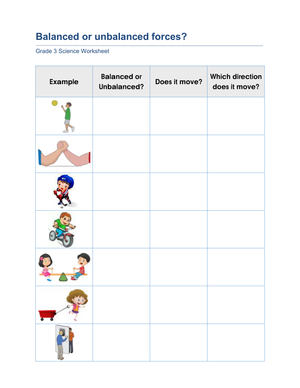
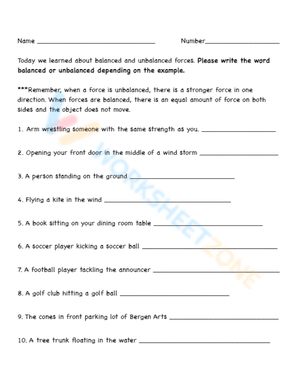
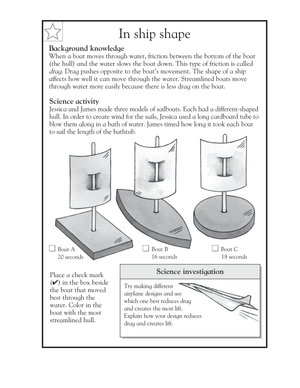
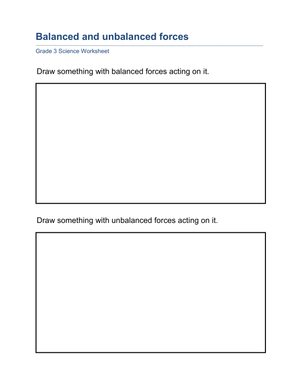
When you are planning a force and motion unit, the goal is rarely just teaching two vocabulary terms. Students need to see how a set of forces acting on an object determines whether that object speeds up, slows down, changes direction, or keeps moving at a steady pace. Balanced and unbalanced forces worksheets give you a low-prep way to get students reasoning about force sums before they ever touch a cart, spring scale, or motion sensor. Used well, they are not a substitute for the lab; they are the thinking scaffold that makes the lab make sense.
For middle school physical science teachers, this practice sits squarely inside the sum-of-forces reasoning that later supports Newton's Laws. For upper elementary teachers, the same worksheets can be simplified into push-and-pull investigations that build early intuition about motion.
What NGSS MS-PS2-2 Asks Students To Do
NGSS MS-PS2-2 requires students to plan an investigation to provide evidence that the change in an object's motion depends on the sum of the forces on the object and the mass of the object. That framing matters for worksheet design: the standard is not asking students to memorize a definition of balanced forces. It is asking them to reason about investigation design, using force sums as evidence.
The standard also draws an explicit connection that your worksheets should make visible: balanced forces relate to Newton's First Law, while unbalanced forces relate to Newton's Second Law. A worksheet that pairs each force scenario with the matching law reinforces that link instead of treating the two ideas as separate units.
The assessment boundary for MS-PS2-2 keeps the scope manageable for classroom practice. It limits reasoning to one-dimensional motion in an inertial reference frame, changes only one variable at a time, and does not require trigonometry. That boundary is useful when you are selecting or building worksheet problems, since it tells you exactly how complex your force diagrams need to be for grade-level appropriate practice.
Scaffolding From Grade 3 Pushes and Pulls to Grade 6-8 Force Sums
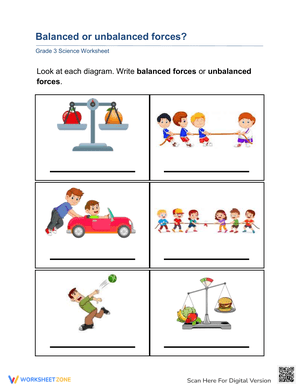
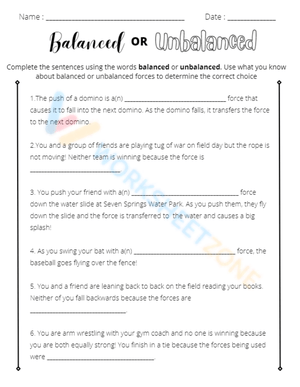
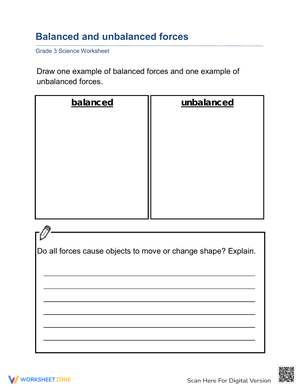
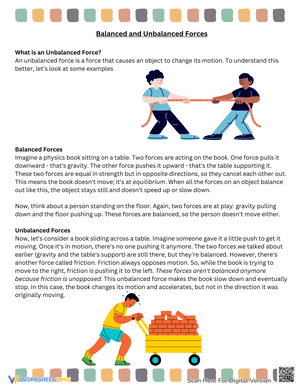
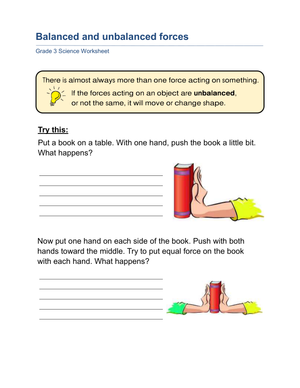
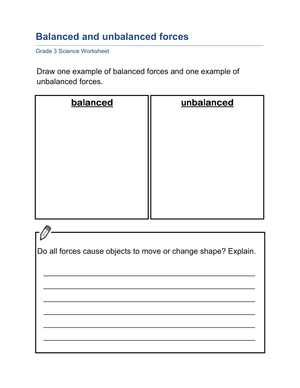
NGSS 3-PS2-1 introduces balanced and unbalanced forces at grade 3 through investigations of pushes and pulls on an object's motion. At this level, worksheets should stay concrete: simple pictures of two people pushing a wagon from opposite sides, or one push against no opposing force at all.
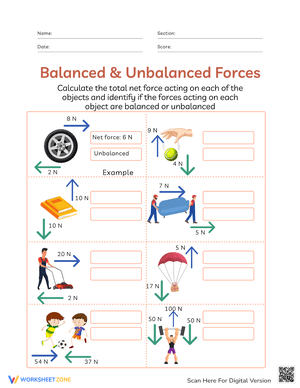
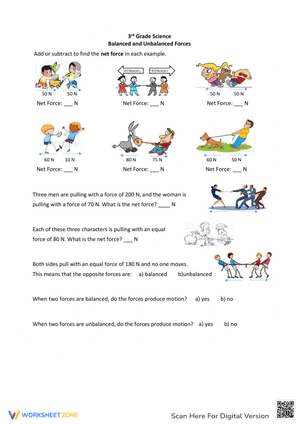
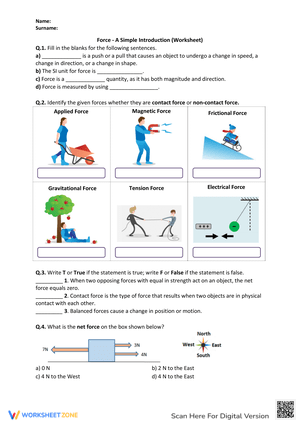
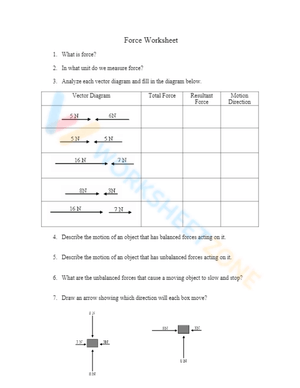
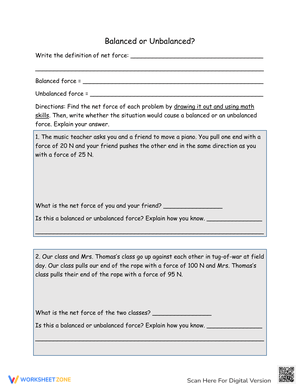
By grade 6-8, worksheets can move toward abstract force diagrams with labeled arrows and numeric values, asking students to calculate net force and predict the resulting change in motion. If you teach a mixed-level classroom or run intervention groups that include students working below grade level, keeping both tiers of worksheets on hand lets you scaffold up or down without rewriting materials mid-unit.
Building Force Diagrams and Free-Body Sketches on Paper First
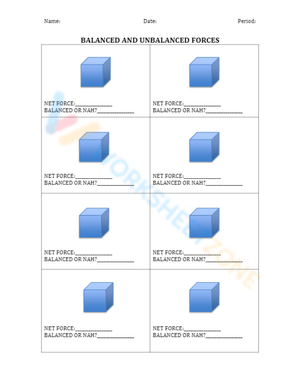
Free-body sketches are one of the highest-leverage skills you can build with a worksheet before students head into a lab. A worksheet that asks students to draw arrows representing every force acting on an object, then sum those arrows to find net force, forces them to slow down and account for each variable individually.
This paper-based practice pays off during hands-on investigations because students who have already drawn several force diagrams recognize the pattern faster when they see it in a real cart-and-track setup or a spring-scale pull test. It also gives you a quick way to check understanding before committing lab time to a misconception that has not been addressed.
Using Worksheets to Catch the Constant-Motion Misconception Before the Lab
A common and persistent student misconception is that a moving object needs a continuous unbalanced force just to keep moving at a constant speed. Worksheets that isolate balanced-force scenarios, such as an object moving at constant velocity or sitting at rest, directly target this misconception by forcing students to identify when forces are balanced even though the object is in motion. Running one of these quick-check worksheets a day or two before a forces lab lets you catch and address the misconception in a low-stakes setting rather than during data collection, when a wrong mental model can derail an entire group's interpretation of results.
The MS-PS2-2 evidence statements from the Next Generation Science Standards describe this same distinction as central to how students should reason about motion: change in motion depends on the sum of forces, not on motion itself. A worksheet item that asks whether a coasting bicycle experiences balanced or unbalanced forces gets directly at this idea in a way students can answer without a lab setup.
Teacher Tips for Pairing Worksheets With Hands-On Investigations
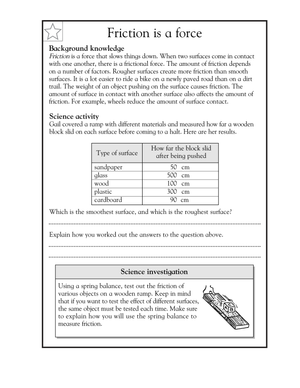
Worksheets work best as the thinking layer that surrounds an investigation, not as a replacement for it. Before a lab using carts, spring scales, or friction ramps, assign a short diagram-based worksheet so students arrive with a working prediction. After the lab, a second worksheet asking students to reconcile their prediction with their data reinforces the evidence-based reasoning that MS-PS2-2 is built around.
For formative assessment, a two- or three-item exit-ticket worksheet at the end of a class period gives you a fast read on which students are ready to move forward and which need another round of small-group support. Keep a bank of both grade 3 push-and-pull items and grade 6-8 force-sum items so you can regroup students quickly based on what the exit ticket shows.
When you are documenting standards alignment for administrators or curriculum leads, cite the specific performance expectation and the matching assessment boundary rather than a general force-and-motion label. This makes it easier to show exactly how a given worksheet set supports the investigation-planning skill that MS-PS2-2 requires, not just vocabulary coverage.
Frequently Asked Questions
1. What is the difference between balanced and unbalanced forces for middle school students?
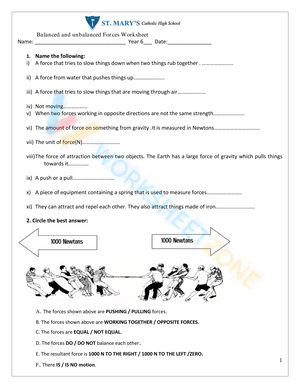
Balanced forces are equal and opposite, so they cancel out and the object's motion does not change; it either stays at rest or keeps moving at a constant speed. Unbalanced forces do not cancel out, so the object speeds up, slows down, or changes direction.
2. Which NGSS standard covers balanced and unbalanced forces?
MS-PS2-2 covers this concept at grades 6-8, focusing on the sum of forces and an object's mass as evidence for change in motion. 3-PS2-1 introduces the same idea at grade 3 through simpler push-and-pull investigations.
3. How can teachers use these worksheets for formative assessment before a forces lab?
A short diagram or exit-ticket worksheet given a day or two before a lab can reveal whether students still believe constant motion requires a continuous unbalanced force, letting you address the misconception before it affects lab data interpretation.
4. What grade levels are appropriate for balanced and unbalanced forces worksheets?
Grade 3 worksheets should stay concrete with push-and-pull scenarios, while grade 6-8 worksheets can include labeled force diagrams and net-force calculations aligned to the one-dimensional, single-variable scope of the MS-PS2-2 assessment boundary.
5. How do these worksheets address common misconceptions about motion and force?
Worksheets that isolate balanced-force scenarios where an object is still moving directly confront the idea that motion requires a continuous force, while worksheets contrasting balanced forces with zero force help students see that balanced does not mean absent.