


























Views
Downloads



Ready Neighboring Elements Worksheet | Grade 11 Chemistry
Paste this activity's link or code into your existing LMS (Google Classroom, Canvas, Teams, Schoology, Moodle, etc.).
Students can open and work on the activity right away, with no student login required.
You'll still be able to track student progress and results from your teacher account.
This worksheet teaches Grade 11 chemistry students to predict the properties of an element from its neighbors on the periodic table. Students bound a value, estimate it, then judge when the method fails, using atomic radius, first ionization energy, and valence configurations.
At a Glance
- Grade: 11 · Subject: Chemistry
- Standard: Periodic trends — use neighboring elements to predict radius and ionization energy, then check the prediction.
- Skill Focus: Predict properties of neighboring elements using bounds and linear estimates
- Format: 5 pages · 10 problems · Answer key included · PDF
- Best For: Periodic trends unit practice and review
- Time: 35–45 minutes
What's Inside
The 5-page worksheet opens with a reference box holding a simplified effective nuclear charge model, assumptions, and a period 2 data table. Ten tasks follow: a multiple-choice item, bounded range estimates, linear interpolation, percent error, and claim evaluation. A 3-page answer key covers all ten tasks.
Skill Progression
- Guided practice (2 tasks): Part A uses the reference box and answer choices to identify when neighbor-based bounds hold.
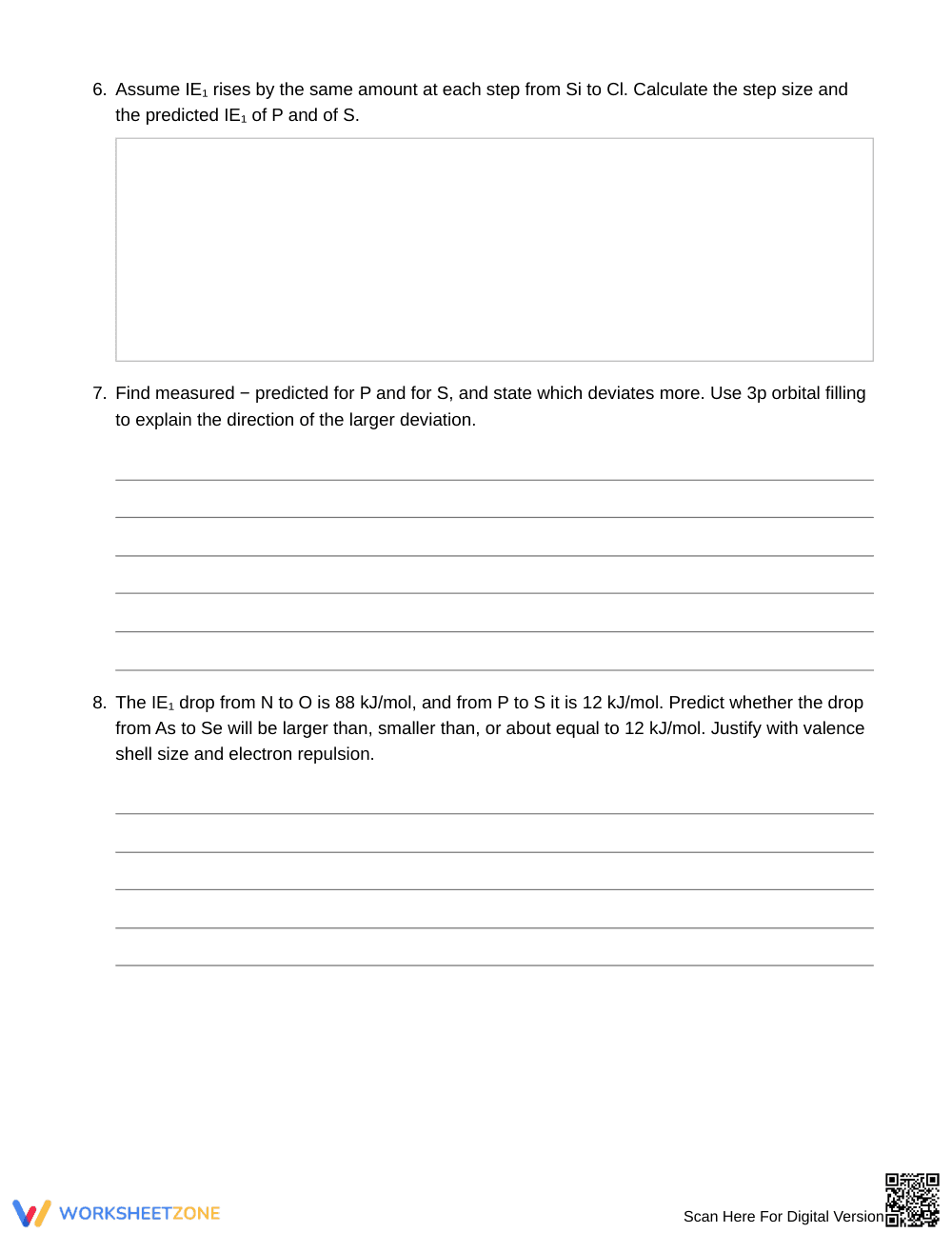
- Supported practice (6 tasks): Part B gives data tables for Group 2 and Period 3 and asks for ranges, linear estimates, percent error, and deviations.
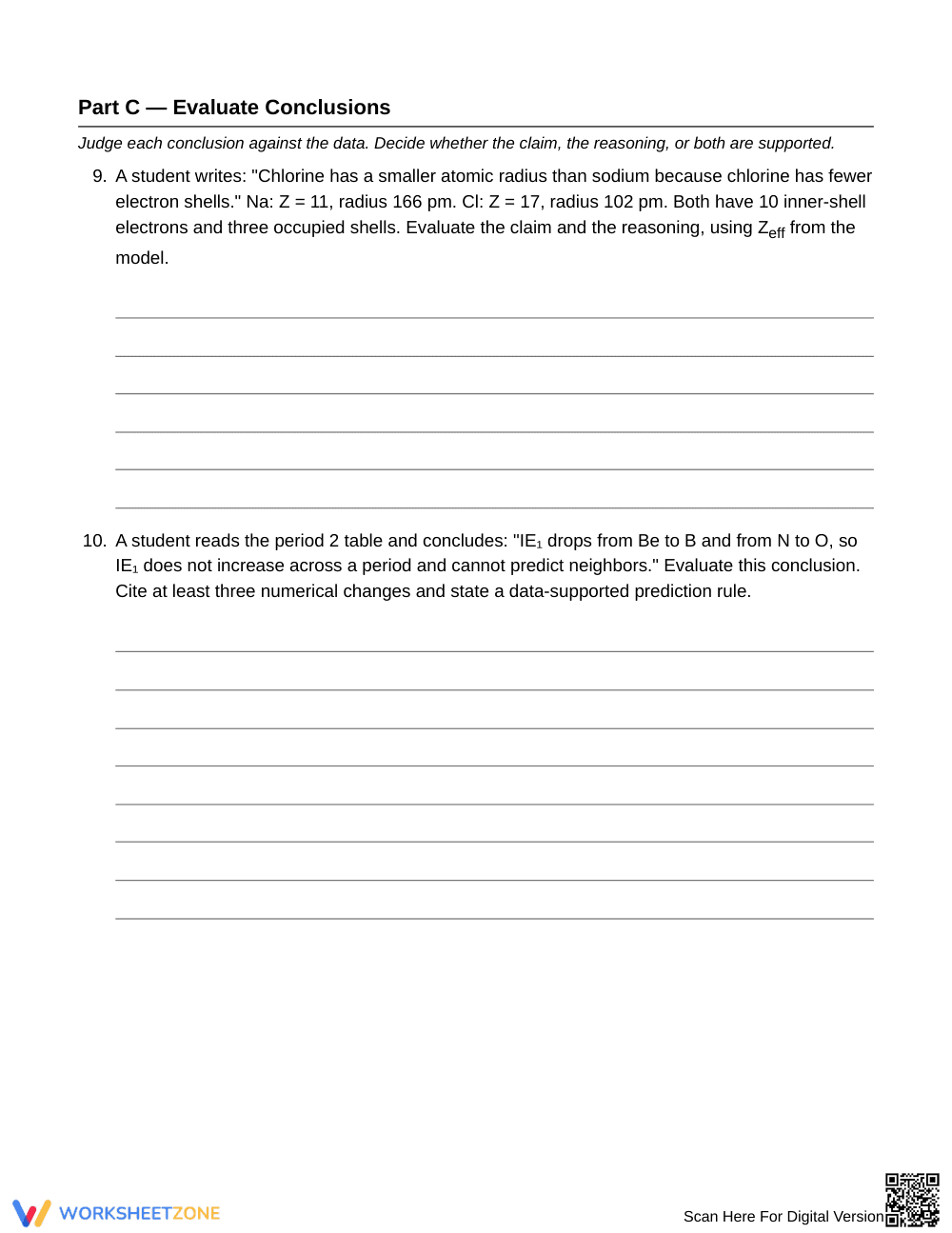
- Independent practice (2 tasks): Part C asks students to evaluate written conclusions using numerical evidence.
The sequence follows gradual release: I do, we do, you do.
Standards Alignment
No standard code is attached to this worksheet. It supports high school chemistry expectations for periodic trends: use nuclear charge and valence shell patterns to explain and predict trends in radius and ionization energy. Add your state or district standard code when copying it into lesson plans, IEP goals, or curriculum mapping tools.
How to Use It
- After direct instruction: assign Parts A and B as classwork once students have seen radius and IE₁ trends.
- Review or homework: assign Part C before a unit quiz.
Formative tip: circulate during Case 2 and note which students explain the P-to-S dip with 3p orbital filling rather than just calling it an exception. Expect 35–45 minutes.
Who It's For
Built for Grade 11 chemistry students in a periodic trends unit. Let students lean on the reference box for support, and use Part C as the stretch. Pair it with a periodic table anchor chart or a lesson on effective nuclear charge.
Predict Properties of Neighboring Elements is a Grade 11 chemistry worksheet for the periodic trends unit. Students use a reference box with a simplified effective nuclear charge model to bound a missing radius or first ionization energy between neighboring elements, calculate a linear estimate, and compute percent error. They then evaluate where the method breaks down, such as the Be-to-B and N-to-O dips in period 2 and the phosphorus-to-sulfur exception in period 3, and defend a data-supported prediction rule. The 10 tasks, spread across 5 pages with a 3-page answer key, move from guided identification to independent evaluation. This structure follows the gradual release of responsibility model described by Fisher & Frey (2014), in which teachers shift cognitive work to students in stages. The worksheet fits review, homework, or formative checks, and gives teachers numerical evidence of whether students reason from valence configuration and shell size rather than memorized trends.


