What Balancing Act Worksheets Actually Build
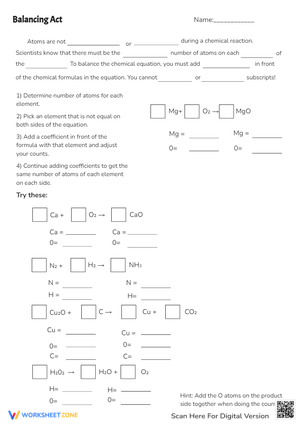
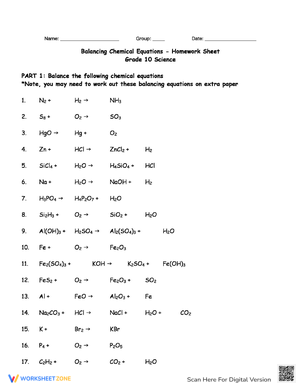
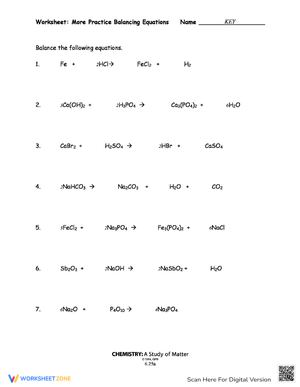
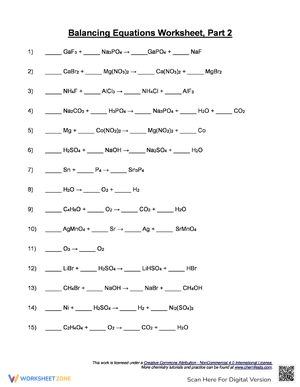
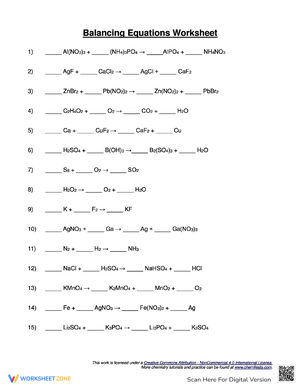
Balancing act worksheets give chemistry and physical science students repeated practice at one specific skill: adjusting coefficients so the number of atoms of each element is equal on both sides of a chemical equation. The skill sounds narrow, but it carries the biggest idea in an early chemistry unit, the law of conservation of mass. When students balance an equation correctly, they're showing on paper that atoms are neither created nor destroyed during a reaction.
In most US classrooms, this topic shows up first in middle school physical science and returns, with more demanding examples, in high school chemistry. A useful worksheet set meets students where they are. Some pages stay with two-element reactions, while others move toward multi-compound equations that include polyatomic groups. The goal isn't speed. It's getting students to reason about atom counts instead of guessing numbers until an equation happens to look right.
The law of conservation of mass, demonstrated in Antoine Lavoisier's closed-vessel combustion experiments in the 1770s, established that the total mass of reactants equals the total mass of products. Every balancing act worksheet rests on this rule: if 100 grams of reactants enter a sealed reaction, 100 grams of products must remain.
Scaffold Practice from Simple to Multi-Compound Equations
The quickest way to lose a class here is to open with an equation that has four compounds and a polyatomic ion. Start smaller and let each worksheet page add one layer of difficulty. A first page should use synthesis reactions with single-element reactants, such as hydrogen and oxygen forming water, where students track only two elements at a time.
- Stage one: two-element synthesis and decomposition reactions with small coefficients.
- Stage two: single-replacement reactions that add a third element to track.
- Stage three: combustion of simple hydrocarbons, which forces students to balance carbon, hydrogen, and oxygen in a set order.
- Stage four: equations with polyatomic ions treated as one unit, plus double-replacement reactions.
When worksheets follow this order, students build a repeatable method rather than a page of one-off tricks. By stage three, many students start balancing the most complex element first and saving pure oxygen or hydrogen for last, which is exactly the habit you want them carrying into a high school chemistry course.
A predictable sequence also helps you write clear objectives for each day. When Monday's page is only two-element synthesis and Thursday's page adds combustion, you can name the exact skill each lesson targets and spot the day a student's progress stalls. That clarity matters most for students who were absent, since you can hand them the specific stage they missed rather than a mixed page that assumes every earlier skill is already in place.
Fix the Coefficient-Versus-Subscript Mistake
The most common error on balancing worksheets is predictable, and it's worth planning around. Faced with an unbalanced equation, students change a subscript to force the atom counts to match. Rewriting H2O as H2O2 does balance the oxygen, but it also changes water into hydrogen peroxide, a different substance entirely.
Good worksheets build the correction into the layout. Ask students to write the atom count for each element under both sides before they touch a coefficient, then re-tally after every change. A worksheet that reserves two columns, one for atoms before and one for atoms after, makes the subscript trap visible, because students can see that editing a subscript changed the actual formula, not just the balance.
It also helps to name the misconception out loud. Tell students directly that coefficients are the only numbers they may change, and that subscripts belong to the chemists who wrote the formula. Some teachers have students circle every subscript before balancing so those numbers are visually off-limits. A worksheet that prints formulas with generous spacing gives students room to write coefficients large and to the left, which further separates the two kinds of numbers in their minds.
Pair Worksheets with the PhET Balancing Chemical Equations Simulation
Paper practice and a digital lab reinforce each other well on this topic. The PhET Interactive Simulations tool lets students drag coefficients up and down while a balance-scale graphic and a bar chart show whether atom counts match on each side. Running the simulation for ten minutes before a worksheet gives students a mental image of the balance tipping, which they can then picture while working equations by hand.
The sharpest gain comes from sequencing the two tools deliberately, not just assigning both. Have students balance three equations on paper first, then check those same three in the PhET simulation. The paper-first order forces a prediction before the visual confirms it, so the simulation becomes a feedback check rather than a place to guess and drag until the scale levels. Students who guess inside the simulation often produce a balanced screen without being able to reproduce the result on a blank page the next day.
The simulation also gives you a quick differentiation move. Faster students can switch to a harder level and balance more complex equations, while students who need more support use the introduction level, where the tool shows atom counts directly under each molecule. Everyone stays on the same core task, but the challenge scales to the student.
Classroom Implementation
Balancing act worksheets work best as short, frequent practice rather than one long packet. Place them at three points in a conservation of mass unit: a diagnostic at the start, guided practice mid-unit, and a short independent set before your assessment.
- Exit tickets: two equations at the end of class tell you who is still editing subscripts before the misconception hardens.
- Small-group intervention: pull students who miss the same reaction type and reteach with stage-one pages.
- Differentiation: offer sentence-frame support and pre-counted atom tables for some students, and open-ended multi-compound equations for those ready to stretch.
- Documentation: label each page with the reaction type and difficulty stage so your practice ties cleanly to your unit's stated learning goals.
Keep a simple record of which reaction types each student has mastered. That record turns a stack of worksheets into evidence of progress you can share during team planning or a parent conference, and it tells you exactly which page to hand out next.
Frequently Asked Questions
1. What grade level are balancing act worksheets appropriate for?
They fit middle school physical science, usually grades 7 and 8, as an introduction to conservation of mass, and high school chemistry, around grades 9 and 10, for more demanding multi-compound work. Start with simpler pages in middle school and reserve polyatomic and combustion equations for high school.
2. What science skills do these worksheets support?
They build the core idea that atoms are conserved during a chemical reaction, so mass is conserved. Students use coefficients to model equal atom counts on both sides, which supports both modeling and mathematical-reasoning goals in a physical science or chemistry unit.
3. How can teachers use these worksheets alongside the PhET simulation?
Assign three to five equations on paper first, then have students verify the same equations in the PhET Balancing Chemical Equations simulation. The balance-scale visualization confirms their coefficients, and any mismatch becomes an immediate, self-checking correction rather than a mark on a graded page.
4. What is the most common student mistake, and how do worksheets address it?
Students change subscripts instead of coefficients, which quietly turns one substance into another. Worksheets that require an atom tally on both sides before and after each change make the error visible and train students to adjust only coefficients.
5. How should teachers sequence balancing practice within a unit?
Open with a diagnostic on two-element reactions, move through single-replacement and combustion equations during guided practice, and finish with polyatomic and double-replacement equations. Short daily sets with quick feedback work better than one long packet at the end.