Why these worksheets fit chemistry instruction
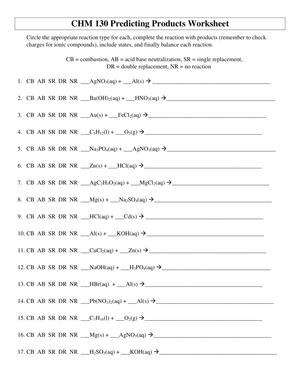
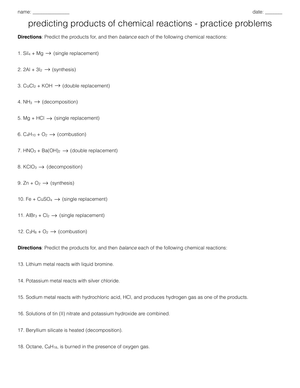
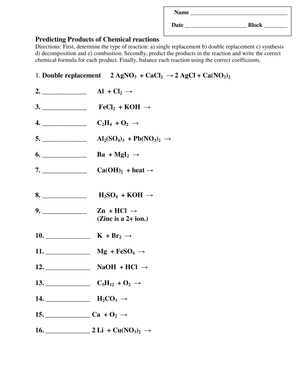
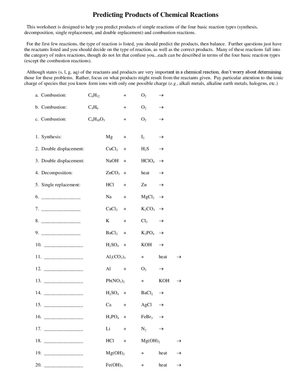
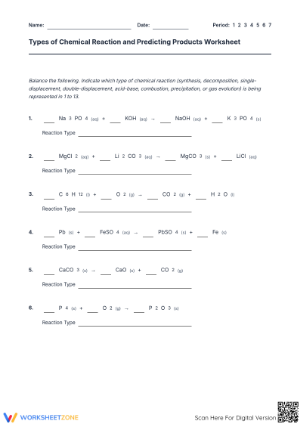
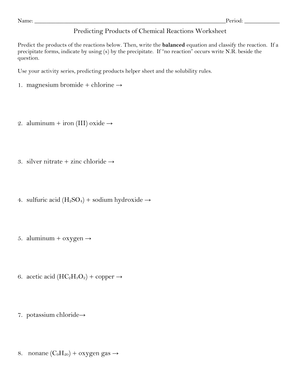
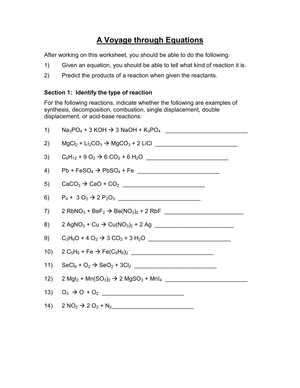
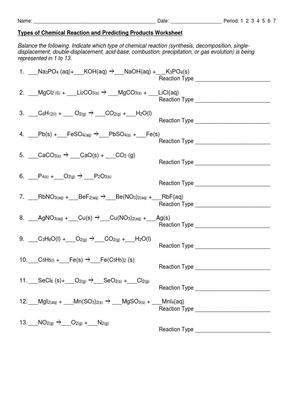
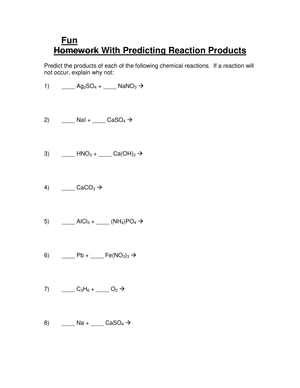
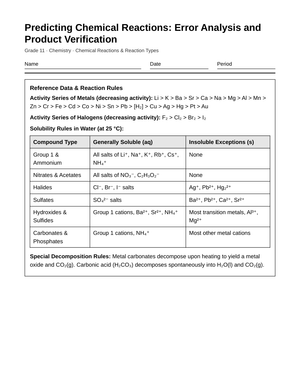
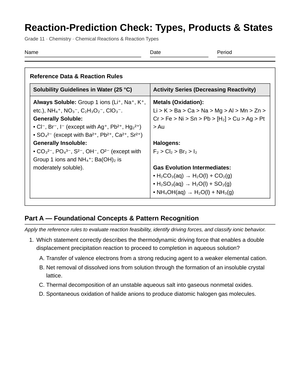
Predicting products of chemical reactions worksheets give teachers a focused way to practice one of the most teachable parts of introductory chemistry: recognizing a reaction pattern and using that pattern to determine likely products. Instead of asking students to solve a full multistep problem all at once, these worksheets isolate the decision point that often causes hesitation. Students look at the reactants, decide whether the equation shows synthesis, decomposition, single replacement, double replacement, or combustion, and then write the products that match the pattern.
That makes these pages useful across several points in a unit. Teachers can use them right after direct instruction on reaction types, during guided practice in pairs, as a short bell ringer before a lab, or as homework that prepares students for balancing equations the next day. Because the work is narrow and repeatable, it also works well for review packets and quick formative checks. On Worksheetzone, the best use case is straightforward: give students enough repeated exposure that reaction patterns start to feel recognizable rather than random.
What students should know before they begin
Most students do better with product prediction when a few pieces are already in place. They need to read chemical formulas accurately, identify common element symbols, and understand the difference between subscripts and coefficients. They also need a basic sense of what a reactant and a product are, since many early mistakes come from copying the left side of the equation onto the right side without changing the substances at all.
It also helps if students have seen both word equations and symbolic equations. A worksheet set that moves between the two formats supports deeper recognition. When students read a word equation such as metal plus oxygen, they can think through the pattern in plain language before converting it to formulas. When they work with symbolic equations, they can connect that same pattern to chemical notation. This back-and-forth is especially helpful in middle school physical science classes that are transitioning into high school chemistry expectations.
Teachers do not need students to master balancing first. In fact, many classes move more efficiently when predicting products comes before balancing. Once learners can tell what should form, then they can work on making the completed equation show equal numbers of atoms on both sides.
Which reaction patterns belong on a strong practice set
The most effective predicting products of chemical reactions worksheets stay centered on the common patterns students are most likely to meet in introductory courses. Keeping the reaction families consistent helps teachers see whether errors come from pattern recognition, formula writing, or balancing after the products are found.
- Synthesis: two or more reactants combine to form one product.
- Decomposition: one compound breaks apart into simpler substances.
- Single replacement: one element replaces another element in a compound.
- Double replacement: ions switch partners between two compounds.
- Combustion: a fuel reacts with oxygen, often producing carbon dioxide and water in introductory examples.
Worksheetzone reinforces broad instructional idea: students learn reaction types more successfully when they can classify what they see rather than guess from memory. For classroom materials, that means a strong worksheet should mix straightforward examples with a few cases that require students to slow down and justify the pattern they selected.
Why predicting first and balancing second works better
Teachers often ask whether students should balance an equation before or after predicting the products. For this topic, after is the better sequence. Product prediction answers the question, What substances are likely to form? Balancing answers a different question, How many units of each substance are needed to conserve atoms? When those steps are separated, students can focus on one kind of reasoning at a time.
One recurring error pattern appears when balancing begins too early: students start treating coefficients as clues for which products should exist, even though coefficients only adjust quantities after the formulas are known. Keeping prediction and balancing in two separate passes makes feedback sharper, because a teacher can tell immediately whether the mistake came from reaction recognition or from balancing arithmetic.
This is why many teachers assign a two-column routine. In the first column, students name the reaction type and write predicted products. In the second, they balance the finished equation. That format reduces cognitive overload, gives partial credit opportunities, and makes reteaching simpler for small groups.
Classroom Implementation
These worksheets are flexible enough to support several classroom routines without extra prep. In a full chemistry class, they work well as independent practice after a mini-lesson on reaction types. In mixed-readiness groups, they can become station work where one group practices word equations, another practices symbolic equations, and a third checks balanced answers. For tutors and intervention teachers, the same pages can be shortened into a targeted set of ten items that reveals exactly where a student gets stuck.
Teachers can also use the format in short assessment cycles:
- Bell ringers with 2 or 3 quick equations
- Exit tickets focused on one reaction family
- Homework that asks for product prediction first and balancing second
- Sub plans that review previously taught reaction patterns
- Test review packets that combine classification, prediction, and balancing
If you want cleaner evidence of understanding, ask students to label the reaction type before writing any products. That small requirement turns a worksheet from answer hunting into reasoning practice. It also helps when grading, since teachers can see whether the student chose the wrong pattern or simply made a formula mistake after choosing the right one.
What to look for in predicting products worksheets
Not every worksheet on this topic gives teachers the same instructional value. The strongest sets include a deliberate mix of item types and a clear progression from accessible to more demanding problems. Early items should let students recognize obvious patterns quickly. Later items can ask them to distinguish between similar-looking equations or translate a word equation into chemical formulas before predicting products.
Useful sets usually include these features:
- A balance of word equations and symbolic equations
- Space for students to label the reaction type
- Practice that separates product prediction from balancing
- A range of item difficulty for review, homework, and quick checks
- Enough repetition within each reaction family to build confidence
For middle school physical science, teachers may prefer a narrower set with more guided wording and fewer exceptions. For high school chemistry, a broader set with more symbolic equations is often the better fit. In both settings, clarity matters more than novelty. Students improve when the task stays consistent and the pattern becomes easier to spot over time.
How Worksheetzone supports lesson flow
Worksheetzone resources are most useful when teachers need practice that fits into a real lesson sequence, not just a standalone printable. A predicting products page can open a reaction-types lesson, reinforce notes from direct instruction, or sit inside a larger review cycle that also includes balancing and short-response explanation. Because the task is compact, teachers can assign it in class without giving up an entire period.
It also fits well with spiral review. A teacher might revisit these worksheets weeks after the initial unit to check whether students still recognize the five common patterns. That kind of return practice matters because students often remember balancing procedures longer than they remember how to choose the correct products. Revisiting product prediction helps restore the conceptual side of equation work.
For planning purposes, this makes the resource useful beyond one day of instruction. It can support first teaching, intervention, make-up work, and end-of-unit review while keeping the focus on the same core chemistry skill.
Frequently Asked Questions
1. What skills do students need before predicting products of chemical reactions?
Students should be able to read chemical formulas, identify reactants and products, and recognize the basic reaction families used in introductory chemistry. Exposure to both word equations and symbolic equations also helps, because students can connect the language of reactions to the formulas they are expected to write.
2. Which reaction types are usually included on product prediction worksheets?
Most introductory sets focus on synthesis, decomposition, single replacement, double replacement, and combustion. Those five patterns give teachers a manageable scope for guided practice and align well with the way reaction classification is commonly introduced in chemistry instruction.
3. Should students balance equations before or after predicting the products?
They should usually predict the products first and balance second. Product prediction depends on recognizing the reaction pattern, while balancing depends on conserving atoms after the correct formulas are already written. Keeping the two steps separate makes student errors easier to diagnose and correct.
4. Are these worksheets better for middle school physical science or high school chemistry?
They can work in both settings. Middle school classes often benefit from shorter, more scaffolded sets with word equations and obvious patterns. High school chemistry classes usually need more symbolic equations and more independent practice. The right fit depends on how much formula knowledge and reaction-type instruction students already have.