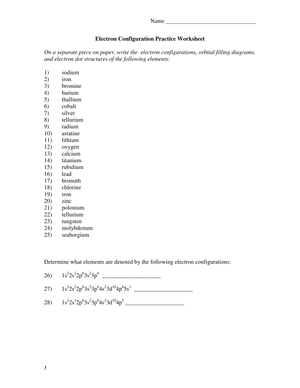
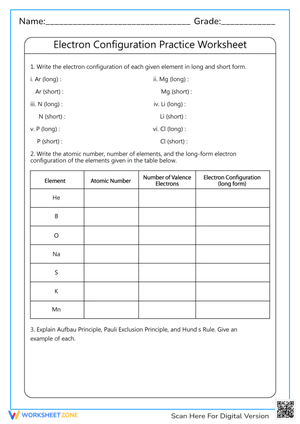
What Electron Configuration Practice Worksheets Should Cover
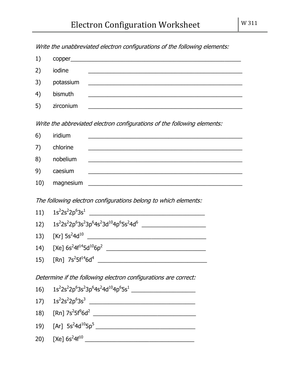
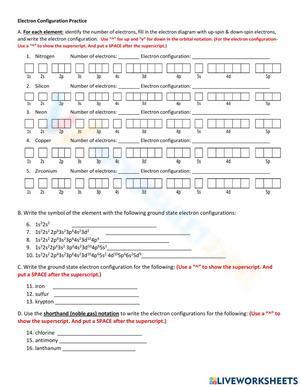
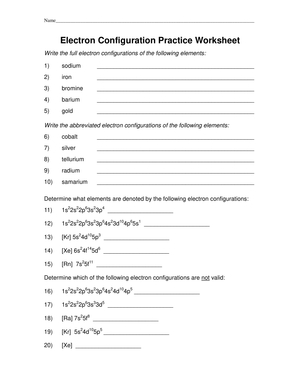
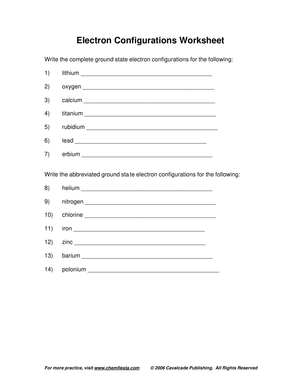
Electron configuration is one of the first places high school chemistry students hit a wall. They can recite the periodic table facts, but writing out where every electron actually sits takes repeated, structured practice. Good electron configuration practice worksheets give students that repetition without turning a full class period into a lecture. For grades 9-12, the strongest sets move students through ground-state configurations, noble gas shorthand, and orbital diagrams, then push into ion configurations once the core pattern holds.
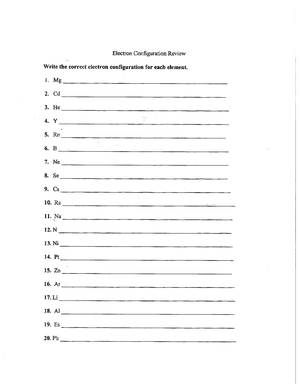
When you evaluate a worksheet set for your classroom, look for variety in element choice and in the notation being asked for. A single page of first-row elements won't stretch students who already understand the pattern, and a page that jumps straight to transition metals will lose students who are still counting sublevels. The best practice packs let you assign different rows to different students on the same day.
Repetition alone isn't the goal, though. Worksheets work best when each row nudges students toward a slightly harder case, so a student who nails sodium is then asked about a transition metal or an ion. That built-in progression is what separates a practice set that builds fluency from a page students finish on autopilot without learning anything new.
Sequencing Practice From Full Notation to Orbital Diagrams
Skill order matters more than volume here. Effective practice sequences build from full electron configuration notation, to noble gas (condensed) notation, to orbital diagrams that show Hund's rule and the Pauli exclusion principle, before students apply the pattern to ions. Skipping ahead to orbital diagrams before students are fluent with sublevel filling order almost always produces boxes filled in the wrong sequence.
Start students with full notation for elements through argon so the 1s, 2s, 2p, 3s, and 3p pattern becomes automatic. Once they can write those without a reference, introduce noble gas notation as a shortcut rather than a new rule. Students who see condensed notation as replacing the core with a bracketed noble gas retain it far better than students who memorize it as a separate skill.
Teaching the Chromium and Copper Exceptions
Once the Aufbau pattern is stable, worksheets can introduce the exceptions students will actually see named on assessments. Chromium and copper are the two most commonly taught departures from the predicted filling order.
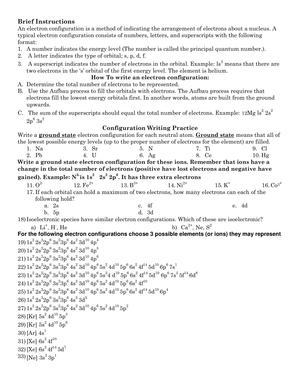
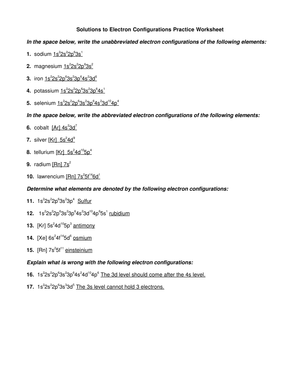
Chromium is [Ar]4s1 3d5 instead of the predicted [Ar]4s2 3d4, and copper is [Ar]4s1 3d10 instead of [Ar]4s2 3d9. In both cases an electron shifts from the 4s sublevel to the 3d sublevel because a half-filled or fully-filled d sublevel carries extra stability, as the Physics Classroom explains in its treatment of configuration exceptions. Framing both cases as the same stability rule, rather than two facts to memorize, gives students something they can reason through instead of recall cold.
Common Electron Configuration Mistakes to Watch For
Most errors on these worksheets cluster around a handful of predictable slips, and naming them for students shortens grading. The most frequent is reversing 4s and 3d, writing 3d before 4s in the filling order even though 4s fills first for neutral atoms. Close behind is miscounting p and d electrons, usually a student who writes 2p4 when the diagram clearly shows five arrows, or who forgets that a d sublevel holds ten electrons, not eight.
Orbital diagrams add their own set of errors. Students pair electrons in a single orbital before placing one in each degenerate orbital, which violates Hund's rule, or they draw two arrows pointing the same direction in one box, which breaks the Pauli exclusion principle. A worksheet that asks students to spot the error in a pre-drawn diagram, rather than only build their own, catches these habits faster because students have to articulate the rule being broken.
Using These Worksheets In Chemistry Lessons
Build a predictable weekly rhythm around the worksheets rather than assigning them as one-off homework. A workable pattern is a five-minute warm-up configuration to open class, a guided block where students complete a row together, and an independent row they finish before the bell. This keeps practice visible and gives you a live read on who is ready to move to orbital diagrams.
For small-group intervention, pull the four or five students who confuse 4s and 3d ordering and work a single worksheet row aloud, narrating each sublevel as you fill it. Reteach is faster when students hear the filling order spoken while they write it. Keep an answer key visible for self-checking so students catch reversed sublevels themselves instead of waiting for you to grade.
- Open with a one-element warm-up to check retention from the prior day.
- Assign rows by readiness, not by seating.
- Use exit tickets to decide the next day's grouping.
- Save exception elements for students who finish early.
Frequently Asked Questions
1. What order should I teach electron configuration practice in?
Move from full notation, to noble gas shorthand, to orbital diagrams, and finish with ion configurations. Students need fluency with sublevel filling order before orbital diagrams make sense, so resist jumping ahead even when a few students seem ready.
2. How do I introduce the chromium and copper exceptions?
Wait until the standard Aufbau pattern is stable, then present both as the same stability rule: an electron moves from 4s to 3d to reach a half-filled or fully-filled d sublevel. Framing them together keeps students from treating each as an isolated fact.
3. What grade or course covers electron configuration practice?
It typically lands in first-year high school chemistry, usually grades 9-12, and is revisited in honors and AP Chemistry with added depth on ions and exceptions.
4. How can I use these worksheets for formative assessment?
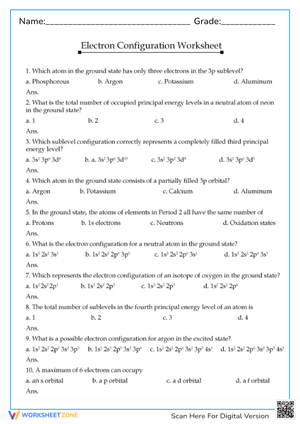
Use short warm-ups and two-question exit tickets that ask for a configuration plus a one-line explanation. They surface shielding and sublevel-order misconceptions in minutes and tell you how to group students the next day.
5. Do students need the Aufbau exceptions for the AP exam?
No. The AP Chemistry exam accepts standard Aufbau-based configurations for scoring, so treat chromium and copper as enrichment for students ready to go deeper rather than required memorization.
6. How many electron configuration worksheets do students need to reach fluency?
Most students need several short exposures rather than one long packet. Spacing five to ten configurations across several class openers works better than a single fifty-item worksheet, because retrieval practice over days locks in the filling order more durably than one marathon session.