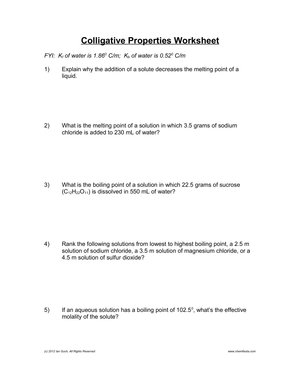
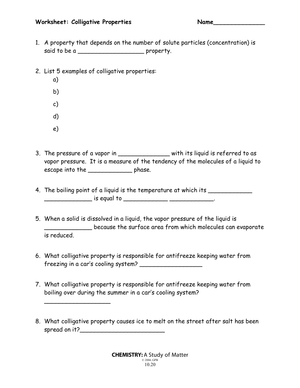
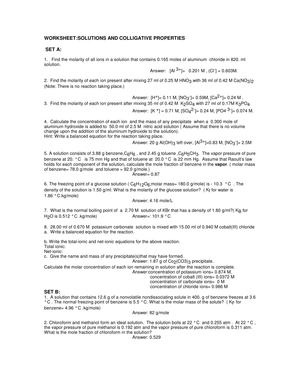
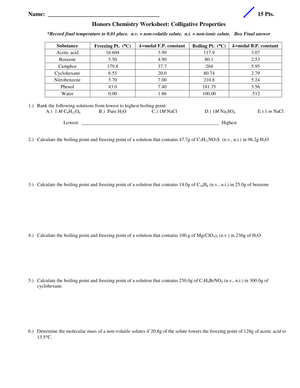
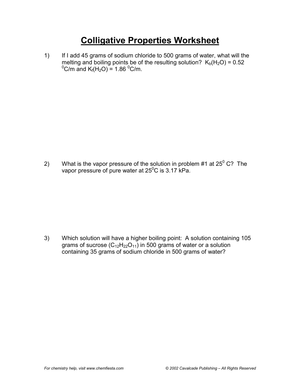
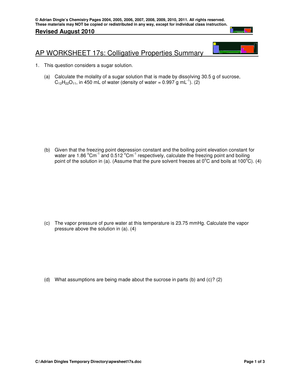
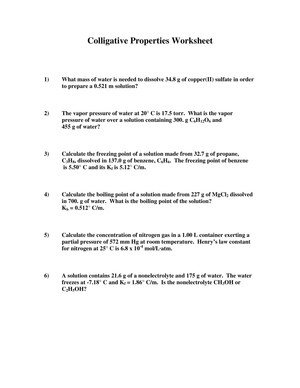
When students hit the solutions unit in chemistry, colligative properties are usually the first topic where a formula alone will not save them. They need to understand why a mole of table salt lowers the freezing point of water more than a mole of sugar does, and that requires reasoning about particles, not just plugging numbers into an equation. Colligative properties worksheets built around this particle-count logic give grades 10-12 chemistry teachers a reliable way to move students from surface-level memorization to real conceptual fluency before a lab or unit test.
What Colligative Properties Worksheets Should Cover
A solid worksheet set for this unit needs to touch all four colligative properties: boiling point elevation, freezing point depression, vapor pressure lowering, and osmotic pressure. Each of these depends only on how many solute particles are dissolved in a solvent, not on what those particles chemically are. That single idea is the throughline for the entire unit, and it is worth stating explicitly on every worksheet page rather than assuming students absorbed it from a lecture slide.
Strong worksheets sequence problems from qualitative to quantitative. Start with particle-counting tasks: given a solute formula, how many ions or molecules does it produce in solution? Then move to calculation-heavy problems using deltaTb = i x Kb x m and deltaTf = i x Kf x m, where m is molality and i is the van't Hoff factor. Saving the two-step problems, where students first find molality and then plug into the freezing or boiling point formula, for the back half of the worksheet lets you use early problems as a quick formative check.
Teaching the Van't Hoff Factor With Ionic and Covalent Solutes Side by Side
The van't Hoff factor, i, is what separates a genuinely useful colligative properties worksheet from a plug-and-chug formula sheet. Ionic solutes dissociate into multiple particles in solution, so they produce a larger colligative effect per mole than nonionic solutes at the same molality. A worksheet that pairs glucose (i equal to 1), sodium chloride (i equal to 2), and calcium chloride (i equal to 3) on the same problem set makes this concept concrete rather than abstract.
Design these comparison problems so students calculate the freezing point depression for equal molal solutions of each compound. When students see that a 0.5 molal CaCl2 solution produces roughly three times the freezing point shift of a 0.5 molal glucose solution, the van't Hoff factor stops being an abstract multiplier and becomes a predictive tool they can reason with on their own.
Connecting Worksheets to Real Classroom Contexts
Colligative properties worksheets land better when a real-world hook opens the set before the calculations start. Road salt lowering the freezing point of ice on winter streets and antifreeze protecting a car engine across both hot and cold extremes are the two most familiar entry points for US students, and both map directly onto freezing point depression and boiling point elevation without requiring any outside content.
A practical sequence: open with a short scenario question (why do road crews spread salt before a storm rather than after ice has already formed), have students predict the qualitative effect, then move into the quantitative worksheet problems that calculate the actual freezing point shift for a given salt concentration. This keeps the worksheet from feeling like an isolated math exercise disconnected from the unit's real-world relevance.
Classroom Implementation
Colligative properties worksheets work best broken into three short sessions rather than one long problem set. Session one covers particle counting and the van't Hoff factor conceptually, with no calculations. Session two introduces deltaTb and deltaTf with straightforward one-step problems using molality values already given. Session three assigns the harder two-step and reverse-calculation problems, including the molar mass determination setup, once you have seen from session two which students still confuse molarity and molality.
For differentiation, keep a set of qualitative particle-counting worksheets on hand for students who need more conceptual review, and a set of quantitative calculation worksheets with multi-step problems for honors or AP-track students who are ready to move faster. Both sets should still reference the same core equations so the whole class stays aligned to a common vocabulary heading into assessment.
Frequently Asked Questions
1. What grade level and course typically covers colligative properties worksheets?
Colligative properties are most commonly taught in grades 10-12 within a high school chemistry solutions unit, often appearing in both standard and AP or honors-level courses with differing problem complexity.
2. What is the difference between molarity and molality on these worksheets, and why does it matter?
Molarity measures moles of solute per liter of solution, while molality measures moles of solute per kilogram of solvent. Colligative property formulas require molality specifically because they depend on the fixed mass of solvent rather than a solution volume that can shift with temperature.
3. How does the van't Hoff factor change the answer for ionic compounds like NaCl or CaCl2?
The van't Hoff factor, i, represents the number of particles a solute produces in solution. Sodium chloride has an i value of 2 and calcium chloride has an i value of 3, so both produce a larger freezing point depression or boiling point elevation than a nonionic solute at the same molality.
4. What real-world examples make freezing point depression and boiling point elevation relevant to students?
Road salt lowering the freezing point of ice and antifreeze protecting a car engine across temperature extremes are two familiar examples that connect directly to the freezing point depression and boiling point elevation calculations students practice on these worksheets.
5. How can teachers use these worksheets to prepare students for a molar mass determination lab?
Assigning a reverse-calculation worksheet, where students start from a measured freezing point depression and work backward to molality, moles, and finally molar mass, gives students practice with the exact math sequence the lab will require before they have to manage lab equipment at the same time.