What Protons, Neutrons, and Electrons Practice Worksheets Ask Students to Do
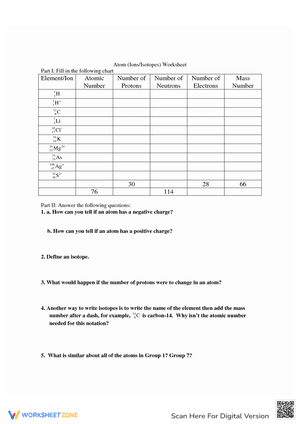
Protons neutrons and electrons practice worksheets give students a repeatable format for turning periodic table data into subatomic particle counts. A typical set lists an element or symbol, then asks students to record the atomic number, mass number, and the number of protons, neutrons, and electrons. The skill sounds small, but it's the backbone of every later chemistry unit, from bonding to nuclear change. When students can move confidently from a square on the periodic table to a full particle count, they stop guessing and start reasoning.
For a US science classroom, the value of these sheets is how flexibly they slot into a unit. You can run them as a five-minute bell-ringer, a station task, a homework check, or a quick exit ticket. Because the underlying rule set is short, you can grade a stack in a single planning period and still see exactly where each student's reasoning breaks down.
The Core Math Behind Every Problem
Three relationships drive almost every question on these worksheets. First, the atomic number equals the number of protons, and in a neutral atom it also equals the number of electrons. Second, the mass number equals protons plus neutrons, so students find neutrons by subtracting the atomic number from the mass number. Third, isotopes of one element share a proton count but differ in neutrons, which shifts the mass number.
Once students internalize those three moves, a worksheet becomes a series of small, checkable steps rather than a memory test. Atomic number gives protons and electrons; mass number minus atomic number gives neutrons. Writing that rule at the top of a page turns a blank stare into a starting point, especially for students who freeze when they see an unfamiliar element symbol.
NGSS Alignment for Atomic Structure
These worksheets map cleanly onto the modeling work that national standards expect, which helps when you're documenting alignment for a curriculum lead or a lesson observation.
The Next Generation Science Standards frame this skill through performance expectation MS-PS1-1, which asks students in grades 6-8 to develop models describing the atomic composition of simple molecules and extended structures. That standard sets the ceiling for middle school: model the particles, but save heavier isotope-and-ion arithmetic for high school HS-PS1-1 chemistry work.
Classroom Implementation
Start with a two-minute model. Project one element, think aloud through atomic number, mass number, protons, neutrons, and electrons, then hand the same structure to students. Keep the first practice set to six or eight neutral atoms so nobody stalls on setup.
From there, use the worksheets in rotation. A short version works as a bell-ringer while you take attendance. A mixed version fits a station rotation, where one group works particle counts, another sorts isotopes, and a third tackles ions. For small-group intervention, shrink the set to four problems and sit with students as they narrate each step, so you hear the reasoning instead of only seeing the answer.
- Bell-ringer: three neutral atoms, self-checked against a projected key.
- Station task: a mixed set with isotopes and ions for stronger groups.
- Exit ticket: one ion problem to check whether electron adjustment stuck.
- Intervention: four scaffolded problems with a written rule reminder at the top.
Frequently Asked Questions
1. How do I choose the right difficulty for grade 8 versus high school chemistry?
Match the worksheet to the skill you're assessing. For grade 8, stay with neutral atoms of common elements so students practice the atomic number and mass number relationship. For high school, add isotopes and ions once basic particle counting is automatic, since those problems assume students already move fluently from the periodic table to a particle count.
2. What is the fastest way to check answers during class?
Use a three-column key and scan one column at a time, or project the key for student self-checking. Ask students to circle missed rows and write a one-line reason, which shows you the misconception behind the wrong number rather than just the score.
3. Can these worksheets support both bell-ringers and small-group intervention?
Yes. A three-problem set of neutral atoms works as a bell-ringer, while a shortened four-problem version with a written rule reminder fits intervention, where you sit with students and have them narrate each step out loud.
4. What should students know before starting these worksheets?
Students need to locate an element on the periodic table and read its atomic number and mass number. Without that, particle counting stalls immediately, so a two-minute periodic table warm-up is worth the time before the first set.
5. How do isotope and ion problems differ from basic counting?
Isotope problems change the neutron count and mass number while protons stay fixed, so the element never changes. Ion problems change only the electron count to reflect charge, so protons stay the same but electrons rise or fall. Keeping protons constant is the key idea in both.