Where nitrogen cycle worksheets fit in your science unit
Students can usually name the parts of the nitrogen cycle without picturing any of it. A focused set of nitrogen cycle worksheets gives grades 6-12 teachers a way to move learners from reciting four vocabulary terms to actually tracing where a single nitrogen atom travels through air, soil, and living things. The goal here is practical: how to choose, sequence, and adapt these worksheets so they carry real instructional weight in life science, biology, or environmental science rather than sitting in a folder as busywork.
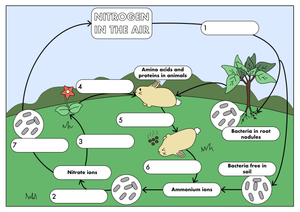
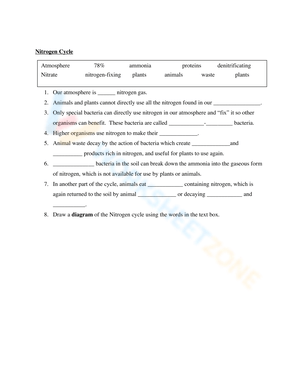
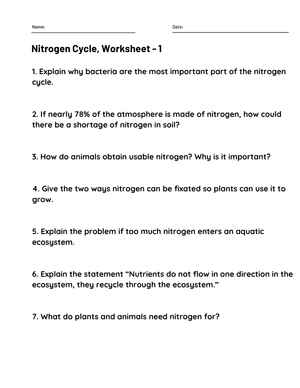
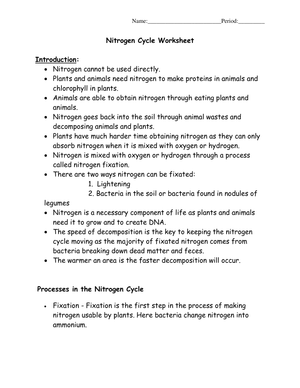
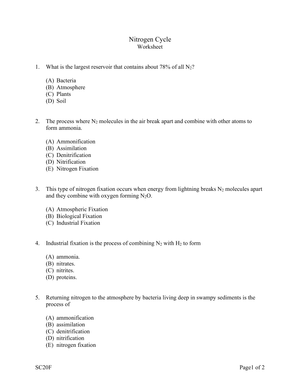
Most classroom sets combine three parts: a labeled diagram, a fill-in-the-blank vocabulary page, and a short-answer or modeling task. Used together, they let you check whether students grasp the cycle as a connected system instead of a list of isolated steps. That system view is exactly what you need when you tie the lesson to matter cycling in ecosystems, and it is the difference between a worksheet that reinforces memorization and one that builds understanding.
The four processes students label on every worksheet
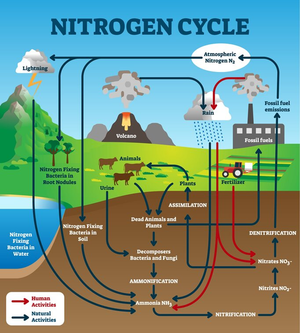
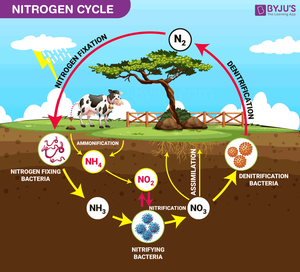
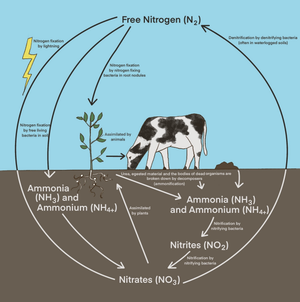
Nearly every nitrogen cycle worksheet is built around four core processes, and students should be able to define and locate each one on a diagram:
- Nitrogen fixation: converting atmospheric N2 gas into ammonia (NH3) that organisms can use.
- Nitrification: bacteria converting ammonia into nitrites and then into nitrates.
- Ammonification: decomposers breaking down waste and dead tissue back into ammonia.
- Denitrification: bacteria returning nitrates to the atmosphere as N2 gas.
The sticking point for most students is the starting problem. Nitrogen gas makes up about 78% of the air we breathe, yet almost no organism can use it in that form. Worksheets that open with that contrast give students a reason the cycle exists at all, instead of treating fixation as an arbitrary first box. Once students feel that tension, the rest of the diagram reads as a set of solutions to a real problem.
Classroom Implementation
Worksheets work best as one stop in a sequence, not the whole lesson. A reliable arc looks like this:
- Open with the 78% problem so students feel the puzzle before naming any steps.
- Use a labeling worksheet to establish the four processes and their vocabulary.
- Run a movement activity, then return to a short-answer worksheet for explanation.
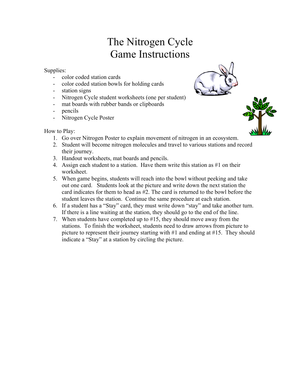
The token or role-play simulation is worth the class time. In activities like the UCAR Center for Science Education nitrogen cycle game, students become nitrogen atoms and physically move between stations representing the atmosphere, soil, plants, and animals. Coming back to a worksheet right after gives them language for the path they just walked, and their labeled diagrams tend to be far more accurate. For formative assessment, collect the post-activity worksheet and scan for one thing: can each student explain a transfer, not just name it?
Connecting worksheets to human impact and environmental science
The nitrogen cycle stops feeling abstract when students connect it to farms, food, and water. Synthetic fertilizer adds usable nitrogen to soil on purpose, which boosts crop yields but also sends excess nitrogen into streams and coastal waters through runoff. Worksheets that add a data-analysis or short-response question about fertilizer use let students apply the same four processes to a problem they can read about in the news.
This framing also gives environmental science classes a natural bridge to human systems. Ask students to trace how nitrogen from a fertilizer bag ends up in a river, and they have to reason across fixation, plant uptake, and denitrification in one connected explanation. That is a higher bar than labeling a diagram, and it rewards the system thinking your best worksheets were building toward.
Frequently asked questions
1. What grade levels are nitrogen cycle worksheets appropriate for?
They fit grades 6-12. Middle school life science classes use them to identify and sequence the four processes, while high school biology and environmental science classes use them for deeper chemical and data-based analysis.
2. How should teachers adapt worksheets for different learning needs?
For students who struggle with abstract concepts, anchor everything in the legume example or another concrete context. For advanced learners, ask them to trace how nitrogen from fertilizer moves through the full cycle and impacts water systems. Pairing worksheets with movement activities where students physically represent nitrogen atoms can also help all learners.
3. What are the four main processes students should learn?
Nitrogen fixation, nitrification, ammonification, and denitrification. Students should be able to define each one and locate it on a cycle diagram.
4. How can teachers pair worksheets with hands-on activities?
Run a movement or role-play simulation where students trace a nitrogen atom's path between the atmosphere, soil, plants, and animals, then return to a labeling or short-answer worksheet so students put the path into their own words. Games like the UCAR nitrogen cycle simulation are especially effective.
5. Why can't most organisms use atmospheric nitrogen directly?
Atmospheric nitrogen exists as N2, a molecule held together by a strong triple bond that most organisms cannot break. It has to be fixed into ammonia by bacteria or lightning before plants and animals can take it up.