


























Views
Downloads




Ready Periodic Trends Check Worksheet | Grade 11 Chemistry
Paste this activity's link or code into your existing LMS (Google Classroom, Canvas, Teams, Schoology, Moodle, etc.).
Students can open and work on the activity right away, with no student login required.
You'll still be able to track student progress and results from your teacher account.
This worksheet helps Grade 11 chemistry students explain and predict periodic trends in atomic radius, first ionization energy, and electronegativity. Students use data tables and electron-shell reasoning to justify each answer with evidence, moving from recognizing a trend to testing a claim against numbers.
At a Glance
- Grade: 11 · Subject: Chemistry
- Standard: Unit-level practice — students explain periodic trends from table data using shell reasoning.
- Skill Focus: Periodic trends in atomic radius, ionization energy, and electronegativity
- Format: 6 pages · 12 problems · Answer key included · PDF
- Best For: Unit review and formative checks
- Time: 40–50 minutes
What's Inside
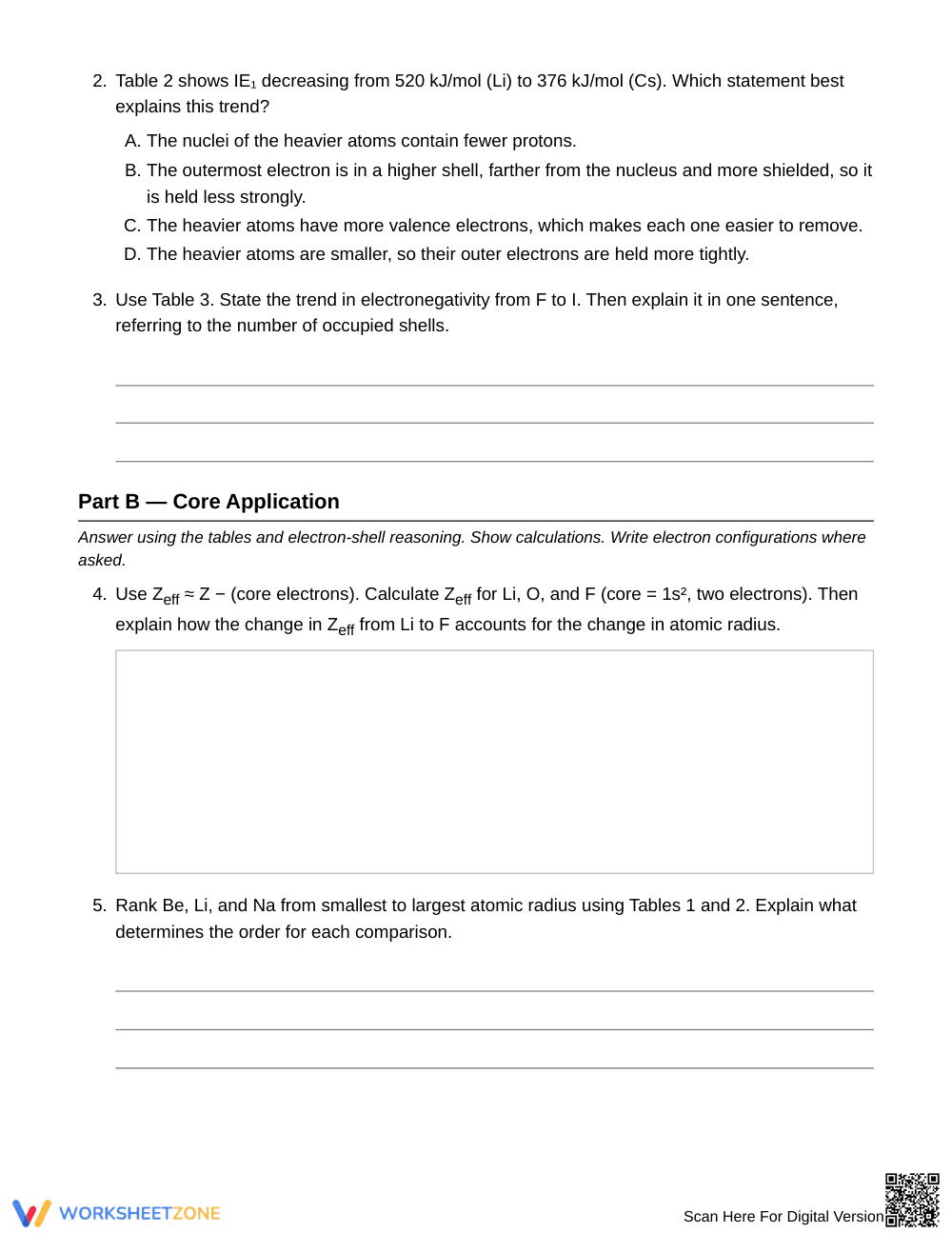
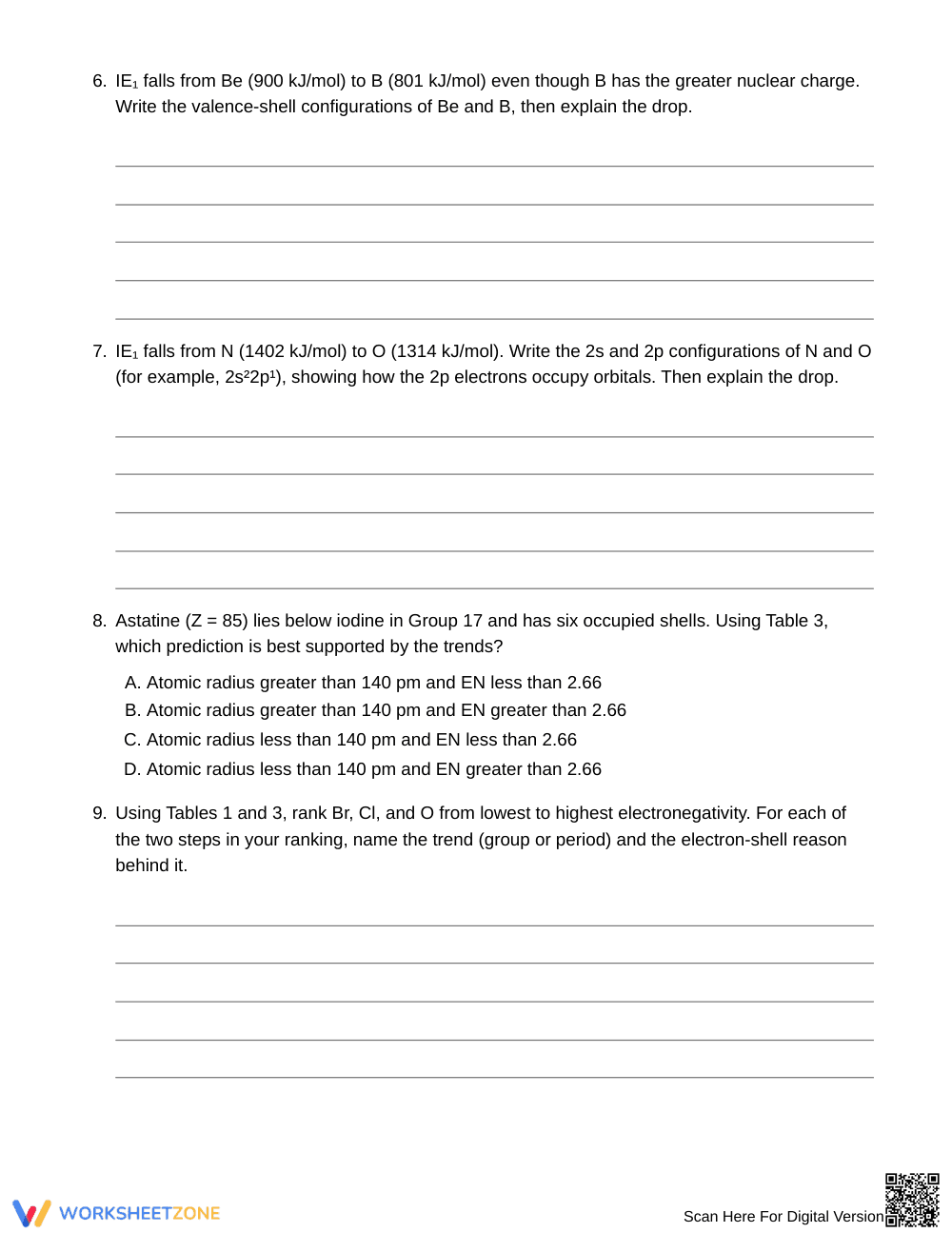
Six pages open with a reference box defining atomic radius, IE₁, electronegativity, and a simplified Zeff model, followed by three data tables for Period 2, Group 1, and Group 17. Part A has 3 foundation items, Part B has 6 core application items with calculations and electron configurations, and Part C has 3 evidence-based challenges using synthetic data. A 3-page answer key is included.
Skill Progression
- Guided practice (Part A, 3 items): Two multiple-choice questions and one short response, with trend explanations anchored to the data tables.
- Supported practice (Part B, 6 items): Zeff calculations, rankings, and electron configurations, with the reference box as a scaffold.
- Independent practice (Part C, 3 items): Students evaluate incorrect claims and read successive ionization energies, citing specific numbers.
The sequence follows a gradual-release model: I Do, We Do, You Do.
Standards Alignment
No standard code was supplied for this worksheet, so none is listed here. The tasks fit high school chemistry expectations: use the periodic table and electron structure to explain and predict trends in atomic radius, ionization energy, and electronegativity. Teachers can add their local or state standard code to lesson plans, IEP goals, or district curriculum mapping tools.
How to Use It
- After direct instruction: Assign it as a unit review or quiz preparation in class or as homework.
- During instruction: Have pairs complete Part A and Part B, then discuss Part C as a class.
As students work, watch whether they cite Zeff and shell count or fall back on vague statements such as "atoms get bigger." Expect 40–50 minutes.
Who It's For
Grade 11 chemistry students in a periodic trends unit, including general and college-prep classes. Struggling students can lean on the reference box and Part A, while stronger students can focus on Part C. It pairs well with a periodic table anchor chart or a lesson on electron configurations.
The Periodic-Trends Check is a Grade 11 chemistry worksheet that teaches students to explain how atomic radius, first ionization energy, and electronegativity change across periods and down groups. Its 12 tasks use five data tables, a simplified effective nuclear charge model, and electron-configuration writing to connect each trend to shell structure. Students evaluate two incorrect claims against evidence, including synthetic data for placeholder elements, and interpret successive ionization energies to find valence electron counts. The sequence follows the gradual release of responsibility framework described by Fisher & Frey (2014), moving from selected-response and short answers to multi-step reasoning and evidence-based argument. The set takes about 40 to 50 minutes, fits six pages, and comes with a three-page answer key. It suits unit review, quiz preparation, and formative checks where teachers need to see student reasoning, not only final answers.


