


























Views
Downloads



Printable Atomic Attraction Worksheet | Grade 11 Chemistry
Paste this activity's link or code into your existing LMS (Google Classroom, Canvas, Teams, Schoology, Moodle, etc.).
Students can open and work on the activity right away, with no student login required.
You'll still be able to track student progress and results from your teacher account.
This worksheet teaches Grade 11 chemistry students to compare two explanatory models of atomic attraction, nuclear charge versus core charge with distance, and to judge which model the periodic data support. Students predict, calculate, and evaluate evidence, then critique an overreaching claim.
At a Glance
- Grade: 11 · Subject: Chemistry
- Standard: Use periodic trend data to compare and evaluate two competing explanatory models
- Skill Focus: Comparing explanatory models of atomic attraction
- Format: 5 pages · 10 problems · Answer key included · PDF
- Best For: Periodic trends model-evaluation practice
- Time: 40–50 minutes
What's Inside
The 5-page worksheet opens with a two-model reference box and stated assumptions. Students then work through prediction questions, three synthetic data tables (Period 3, Group 1, Period 2), multiple-choice items, calculations, an evidence-sorting table, and a written evaluation. A 3-page answer key is included.
Skill Progression
- Guided practice (Part A, 2 tasks): Students predict with each model before seeing any data, using the reference box as support.
- Supported practice (Part B, 6 tasks): Students use the tables to choose controlled comparisons, calculate ratios and Q values, and evaluate evidence.
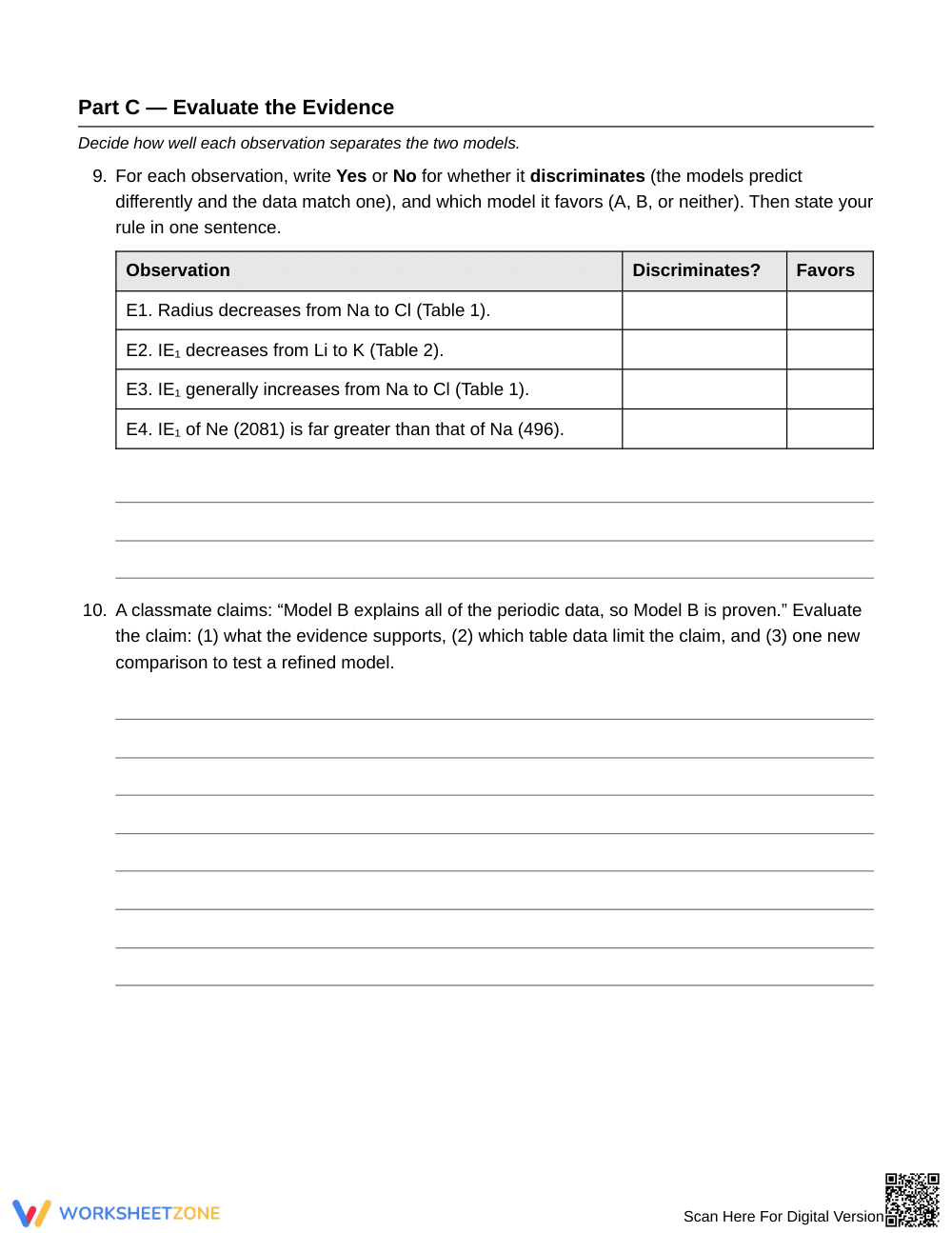
- Independent practice (Part C, 2 tasks): Students decide which observations discriminate between models and critique a “proven” claim.
The sequence follows gradual release: I do, we do, you do.
Standards Alignment
No standard code was supplied for this worksheet. The tasks align with high school chemistry expectations for using the periodic table to explain trends in atomic radius and ionization energy, and for evaluating models against evidence. Add your own state or district code when mapping it into lesson plans, IEP goals, or curriculum tools.
How to Use It
- After direct instruction: Assign Parts A and B as a check on core charge and shielding.
- Before a unit test: Use Part C as a short argumentation review.
Formative tip: while students work, listen for whether they separate “both models predict this” from “the data favor one model.” Expect 40–50 minutes.
Who It's For
Grade 11 chemistry students who have met ionization energy and atomic radius. Students needing support can work Part A in pairs with the reference box. Pair it with a periodic trends anchor chart or a short lesson on shielding.
The Grade 11 Chemistry worksheet Comparing Models of Atomic Attraction asks students to evaluate two explanations for periodic trends in radius and first ionization energy: Model A, which uses nuclear charge alone, and Model B, which uses core charge and shell distance. Across 10 tasks, students predict outcomes, compute a core charge divided by radius squared ratio for Group 1, compare observed and predicted ionization energy ratios, and decide which observations actually discriminate between the models. The final task requires them to critique the claim that a model is proven. This model-evaluation approach reflects Fisher & Frey (2014), whose gradual release framework moves learners from guided prediction to independent argument. The 5-page worksheet comes with a 3-page answer key containing worked values, making it suitable for assessing scientific reasoning in a periodic trends unit.


