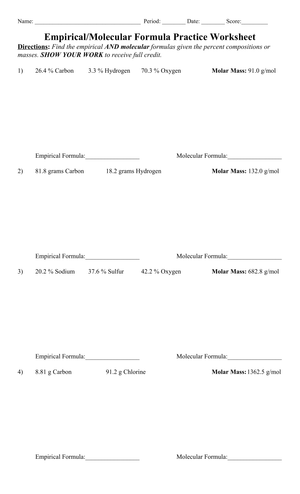
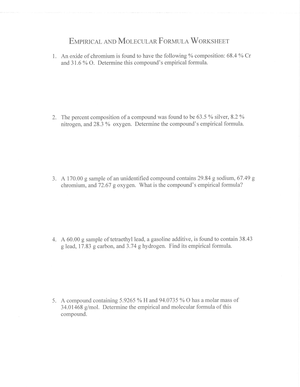
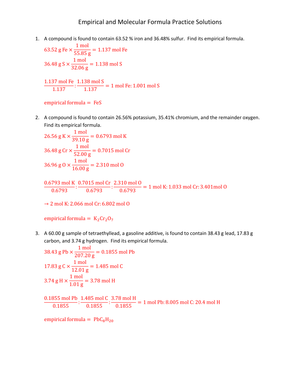
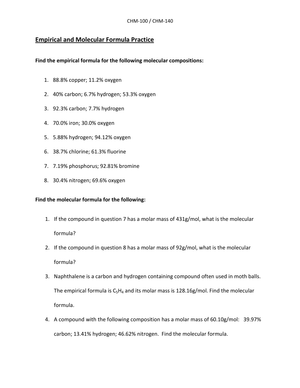
Students need molar mass fluency and comfort with percent composition before this practice is useful. If either skill is shaky, a formula worksheet becomes a mole-ratio worksheet in disguise, and the intended formula-writing goal gets lost. Sequencing practice right after those two skills keeps the cognitive load focused on the new step: converting moles of each element into the smallest whole-number ratio.
Worksheets built around this transition point work well as a bridge activity. Students are not learning something entirely new; they are applying two already-practiced skills (molar mass, percent composition) toward a new outcome (a formula). That makes this an efficient reteach opportunity too, since a struggling student usually needs to shore up one specific link in the chain rather than relearn the whole unit.
Connecting Practice to NGSS HS-PS1-7
Empirical and molecular formula work is grounded in NGSS standard HS-PS1-7, which centers on using mathematical representations to show that mass is conserved during chemical processes, with the mole serving as the conversion between atomic and macroscopic scale. Framing formula practice this way helps teachers explain to students, and to administrators reviewing lesson plans, why this calculation matters beyond a single test question: it is the mathematical proof that atoms recombine in fixed ratios without gaining or losing mass.
A useful framing for students is that every empirical formula problem is really a mass-conservation argument in miniature: the percent composition data implicitly claims that a fixed number of grams of each element combines in a fixed ratio, and the mole conversion is what turns that claim into a checkable, whole-number answer.
Classroom Implementation
A practical sequence for using empirical and molecular formula worksheets looks like this: assign a short percent-composition-only checkpoint first, review common ratio errors as a whole class, then move to full empirical-to-molecular formula problems. Save one or two of the more complex combined problems for a bell-ringer or exit ticket a day or two later, once initial confusion has been addressed.
For small-group intervention after a stoichiometry unit test, pull students by error type rather than by overall score. A student who missed the mole-ratio step needs a different five-minute reteach than one who mixed up empirical formula mass and molar mass, even if both got the same problem wrong on the test.
Frequently Asked Questions
1. What grade level typically covers empirical and molecular formula calculations?
This topic is most commonly taught in grades 10-12 chemistry courses, including honors and AP Chemistry sections, after students have already learned molar mass and percent composition.
2. How do empirical formula worksheets connect to NGSS HS-PS1-7?
NGSS HS-PS1-7 focuses on using mathematical representations to show that mass is conserved during chemical processes, using the mole to convert between atomic and macroscopic scale, which is exactly the reasoning empirical and molecular formula problems require.
3. What prerequisite skills should students have before starting empirical/molecular formula practice?
Students should already be comfortable calculating molar mass and working with percent composition data before attempting empirical or molecular formula problems.
4. How can teachers use these worksheets for review before a stoichiometry unit test?
Assign a percent-composition-only checkpoint first, then use full formula problems as guided practice, saving one or two combined empirical-to-molecular questions as a final check on understanding.
5. What are common student errors on empirical and molecular formula problems?
The two most frequent errors are rounding mole ratios incorrectly instead of scaling the whole ratio, and confusing empirical formula mass with molar mass when calculating the multiplier for a molecular formula.