


























Views
Downloads



Printable Shielding & Zeff Worksheet | Grade 11 Chemistry
Paste this activity's link or code into your existing LMS (Google Classroom, Canvas, Teams, Schoology, Moodle, etc.).
Students can open and work on the activity right away, with no student login required.
You'll still be able to track student progress and results from your teacher account.
This Grade 11 chemistry worksheet teaches students to explain periodic trends using shielding and effective nuclear charge. Students calculate simplified Zeff, read real ionization energy and radius data, and justify predictions with shells, subshells, and electron repulsion, moving from concept distinctions to independent reasoning in 12 tasks.
At a Glance
- Grade: 11 · Subject: Chemistry
- Standard: Periodic trends — explain how nuclear charge, shielding, and shells control radius and ionization energy
- Skill Focus: Shielding and effective nuclear attraction
- Format: 5 pages · 12 problems · Answer key included · PDF
- Best For: Periodic trends unit practice and review
- Time: 40–50 minutes
What's Inside
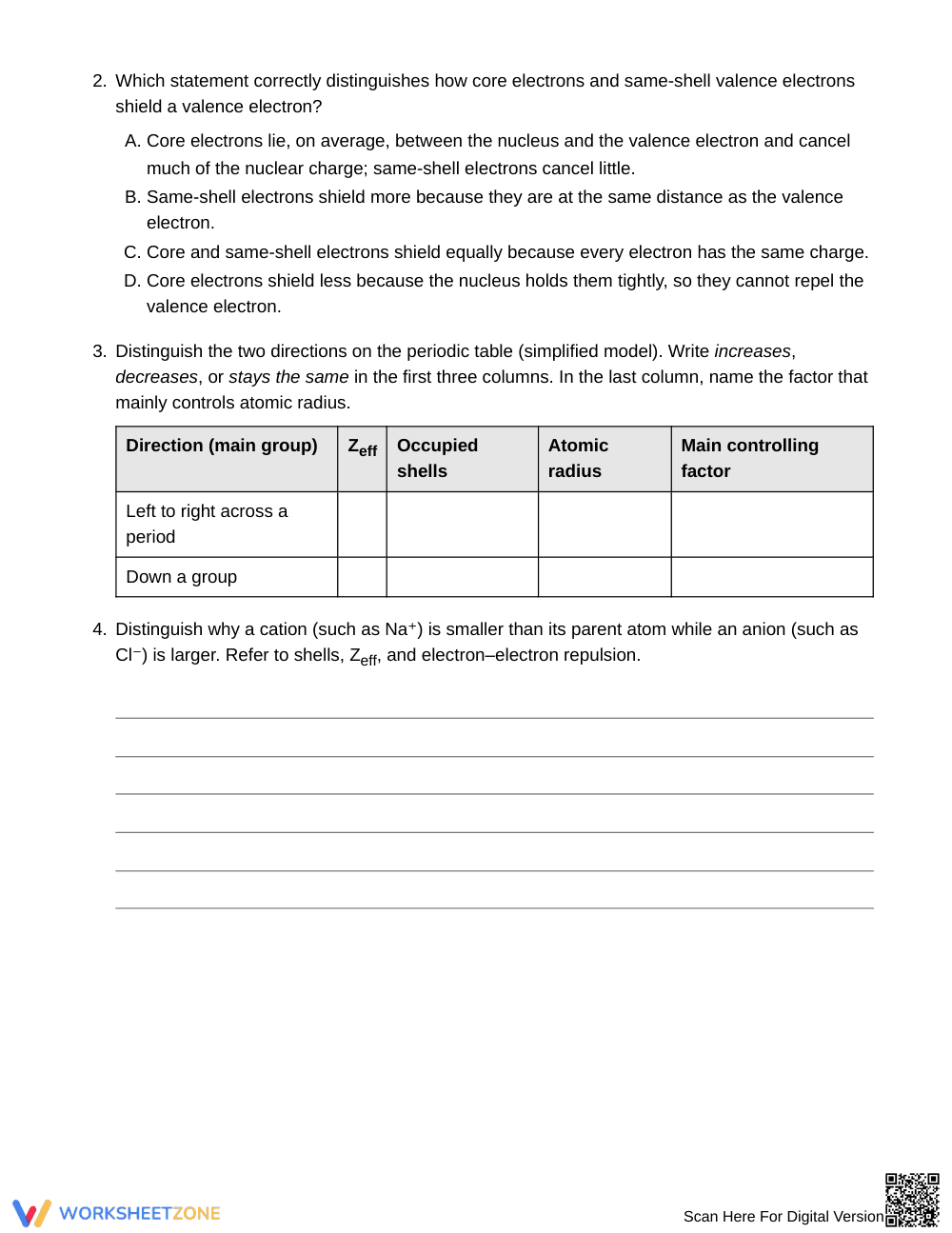
The 5-page PDF opens with a Key Ideas box defining Zeff = Z − S, the simplified core-electron model, first ionization energy, and subshell repulsion. Three parts follow: a multiple-choice item, a fill-in comparison table, short explanations, calculations, and two justified predictions. Period 3, Group 1, and ion radius tables supply real values. A 3-page answer key covers all 12 tasks.
Skill Progression
- Guided practice (Part A, 4 tasks): Concept distinctions between Z and Zeff, core and same-shell shielding, trends across a period and down a group, and cation versus anion size. A choice item and table reduce the writing load.
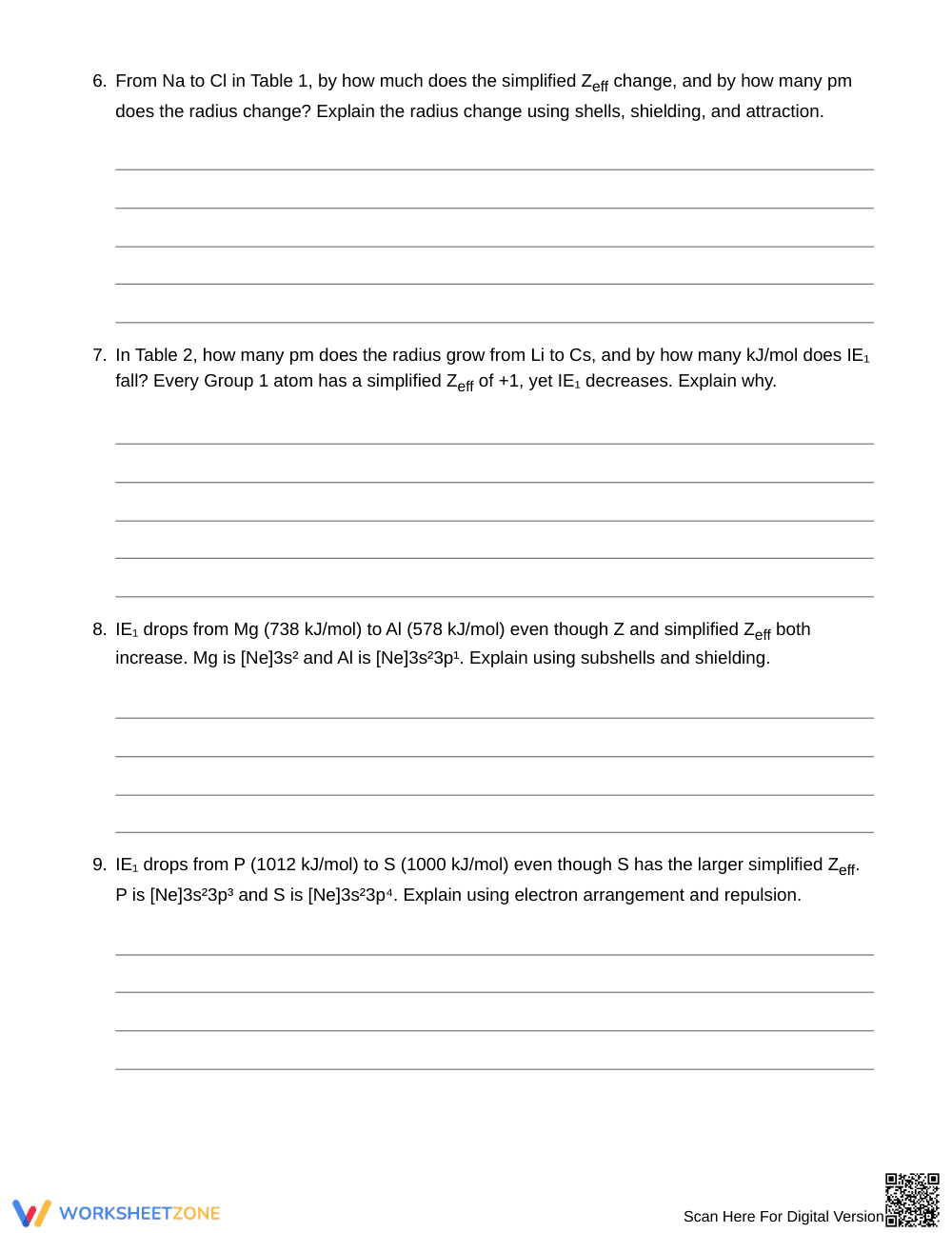
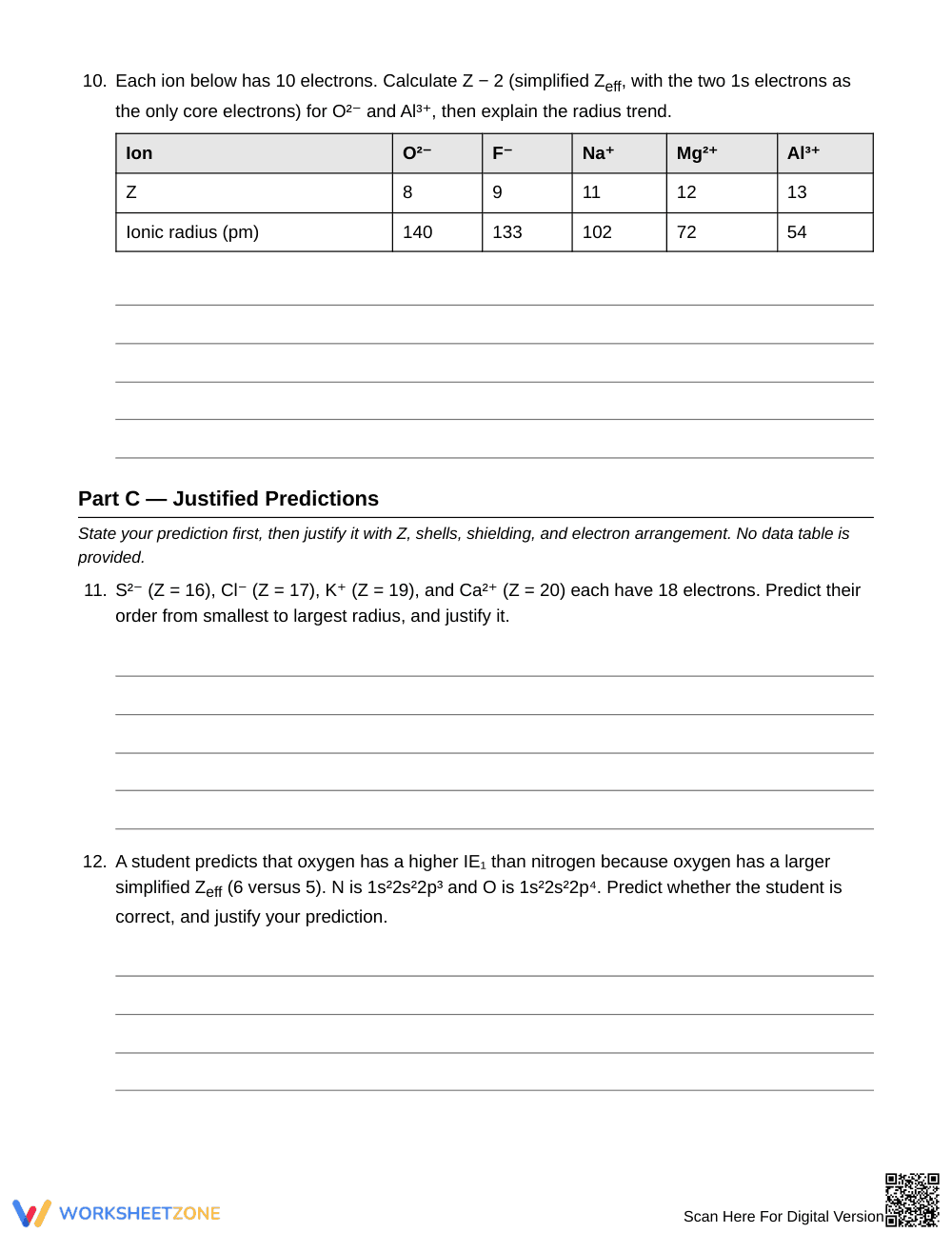
- Supported practice (Part B, 6 tasks): Calculations and explanations from data tables, including the Mg–Al and P–S ionization energy dips and a 10-electron ion series.
- Independent practice (Part C, 2 tasks): Predictions with no data table, including an isoelectronic radius order and an evaluation of a student's claim about N and O.
The sequence follows gradual release: I Do, We Do, You Do.
Standards Alignment
No standard code was supplied for this worksheet. The content aligns with high school chemistry expectations that students use nuclear charge, electron shielding, and electron arrangement to explain periodic trends in atomic radius, ionic radius, and ionization energy.
How to Use It
- After direct instruction: Assign Parts A and B as classwork or homework once students have seen the Zeff model.
- Unit review: Use Part C as a stand-alone check before a quiz.
Formative tip: while students work, listen for explanations that cite distance or shells without mentioning shielding, or that attribute ionization energy drops to Zeff alone. Plan for 40–50 minutes for all 12 tasks.
Who It's For
Grade 11 chemistry students in a periodic trends unit, including honors and general classes. Students who need support can start with Part A and the Key Ideas box, while stronger students can focus on Part C. Pair it with a periodic table and an anchor chart on electron configurations.
The Grade 11 Chemistry worksheet Shielding and Effective Nuclear Attraction trains students to explain periodic trends with the relationship Zeff = Z − S. Across 12 tasks, students distinguish nuclear charge from effective nuclear charge, calculate simplified Zeff from core electron counts, interpret real first ionization energy and radius data for Period 3 and Group 1, and justify predictions for isoelectronic ions and the N/O exception. The structure follows the gradual release model described by Fisher & Frey (2014), which moves learners from teacher-supported work toward independent application. Because nearly every task requires an explanation in terms of shells, shielding, and attraction, the worksheet shows whether students reason from mechanism rather than memorize trends. A 5-page PDF with a 3-page answer key supports quick checking in high school chemistry classrooms. Teachers can use it as a unit review or a formative check.


