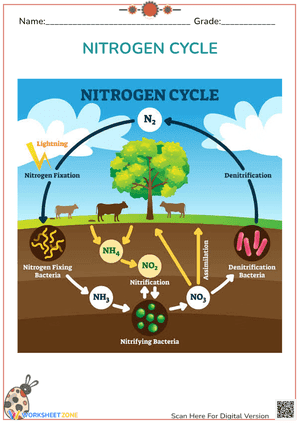
Middle school science teachers are usually looking for one thing when they search out biogeochemical cycles worksheets: a way to make an abstract, systems-level concept concrete for eleven- to fourteen-year-olds. Matter moving between the atmosphere, geosphere, hydrosphere, and biosphere is not something students can watch happen in real time, so a well-built worksheet set becomes the bridge between a diagram on the board and a model students can actually explain in their own words.
These worksheets are most useful when they are treated as a connected unit rather than four unrelated handouts. Grouping the carbon, nitrogen, water, and phosphorus cycles together lets students compare how each cycle moves through reservoirs, which reservoirs overlap, and where human activity speeds up or slows down a natural process.
Sequencing the Unit: Carbon, Nitrogen, Water, and Phosphorus Cycles
A logical worksheet sequence usually starts with the water cycle, since most sixth graders already have some exposure to evaporation and condensation from elementary school. From there, the carbon cycle worksheets can introduce photosynthesis, cellular respiration, combustion, and decomposition as the four main processes moving carbon between reservoirs. Nitrogen cycle worksheets come next, since they require students to understand nitrogen fixation and denitrification, which depend on bacteria rather than physical processes alone. Phosphorus cycle worksheets typically come last because phosphorus moves almost entirely through rock weathering and runoff rather than through the atmosphere, which is a useful contrast for students to notice.
- Water cycle: evaporation, condensation, precipitation, collection
- Carbon cycle: photosynthesis, respiration, combustion, decomposition
- Nitrogen cycle: fixation, nitrification, denitrification, uptake
- Phosphorus cycle: weathering, absorption, runoff, sedimentation
Aligning Biogeochemical Cycles Worksheets to NGSS MS-LS2-3
NGSS middle school standard MS-LS2-3 asks students to develop a model that describes the cycling of matter and the flow of energy among living and nonliving parts of an ecosystem. Worksheets that only ask students to label a diagram will not fully meet this standard on their own; they need to be paired with a short constructed-response section where students explain the model in writing, tracing one atom or molecule through at least three steps of a cycle.
One practical way to check for MS-LS2-3 alignment is to look at whether a worksheet asks students to describe cycling across all four Earth systems, not just one. A carbon cycle worksheet that only covers plants and animals is missing the geosphere and hydrosphere connections the standard expects, so teachers should scan for at least one question that asks students to identify a nonliving reservoir, such as limestone rock or ocean water, alongside the living components.
According to Kesler Science, cycling of Earth materials activities for middle school are built specifically around helping students model interactions between the geosphere, biosphere, atmosphere, and hydrosphere, which is the same systems-thinking goal that MS-LS2-3 requires for biogeochemical cycles instruction in grades 6 through 8.
Diagram Labeling and Reading Comprehension Formats That Support All Learners
Diagram labeling with a word bank remains one of the most reliable worksheet formats for this unit, especially for multilingual learners and students who read below grade level. A labeled diagram lets a student demonstrate understanding of the cycle's structure even if they are still building the vocabulary to write a full explanation. Reading comprehension passages that accompany the diagrams give teachers a second data point on whether a student understands the process itself, not just the visual layout.
Vocabulary-focused worksheets that isolate terms like reservoir, flux, fixation, and decomposition before students tackle a full cycle diagram tend to reduce confusion later in the unit. Introducing five or six key terms per cycle, rather than all twenty terms across all four cycles at once, keeps the cognitive load manageable for a 45-minute class period.
Classroom Implementation
In practice, a four-day rotation works well for most middle school classrooms: one day per cycle, with the final class period reserved for a synthesis activity that asks students to compare all four cycles side by side. A passport or tracking-sheet activity, where students follow a single carbon atom or nitrogen molecule through several stations, gives kinesthetic learners a physical version of the same content covered in the printed worksheets.
Small-group intervention groups benefit from a simplified version of the same worksheet that removes one or two reservoirs, letting struggling readers focus on the core cycle before adding complexity. Keeping the worksheet structure consistent across all four cycles, so the layout and question types do not change from carbon to nitrogen to phosphorus, reduces the amount of new instruction needed just to explain the format itself.
Frequently Asked Questions
1. What grade level is best suited for biogeochemical cycles worksheets?
Most biogeochemical cycles worksheets are built for grades 6 through 8, matching the life science and earth science standards taught at that level, though early high school life science classes often reuse the same worksheets as a review unit.
2. How do biogeochemical cycles worksheets align with NGSS MS-LS2-3?
They align by requiring students to model how matter cycles among living and nonliving parts of an ecosystem, so the strongest worksheets combine diagram labeling with a written explanation rather than labeling alone.
3. What is the difference between teaching the carbon cycle and the nitrogen cycle in a worksheet unit?
Carbon cycle worksheets focus on photosynthesis, respiration, combustion, and decomposition, while nitrogen cycle worksheets require students to understand bacteria-driven processes like fixation and denitrification, which tends to be conceptually harder for students.
4. How can teachers use these worksheets for review versus assessment?
Short, single-cycle worksheets work best as formative checks during the unit, while a combined worksheet covering all four cycles works better as a summative review closer to the unit test.
5. How should teachers incorporate human impact topics into a biogeochemical cycles lesson?
Add at least one analysis question per cycle worksheet that connects a human activity, such as fossil fuel combustion or fertilizer runoff, to a measurable change in the cycle, which keeps the human impact requirement from feeling like an afterthought.