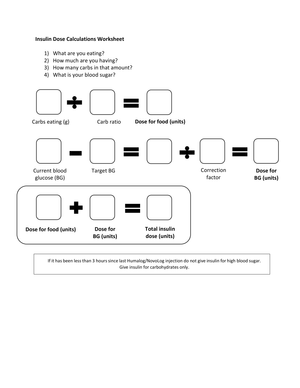
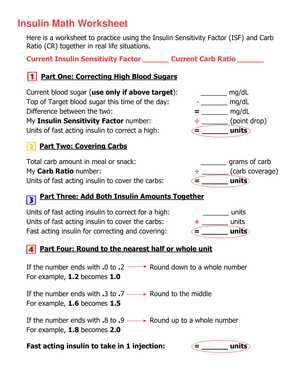
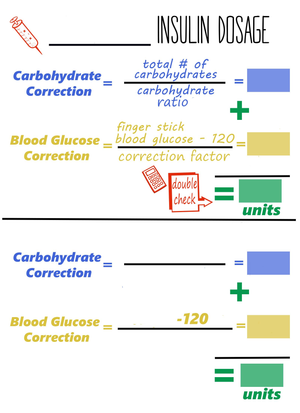
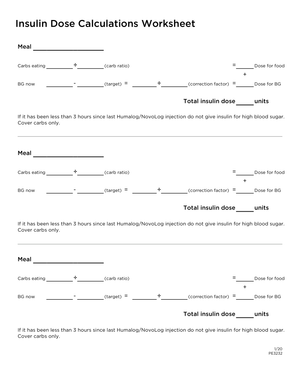
Students with type 1 diabetes rely on accurate mealtime insulin dosing every school day, and the adults supporting them need to be fluent in the math behind that dosing. An insulin-to-carb ratio worksheet set gives school nurses, health science instructors, and paraprofessionals repeated, low-stakes practice with the calculations that carry real consequences when they happen at a lunch table instead of on paper. These worksheets are not a substitute for medical training or an individualized health plan, but they are a strong way to build number fluency before staff apply it in a live setting.
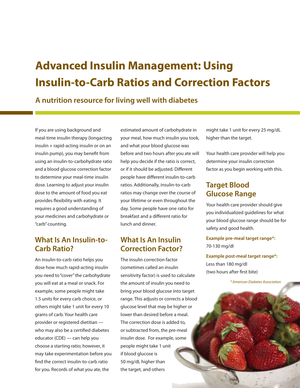
An insulin-to-carb ratio, often written as 1:10, states how many grams of carbohydrate one unit of rapid-acting insulin is expected to cover. That single ratio is the foundation for every dosing calculation a student, family, or trained staff member will do at mealtime, which is exactly why repeated worksheet practice matters for anyone supporting a student with diabetes in a school setting.
The Core Dosing Formula Students and Staff Must Master
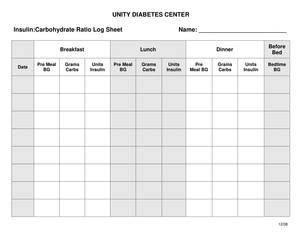
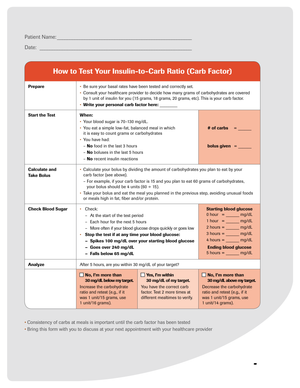
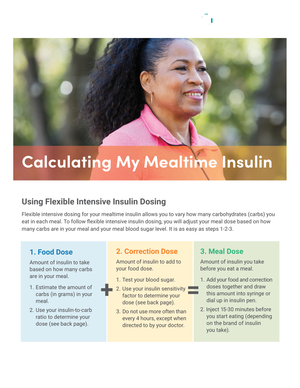
The formula at the center of every worksheet in this set is simple to state but easy to get wrong under time pressure: insulin units needed equal total meal carbohydrates in grams divided by the ICR denominator. A worksheet built around this formula should walk learners from single-step problems toward multi-step ones that mirror an actual school lunch tray, where a student might be eating a sandwich, a fruit cup, and milk, each contributing carbohydrate grams that must be totaled before the division step.
A useful worksheet progression starts with clean numbers, then introduces trays with several food items and slightly awkward totals, so learners get used to adding carb grams from multiple sources before applying the ratio. This mirrors what actually happens in a cafeteria line, where a single food item rarely accounts for the whole carbohydrate count a student needs entered into their dosing plan.
The Rule of 500 as a Teaching Model
The Rule of 500 is commonly used as a starting-point method for estimating an insulin-to-carb ratio: divide 500 by a person's total daily insulin dose, combining both basal and bolus amounts, to get an approximate ICR denominator. This is a valuable inclusion in a health science or nursing pathway course because it shows learners where the ratio number actually comes from, rather than treating 1:10 or 1:15 as an arbitrary figure handed down without explanation.
One unit of rapid-acting insulin typically covers 12 to 15 grams of carbohydrate for many people, though individual sensitivity can push that range from roughly 4 to 30 grams per unit. A worksheet section built around this range gives students in a health science or CTE nursing pathway a concrete way to see why no single ratio applies to every person, and why the number on a student's care plan should never be assumed or estimated by classroom staff.
Classroom Implementation
Health science and CTE nursing pathway teachers can sequence these worksheets across a unit: start with the core division formula, move to multi-item lunch trays, then introduce the Rule of 500 as a way to explain where individualized ratios originate. Each worksheet should end with a short reflection prompt asking students to identify what additional information they would need before applying a calculation to a real person, reinforcing that classroom math is separate from an individualized medical order.
For special education or paraprofessional training contexts, break the worksheet sequence into smaller chunks with more repetition at each step. Staff who are new to carb counting benefit from seeing the same formula applied to five or six different trays before ratios or rounding rules are varied, since consistency at the start builds the confidence needed for accuracy later. Pair worksheet practice with a simple carbohydrate reference sheet so learners are not guessing at food values while they are still learning the division step.
Frequently Asked Questions
1. How can teachers use insulin-to-carb ratio worksheets without giving medical advice themselves?
Teachers can present the worksheets strictly as math and health science practice using fictional student scenarios, keeping any real student's actual insulin dosing decisions with the school nurse and the student's care team.
2. What grade level or course typically covers insulin-to-carb ratio math?
This content generally fits high school health science, CTE nursing pathway, or allied health courses, as well as professional development for school nurses and trained paraprofessionals supporting students with type 1 diabetes.
3. How does the Rule of 500 relate to the practice problems on these worksheets?
The Rule of 500 shows learners how an individualized insulin-to-carb ratio is estimated in the first place, by dividing 500 by a person's total daily insulin dose, which gives context for why the ratio numbers used in practice problems vary from person to person.
4. Who should be trained to use these worksheets in a school setting?
School nurses, health science and CTE instructors, and trained paraprofessionals are the primary audience, since they are the staff expected to understand carb counting and dosing math as part of supporting students with diabetes during the school day.