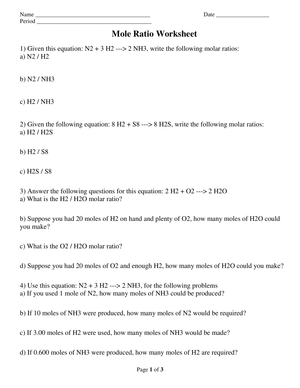
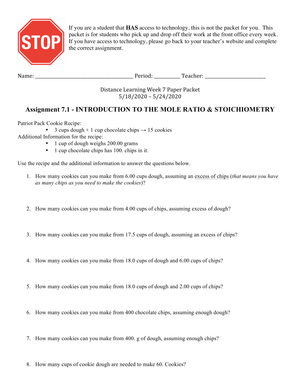
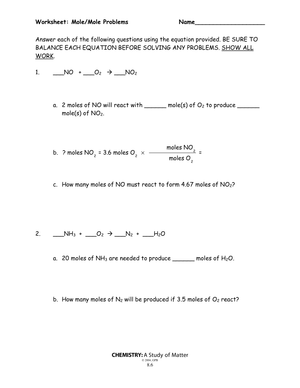
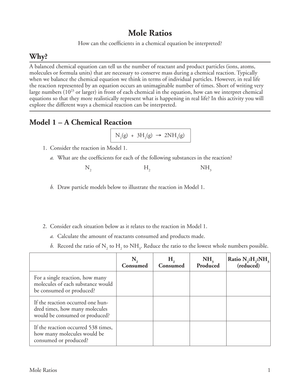
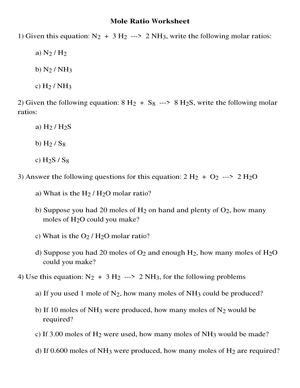
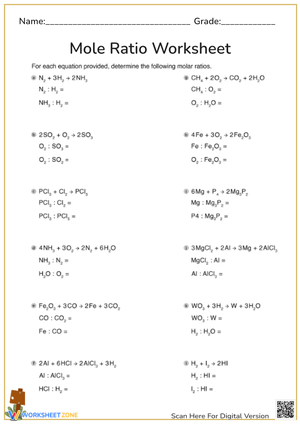
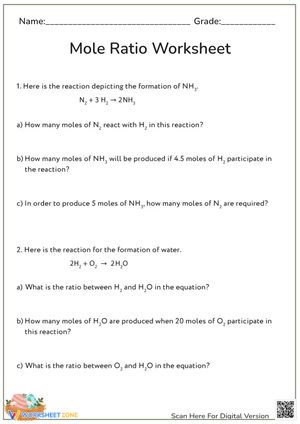
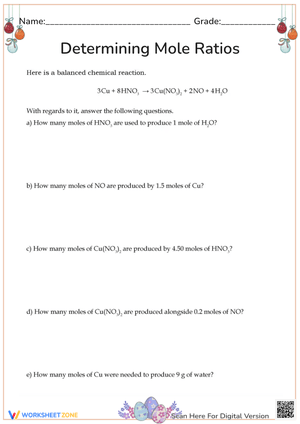
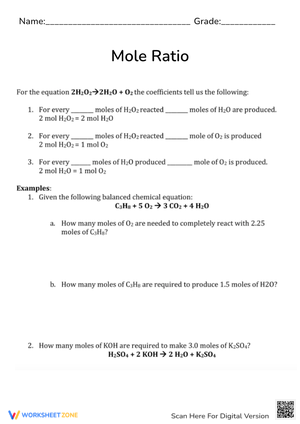
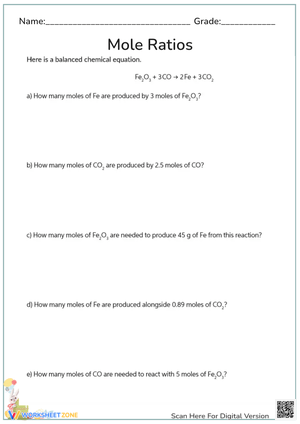
Mole ratios are the “recipe rules” of chemistry. Just as a cake recipe tells you how much flour, sugar, and eggs to use, a balanced chemical equation tells students how many moles of each substance react or form. Mole ratio worksheets help learners read those chemical recipes correctly. Instead of guessing how reactants and products relate, students practice using coefficients to compare substances and solve stoichiometry problems step by step.
The first skill students need is reading a balanced equation. For example, if an equation shows 2 moles of hydrogen reacting with 1 mole of oxygen, students can use that relationship to predict how much water forms. This is why mole ratio worksheets often begin with simple coefficient identification before moving into conversions. If students need more support with this foundation, a balancing chemical equations practice set can help them build confidence before applying ratios in larger problems.
Once students understand where mole ratios come from, they can use them to solve more meaningful chemistry questions. A worksheet may ask learners to find how many moles of product form from a given amount of reactant, compare two substances in a reaction, or identify the missing quantity in a multi-step calculation. These activities strengthen proportional reasoning, formula reading, and problem setup. They also help students see that stoichiometry is not just about memorizing equations; it is about tracking relationships between particles in a reaction.
Mole ratio worksheets also connect naturally to periodic table skills. Students often need molar mass when problems move from moles to grams, so understanding atomic mass and chemical formulas becomes important. Teachers can use this periodic table activities guide to review element symbols, atomic masses, and table navigation before students begin more advanced stoichiometry work. When learners can move confidently between equations, mole ratios, and molar masses, chemistry calculations become much easier to manage.
Worksheetzone’s mole ratio worksheets are designed to make stoichiometry clearer, more organized, and less intimidating. Teachers can use them for guided practice, homework, warm-ups, lab preparation, quiz review, or small-group support. Students benefit from repeated practice with balanced equations, coefficients, conversions, and reasoning steps. With consistent use, these worksheets help learners build the accuracy and confidence they need for chemical reaction calculations, limiting reactants, percent yield, and future chemistry topics.
Frequently Asked Questions
Question 1: What do students learn from mole ratio worksheets?
Students learn how to use coefficients in balanced chemical equations to compare substances in a reaction. They practice writing mole ratios, solving stoichiometry problems, converting between reactants and products, and explaining how quantities in a chemical equation are connected.
Question 2: What grade levels are mole ratio worksheets best for?
Mole ratio worksheets are most useful for high school chemistry students, especially grades 10 through 12. They can also support honors chemistry, AP Chemistry review, and introductory college chemistry courses. Students should understand basic chemical formulas and balanced equations before starting mole ratio practice.
Question 3: Why do students struggle with mole ratios?
Students often struggle because they use subscripts instead of coefficients or try to set up ratios before checking whether the equation is balanced. Some learners also confuse mole-to-mole ratios with gram conversions. Focused practice helps students slow down, identify the correct coefficients, and set up each ratio accurately.
Question 4: How can teachers use mole ratio worksheets in class?
Teachers can use them after lessons on balanced equations, before stoichiometry units, or during review sessions. They work well as guided examples, independent practice, homework, exit tickets, lab preparation, or small-group reteaching for students who need extra support with reaction calculations.