


























Views
Downloads


Printable Atomic Radius Worksheet | Grade 11 Chemistry
Paste this activity's link or code into your existing LMS (Google Classroom, Canvas, Teams, Schoology, Moodle, etc.).
Students can open and work on the activity right away, with no student login required.
You'll still be able to track student progress and results from your teacher account.
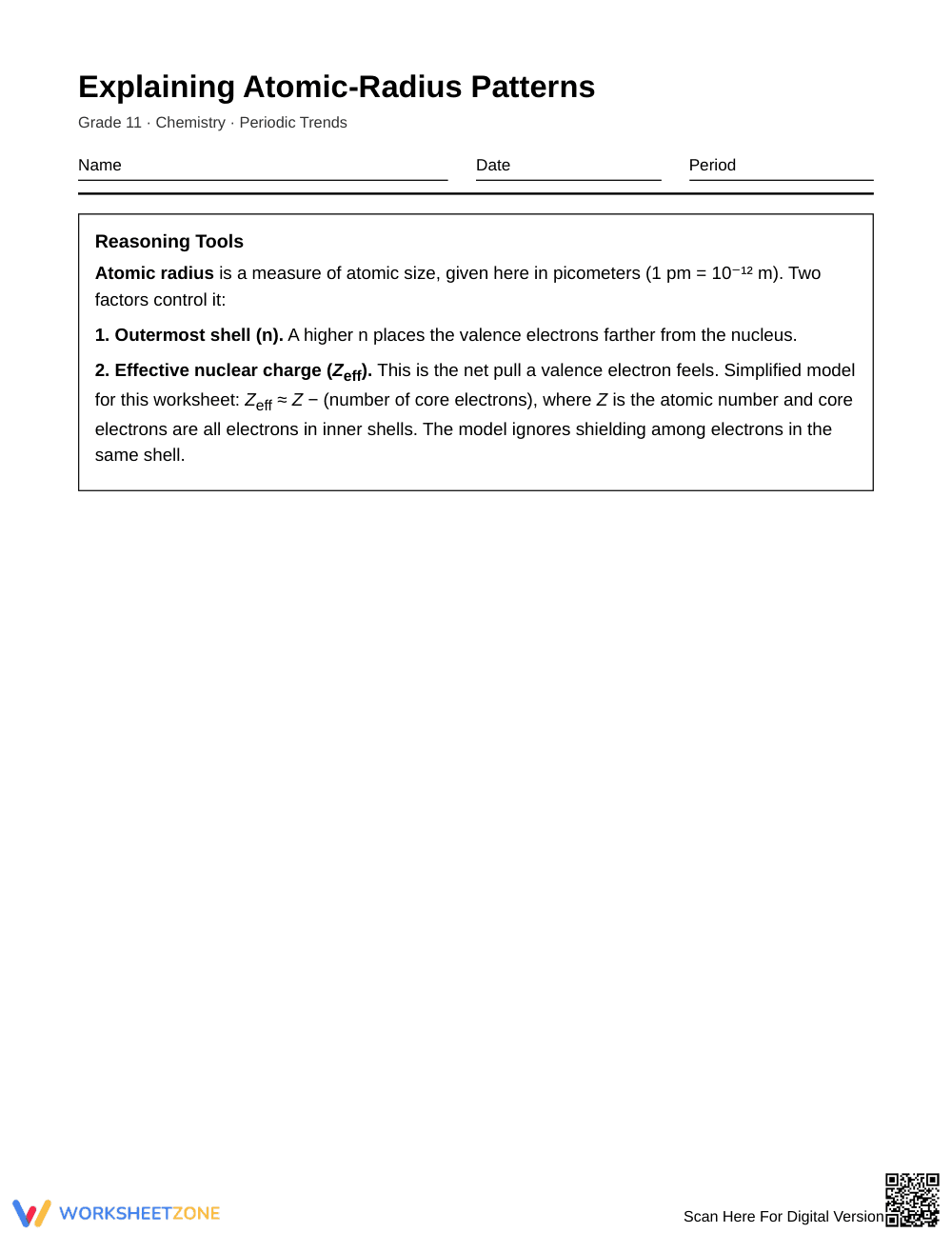
This worksheet helps Grade 11 chemistry students explain why atomic radius changes across a period and down a group. Students use shell number and a simplified effective nuclear charge model, then test each prediction against radius data in picometers, including irregular cases in Groups 13 and 4.
At a Glance
- Grade: 11 · Subject: Chemistry
- Standard: Explain radius trends using shell number and effective nuclear charge
- Skill Focus: Explaining atomic-radius patterns with Zeff
- Format: 5 pages · 10 problems · Answer key included · PDF
- Best For: Periodic trends practice after instruction
- Time: 35–45 minutes
What's Inside
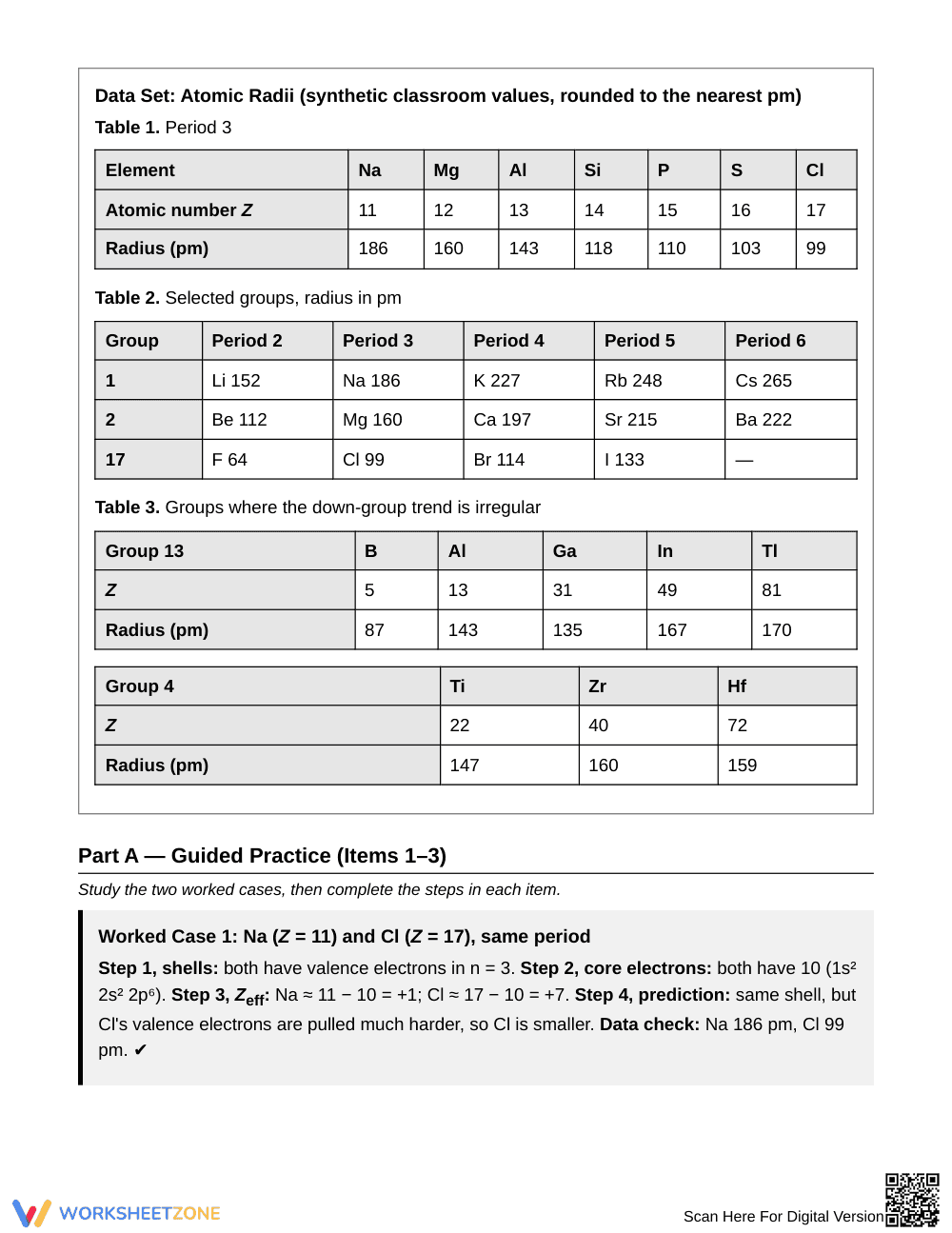
The 5-page worksheet opens with a Reasoning Tools box and three data tables (Period 3, selected groups, and irregular groups). It includes two worked cases, sentence-frame comparisons, a ranking task, percent-change calculations, a multiple-choice item, and two written explanation checks. A 2-page answer key is included.
Skill Progression
- Guided practice (Items 1–3): Two worked cases and fill-in frames that fade into a full four-step response.
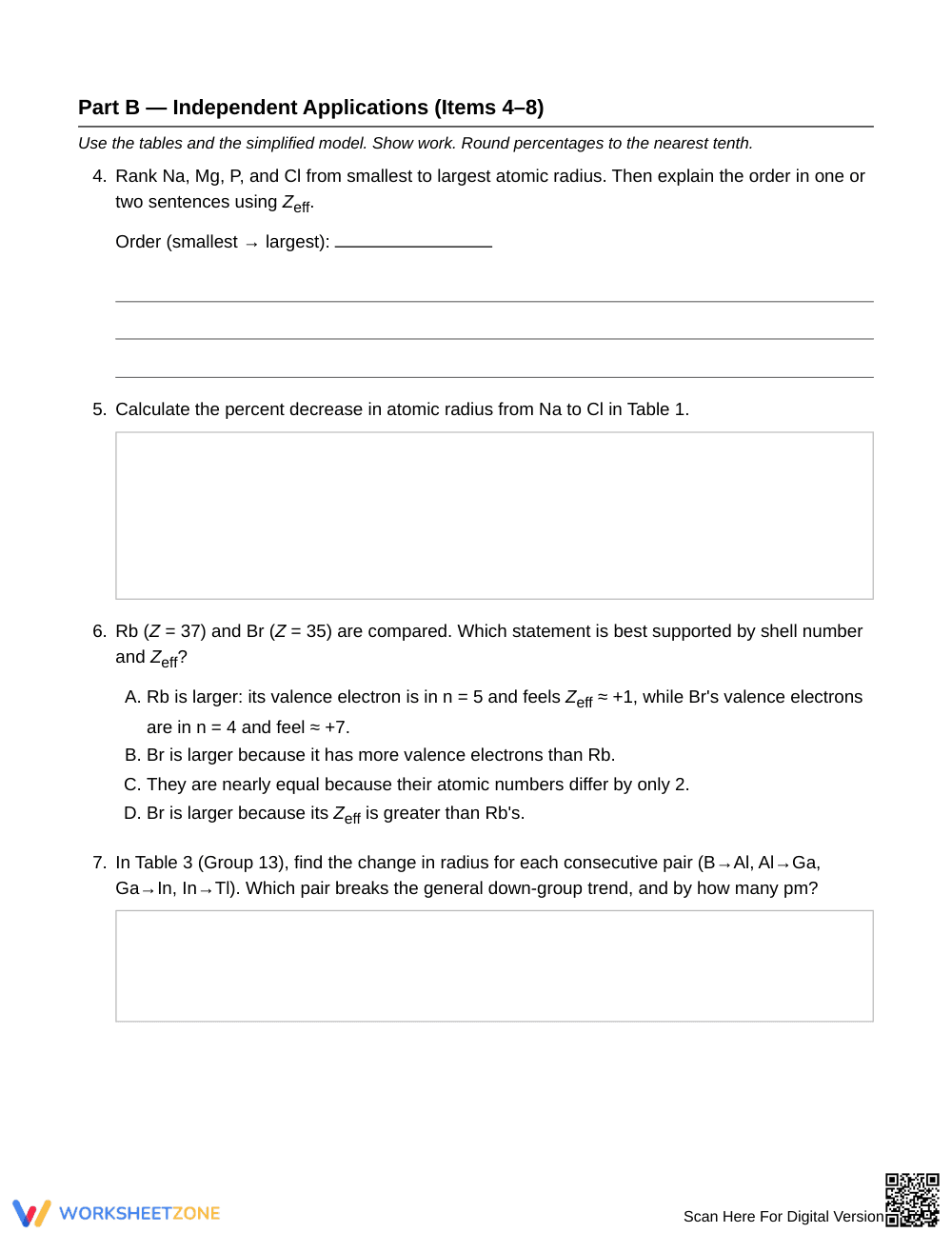
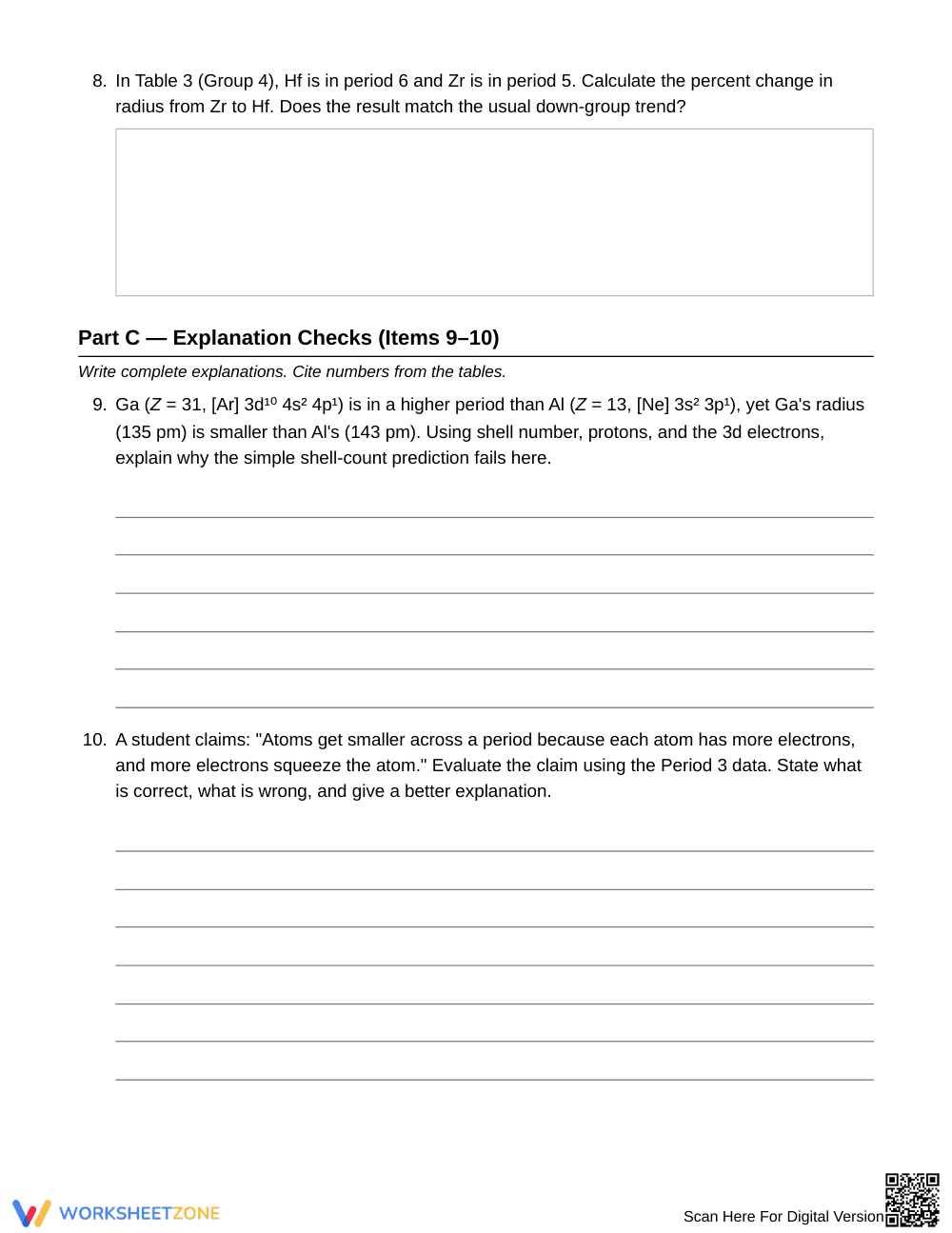
- Supported practice (Items 4–8): Ranking, percent decrease, a best-statement choice, and Group 13 and Group 4 anomalies, using the tables.
- Independent practice (Items 9–10): Written explanations that cite data and evaluate a flawed student claim.
This sequence follows gradual release: I Do, We Do, You Do.
Standards Alignment
No standard code was supplied for this worksheet, so alignment is described by skill: students use electron configuration, shell number, and nuclear charge to predict and justify relative atomic size. Add your state or district code when mapping it into lesson plans or curriculum tools.
How to Use It
- After direct instruction: Assign Parts A and B as classwork once periodic trends have been introduced.
- Before a unit quiz: Use Part C as a written review of the reasoning.
While students work, watch whether they cite Zeff and shell number together instead of saying only that more electrons squeeze the atom. Expect 35–45 minutes for the full set.
Who It's For
Grade 11 chemistry students in a first-year or college-prep course. The sentence frames support students who need structure, and Part C and the Group 13 and Group 4 anomalies stretch stronger students. Pair it with a periodic table and a short lesson on electron configurations.
The Explaining Atomic-Radius Patterns worksheet for Grade 11 Chemistry teaches students to explain periodic size trends rather than memorize them. Across 10 items on 5 pages, students compare atoms using valence shell number and a simplified effective nuclear charge, Zeff ≈ Z − core electrons, then verify each prediction with radius data in picometers. The sequence follows the gradual-release model described by Fisher & Frey (2014): two worked cases and three guided frames, five independent items, and two written explanation checks. Students also examine irregular data in Groups 13 and 4, where added 3d electrons make Ga smaller than Al despite an extra shell. A two-page answer key supports quick scoring. No standard code was supplied, so alignment is described by skill: using shell number and nuclear charge to predict and justify relative atomic radius.


