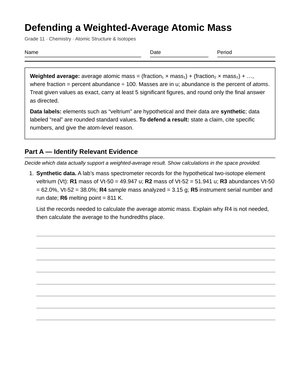
If you teach isotopes and atomic structure, you already know where students stumble: they see a decimal number on the periodic table and assume it is just a normal average, or worse, they confuse it with mass number. Calculating average atomic mass worksheets give students a place to practice the actual weighted-average method until it becomes automatic, rather than a formula they half-remember for a quiz.
This topic sits squarely inside atomic structure units for high school chemistry, and it pairs naturally with periodic table literacy. Students need to be fluent with isotope notation and percent abundance before a worksheet on this skill will do much good, so sequencing matters as much as the practice problems themselves.
The Weighted-Average Formula Teachers Should Model First
Average atomic mass equals the sum of each isotope's mass multiplied by its fractional, or decimal, natural abundance. Written out for a two-isotope element, that looks like: (mass of isotope 1 times its decimal abundance) plus (mass of isotope 2 times its decimal abundance).
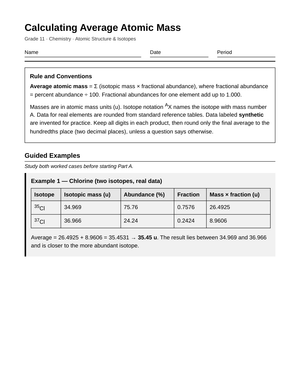
A dependable classroom example is chlorine, which has two naturally occurring isotopes: chlorine-35 at about 75.77 percent abundance and chlorine-37 at about 24.23 percent abundance. Multiplying 35 by 0.7577 and 37 by 0.2423, then adding the results, lands close to 35.45, which matches the value printed on the periodic table. Modeling this exact calculation on the board gives students a concrete anchor before they attempt independent problems.
Sequencing Instruction Before the Worksheet
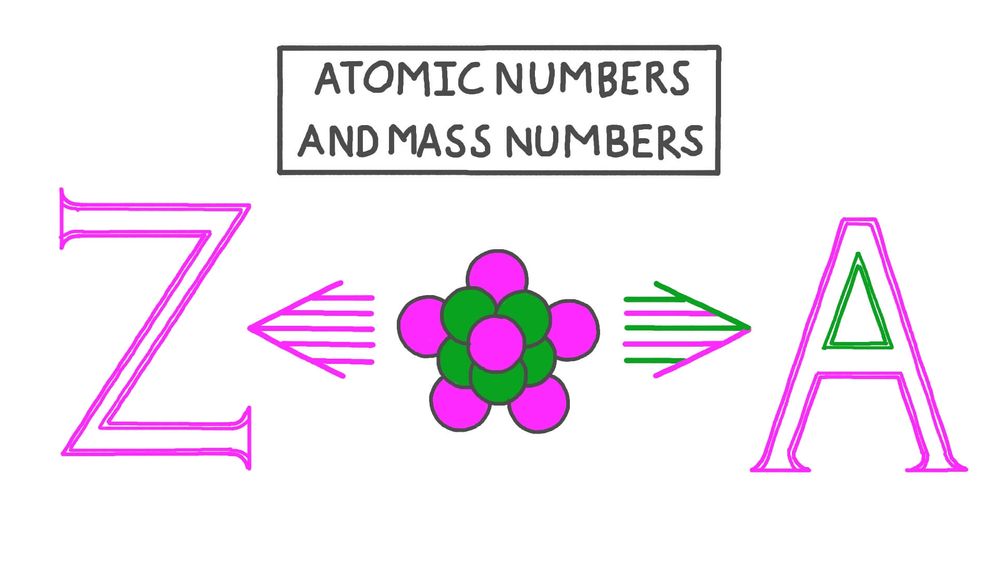
Worksheets work best as the third or fourth step in a sequence, not the first. Start with isotope notation and mass number, since students need to understand that mass number is a whole number specific to one isotope. Then introduce percent abundance as a description of how common each isotope is in a natural sample. Only after both ideas are solid should you move to the weighted-average calculation itself.
Once students can explain why the periodic table mass is a decimal rather than a whole number, a calculating average atomic mass worksheet becomes a tool for reinforcing that reasoning instead of a set of disconnected steps to memorize.
Common Student Errors on Weighted-Average Problems
- Averaging the isotope masses without weighting them by abundance, which produces a value that ignores how rare or common each isotope actually is
- Forgetting to convert percent abundance into decimal form before multiplying, which inflates the calculated mass
- Mixing up mass number with average atomic mass when reading a periodic table entry or isotope symbol
- Rounding too early in multi-step problems, which shifts the final answer away from the accepted value
Building a short error-analysis section into your worksheet, where students spot and correct a worked example that contains one of these mistakes, tends to surface misconceptions faster than more calculation practice alone.
Differentiating Practice Across Ability Levels
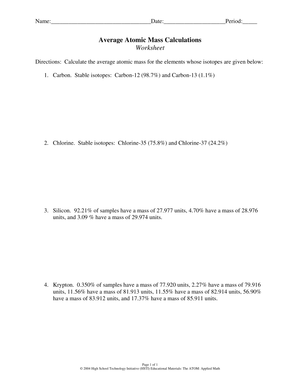
Scaffold problems so students start with two-isotope elements, like chlorine or copper, before moving to elements with three or more naturally occurring isotopes. Two-isotope problems isolate the weighted-average logic without adding extra computational steps, which helps students who are still building confidence with the formula.
For students ready for a challenge, three-isotope problems that require finding a missing abundance value, given the average atomic mass and two known abundances, push algebraic reasoning alongside the chemistry content. This variation also works well as an exit ticket or bell-ringer once the core skill is established.
Classroom Implementation
Plan for one class period on notation and mass number, one period on percent abundance and the hands-on isotope model, and a third period where you introduce the formula and assign the worksheet. This pacing keeps the cognitive load manageable and lets you check for understanding at each stage rather than only at the end.
During independent practice, circulate and watch specifically for the decimal-conversion error, since it is one of the most common and easiest to catch early. A quick reminder prompt on the worksheet itself, such as a note to double-check that abundances are written as decimals, can reduce this error before it becomes a habit. For review or intervention groups, revisit the chlorine example as a shared reference point; students can check new problems against a calculation they already understand.
Frequently Asked Questions
1. How do teachers introduce the difference between mass number and average atomic mass?
Start with isotope notation so students see that mass number is a whole number tied to one specific isotope. Then show the periodic table value as a weighted decimal average across all naturally occurring isotopes of that element, using chlorine as a clear first example.
2. What is a simple two-isotope example teachers can use to model the calculation?
Chlorine works well: chlorine-35 at about 75.77 percent abundance and chlorine-37 at about 24.23 percent abundance combine to a weighted average close to 35.45, matching the periodic table value.
3. How can teachers check for understanding before assigning independent practice?
Have students explain in words why the average atomic mass is not a simple average of the two mass numbers, or ask them to identify the error in a worked example that skips the decimal conversion step.
4. What manipulatives or simulations pair well with average atomic mass worksheets?
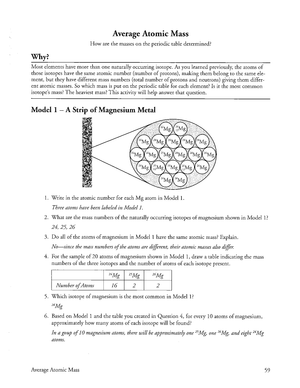
Candy or bead isotope modeling activities, including the AACT simulation and the SERC M&M isotope activity, give students a physical sample to sort and calculate abundance from before moving into decimal-based worksheet problems.
5. How does this topic connect to later units like mass spectrometry or nuclear chemistry?
Students who understand weighted-average calculations are better prepared to interpret mass spectrometry data, where relative peak heights represent isotope abundance, and to reason about isotope ratios in nuclear chemistry and radiometric dating contexts.