Where stoichiometry worksheets fit in a chemistry unit
By the time your students reach stoichiometry, they've balanced a few equations and calculated a molar mass or two, but the mole map still feels like a magic trick. Good stoichiometry worksheets turn that trick into a repeatable routine. The trouble is that most printable sets jump straight to mass-to-mass problems, so students copy a procedure without ever seeing why the mole ratio sits at the center of it. For US high school chemistry classes in grades 9-12, the fix is sequencing: practice that builds one conversion at a time instead of dropping the whole dimensional-analysis chain on students in a single lesson.
This guide lays out how to order that practice, where students predictably stumble, and how to use worksheet sets for formative checks, small-group intervention, and standards-aligned reasoning rather than rote drill.
A worksheet sequence that matches how the skill builds
Stoichiometry is a chain of small moves, and each link deserves its own practice before you connect them. A sequence that holds up across regular and honors sections looks like this:
- Balancing review: a short set that isolates coefficients, since every later step depends on a correct balanced equation.
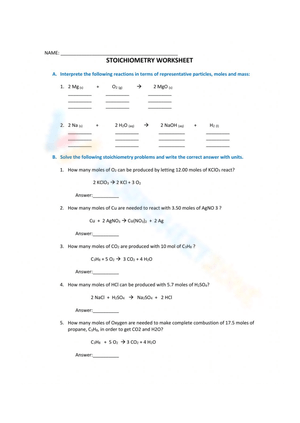
- Mole-to-mole: problems that use only the coefficient ratio, so students internalize the ratio before any grams appear.
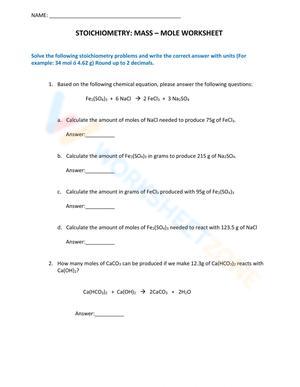
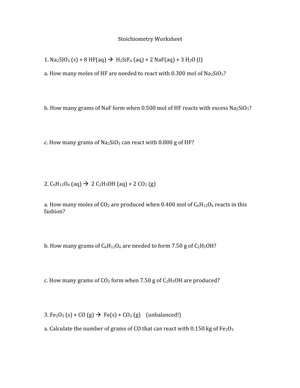
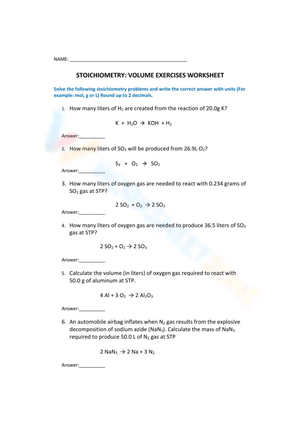
- Mass-to-mole and mole-to-mass: one molar-mass conversion bolted onto that ratio.
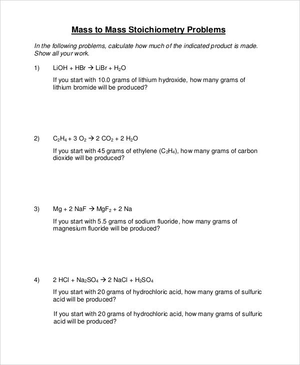
- Mass-to-mass: the full three-step chain, now that each piece is automatic.
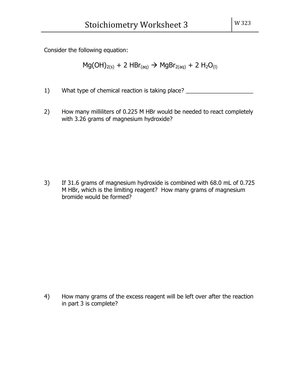
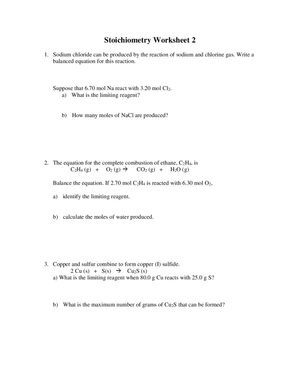
- Limiting reactant: the capstone, where students compare two starting amounts and decide which runs out first.
Keeping each worksheet narrow means a student who misses three problems has a diagnosable gap, not a vague sense that stoichiometry is hard. You can reteach the mole ratio without making them redo molar mass, and you can hand a stronger student the limiting-reactant set while others consolidate mass-to-mass.
Catching mole ratio versus mass ratio confusion early
The single most useful thing a worksheet can do in this unit is surface a misconception before the test. Students routinely multiply by a mass ratio when the balanced equation only justifies a mole ratio, and the wrong answer often looks reasonable enough to slip past a quick glance.
According to research published in the Journal of Chemical Education, students' most persistent stoichiometry errors concentrate in two areas—identifying the limiting reactant and substituting a mass ratio for a mole ratio—and teachers themselves show inconsistencies in mole-ratio reasoning, which is why labeled, step-isolated practice matters more than answer-key speed.
Watch specifically for coefficient-and-subscript confusion. A student who reads the 2 in 2 H2O as though it were part of the formula, or who pulls a subscript out of a formula and treats it as a reaction coefficient, will build an otherwise correct setup on a number sourced from the wrong place, and the arithmetic still works, which is exactly why it slips through. A worksheet that requires students to write each mole ratio as a labeled fraction, coefficients on top, makes that error visible to you in seconds while you circulate.
Teaching stoichiometry as one connected process
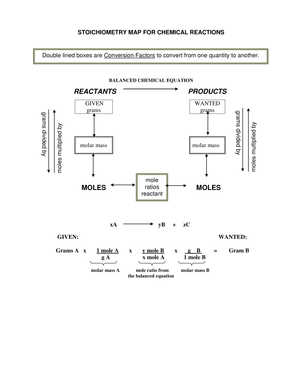
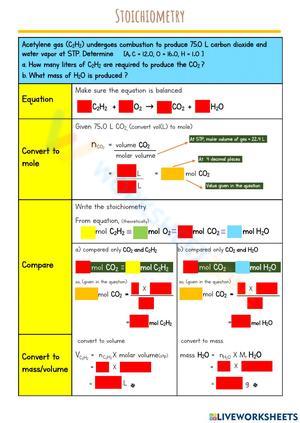
Classroom studies point to the same conclusion: students who see stoichiometry as one connected system—balanced equation to mole ratio to dimensional analysis—do better than those who memorize each problem type as a separate algorithm. That argues for worksheets that keep the format consistent. If every problem is set up as a labeled dimensional-analysis chain, students start to see mole-to-mole, mass-to-mole, and mass-to-mass as the same move with different endpoints, not three unrelated recipes.
A practical way to reinforce this: use an answer key that shows the full labeled chain, units and all, rather than just final values. When students self-check, they compare their reasoning path to yours, which is where the learning actually happens. Keep the bare final answer off your keys for this unit.
Classroom Implementation
Worksheets earn their keep when they're wired into a routine, not handed out as busywork. A few ways to put these sets to work:
- Bell-ringer diagnostics: open with two mole-to-mole problems and read the room before you teach mass-to-mass.
- Exit tickets: one mass-to-mass problem at the door tells you who is ready for limiting reactant tomorrow.
- Small-group intervention: pull the four or five students who missed a stoichiometry quiz and reteach with the mole-to-mole set only, then step up.
- Stations: rotate students through balancing, ratio, and conversion stations so weaker links get extra reps.
Grade for the setup, not just the answer. When you circulate, glance at whether the mole ratio is written as a labeled fraction; that one habit predicts success on limiting reactant more than raw arithmetic speed does.
Differentiating for co-taught and inclusion sections
In co-taught or inclusion sections, the barrier is often the abstraction of the mole, not the arithmetic. Pairing worksheet practice with particulate-level supports helps. Research using particulate models—drawings of the actual particles reacting—has been used to build conceptual stoichiometry understanding, and a worksheet can borrow that move by asking students to sketch reactant and product particles beside the numbers.
Other low-lift supports: pre-balanced equations on the first practice set so students focus on the ratio, a molar-mass reference box at the top of the page, and worked example problems in the margin that students can mirror. Give your co-teacher the same labeled-fraction format so both of you are reinforcing one routine, not two.
Aligning worksheet practice with NGSS HS-PS1-7
Stoichiometry practice maps directly onto NGSS performance expectation HS-PS1-7, which asks students to use mathematical representations to support the claim that atoms, and therefore mass, are conserved in a chemical reaction. The clarification statement leans on proportional reasoning and on using the mole as the bridge between the atomic and macroscopic scales, not on memorizing algorithms.
That framing should change what your worksheets reward. Instead of a page of decontextualized grams-to-grams drills, include a few problems that ask students to show, with numbers, that mass in equals mass out. When a worksheet ties the mole ratio back to conservation of mass, students practice the exact reasoning HS-PS1-7 expects, and the drill becomes evidence of a standard rather than a disconnected skill.
Frequently asked questions
1. What order should stoichiometry worksheet topics follow?
Move from balancing equations, to mole-to-mole, to mass-to-mole and mole-to-mass, to mass-to-mass, and finally to limiting reactant. Each step adds exactly one new conversion, so students master the mole ratio before molar mass enters, and master the full chain before comparing two reactants.
2. How can worksheets catch mole ratio misconceptions early?
Use short mole-to-mole sets as bell-ringers or exit tickets before the unit test. Require the ratio to be written as a labeled fraction with coefficients on top, so a mass-for-mole substitution or a subscript pulled from a formula shows up in the setup, not just the final answer.
3. What's the difference between mole-to-mole and mass-to-mass problems?
Mole-to-mole problems use only the coefficient ratio from the balanced equation, so students practice the ratio in isolation. Mass-to-mass problems wrap that ratio in two molar-mass conversions, grams to moles then moles to grams, making them the full three-step chain rather than a single move.
4. How do these worksheets support limiting reactant instruction?
Limiting reactant sits at the end of the sequence because it layers comparison onto skills students already have. Worksheets support it by giving two starting amounts and asking which reactant runs out first; students run the mass-to-mass calculation twice and compare, reinforcing every earlier step.
5. How does this practice align with NGSS HS-PS1-7?
HS-PS1-7 asks students to use math to show mass is conserved in a reaction, grounded in proportional reasoning and the mole concept. Worksheets that connect the mole ratio to conservation of mass, showing mass in equals mass out, build the exact reasoning the standard expects.