


























Views
Downloads



Ready IE vs Electronegativity Worksheet | Grade 11 Chemistry
Paste this activity's link or code into your existing LMS (Google Classroom, Canvas, Teams, Schoology, Moodle, etc.).
Students can open and work on the activity right away, with no student login required.
You'll still be able to track student progress and results from your teacher account.
This Grade 11 Chemistry worksheet teaches students to compare ionization energy and electronegativity and to explain each periodic trend with effective nuclear charge, shielding, and electron configurations. Students move from recognizing trends to predicting unfamiliar elements, using data tables to support every claim.
At a Glance
- Grade: 11 · Subject: Chemistry
- Standard:
None assigned— Explain periodic trends in ionization energy and electronegativity using data and electron configurations.- Skill Focus: Comparing ionization energy and electronegativity
- Format: 5 pages · 12 problems · Answer key included · PDF
- Best For: Periodic trends practice and review
- Time: 40–55 minutes
What's Inside
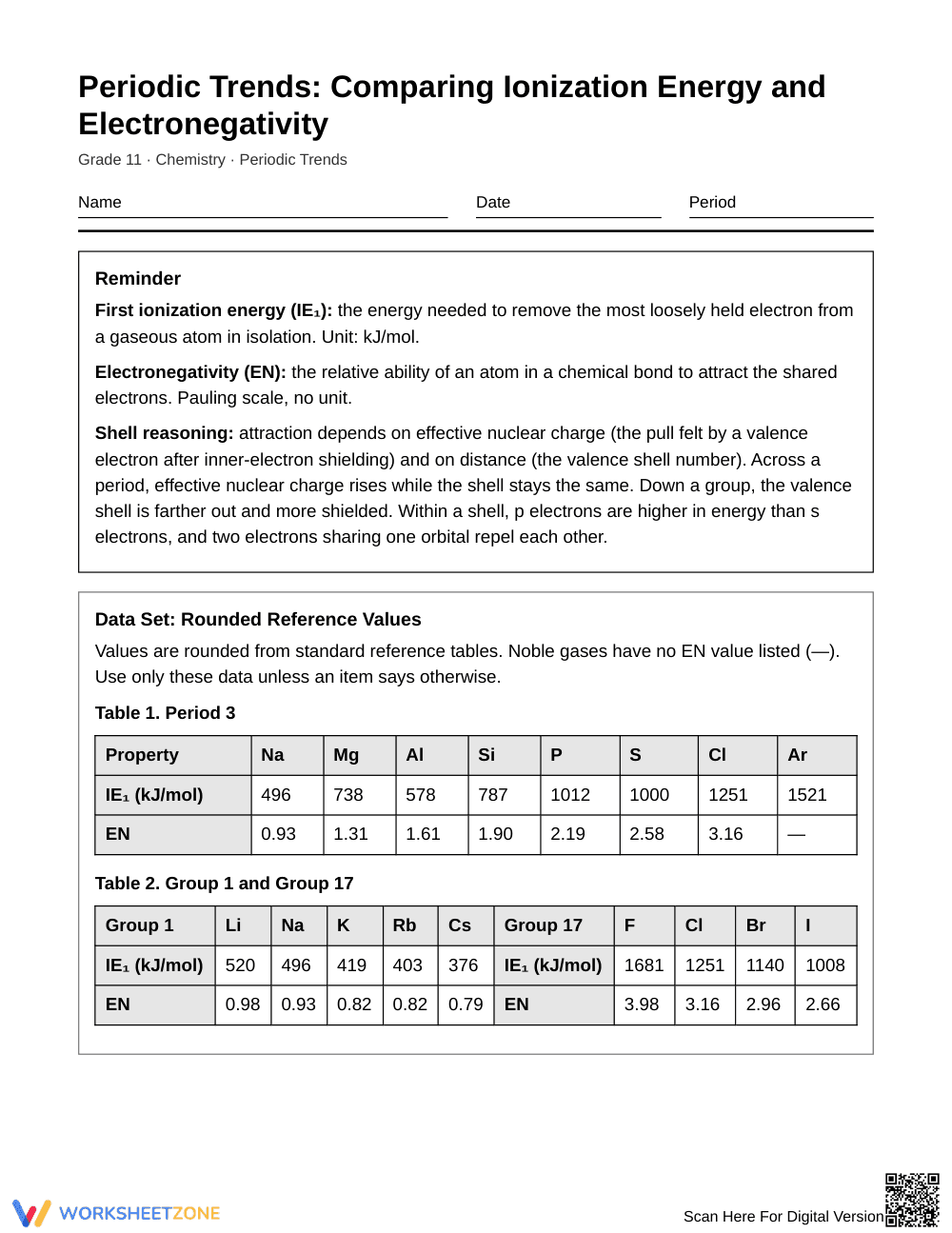
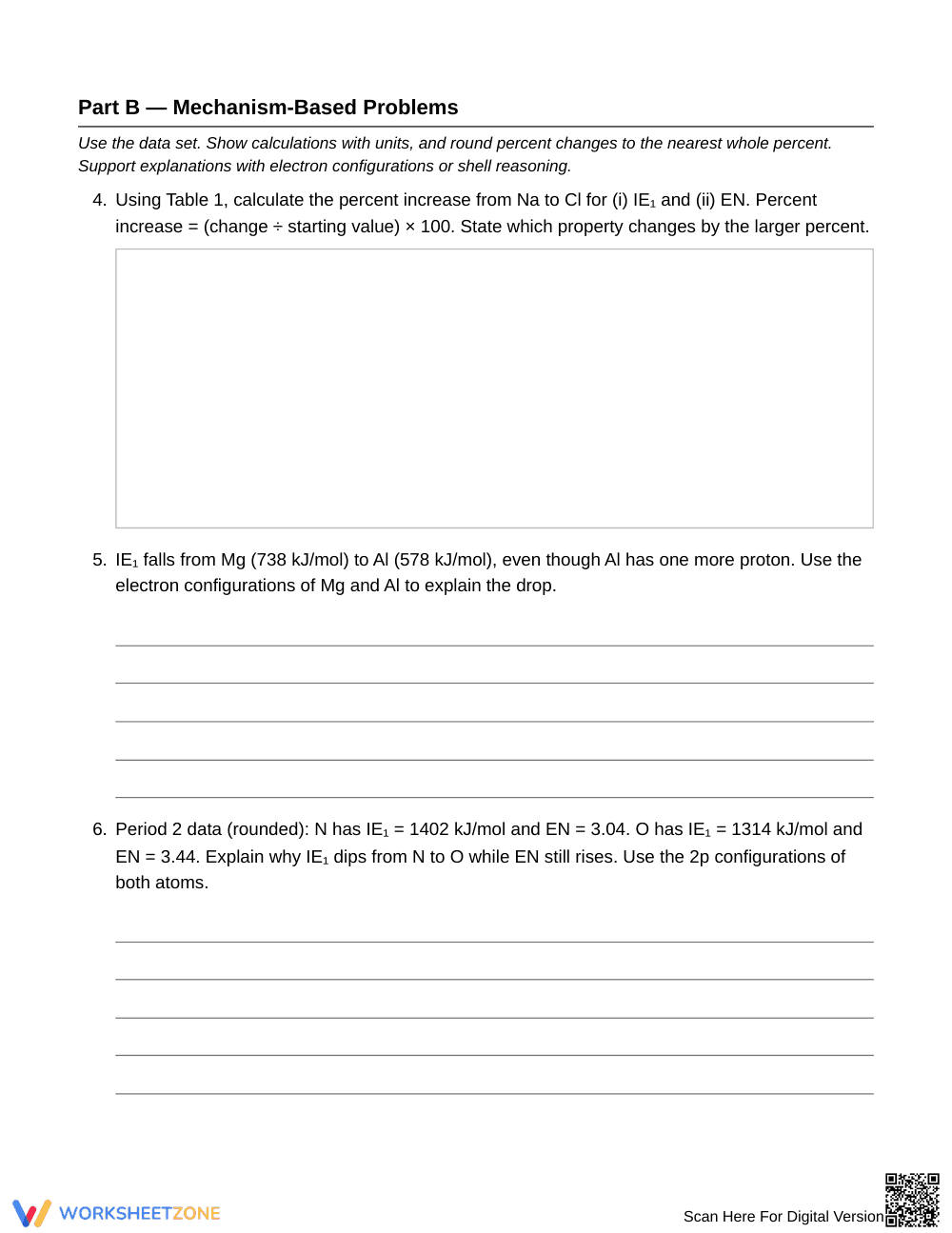
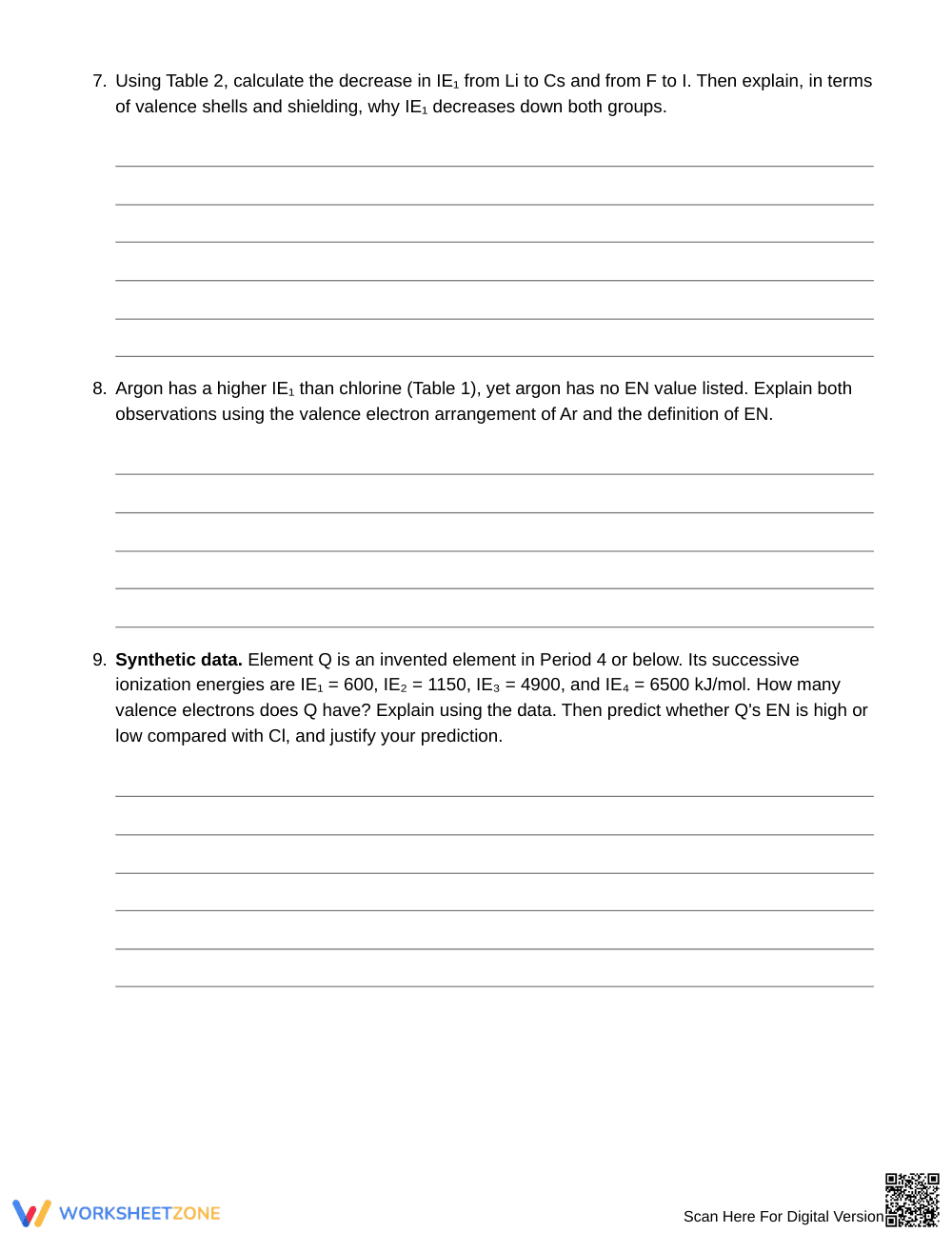
The worksheet runs 5 pages and opens with a reminder box defining first ionization energy, electronegativity, and shell reasoning. Two rounded data tables follow: Period 3 values, and Group 1 and Group 17 values. Part A has two multiple-choice items and one short written response. Part B has six mechanism-based problems that require percent-change calculations, electron configurations, and one synthetic-data problem using successive ionization energies. Part C has three prediction tasks with written justification. A complete answer key is included.
Skill Progression
- Guided practice (Part A, 3 problems): Students choose the best explanation for two trends, then write two differences between the properties. The reminder box carries most of the scaffolding.
- Supported practice (Part B, 6 problems): Students calculate percent increases and decreases from the tables and explain exceptions such as Mg to Al, N to O, and argon, using 2p and 3p configurations.
- Independent practice (Part C, 3 problems): Students predict values for astatine, boron versus beryllium, and the Na–Cl versus Cs–Cl bonds without supplied data.
Standards Alignment
No primary standard code was supplied for this worksheet, so none is listed. Teachers can attach their own standard code for lesson plans or curriculum mapping.
How to Use It
After direct instruction: Assign Parts A and B as independent practice once students have seen effective nuclear charge and shielding. Before a unit test: Use Part C as a timed review, then have partners compare their justifications.
Formative-assessment tip: Watch whether students name both nuclear charge and distance in their explanations. Students who cite only one factor usually need a quick conference. Expect 40–55 minutes for the full set, or about 25 minutes for Parts A and B alone.
Who It's For
This worksheet suits Grade 11 Chemistry and college-prep students who already know basic electron configurations. Struggling students can complete Part A with the reminder box and work through Part B in pairs. Advanced students can focus on the Part B synthetic-data problem and the Part C predictions.
Comparing ionization energy and electronegativity asks Grade 11 Chemistry students to explain periodic trends with effective nuclear charge, shielding, and electron configurations, rather than memorize arrows on the periodic table. This 12-problem, 5-page worksheet moves from trend recognition to data-based calculation to prediction, with an answer key included. No standard code was supplied, so teachers can add their own. The structure follows the gradual release of responsibility model described by Fisher & Frey (2014), in which students shift from guided to independent work. Students explain exceptions such as the Mg to Al and N to O dips, calculate percent change from rounded data, and justify predictions for astatine, boron, and ionic bonds. Because every item requires evidence, teachers can quickly see whether students reason from structure or from memorized patterns.


