What Hess's Law Worksheets Actually Practice
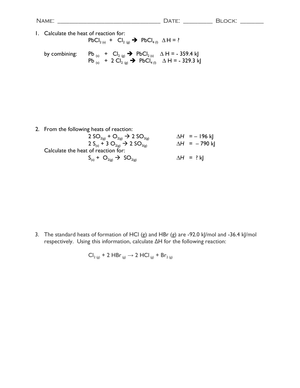
Hess's Law worksheets give high school chemistry students repeated practice applying one big idea: the total enthalpy change for a reaction equals the sum of the enthalpy changes for the steps that build it, no matter what path the reaction takes. On paper that sounds simple, but the skill your students need is procedural. They have to combine two, three, or four thermochemical equations, adjust each delta H correctly, and cancel every intermediate species. A good worksheet set turns that abstract rule into a repeatable routine.
These pages fit squarely inside a thermochemistry unit, usually after students have seen enthalpy diagrams and the idea of energy released or absorbed during a reaction. Because Hess's Law lets you calculate enthalpy for reactions that are hard or unsafe to run directly, such as combustion or formation reactions, it gives students a reason to trust the math even when a lab bench can't confirm the answer.
Building on Skills Students Already Have
One reason Hess's Law rewards worksheet practice is that it recycles skills students already own instead of introducing brand-new math. Balancing equations, working with coefficients, and adding signed numbers all come back here in a new arrangement. When you frame Hess's Law as a fresh use of familiar tools, students who felt shaky about thermochemistry often relax, because the arithmetic itself is nothing they haven't done.
Stoichiometry is the clearest bridge. Students who already scale equations to balance moles are halfway to scaling them to cancel intermediates in a Hess's Law problem. Pointing out that connection out loud helps students see the unit as connected rather than as a pile of separate procedures. A short worksheet that opens with one balancing item and one coefficient item before the first Hess's Law problem makes that link explicit on the page.
It also helps to name why the law holds at all. Because enthalpy depends only on where a reaction starts and ends, the route in between is free to change without changing the total energy. Students who understand that reason are less likely to treat the equation-flipping steps as arbitrary rules and more likely to catch their own mistakes.
The Core Skill: Manipulating Thermochemical Equations
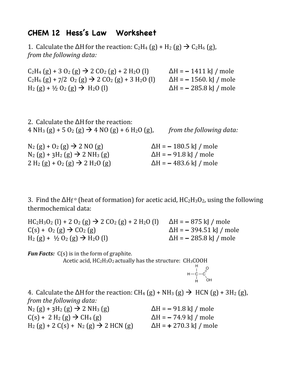
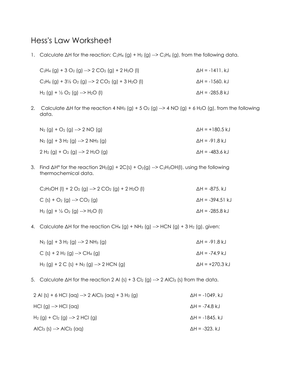
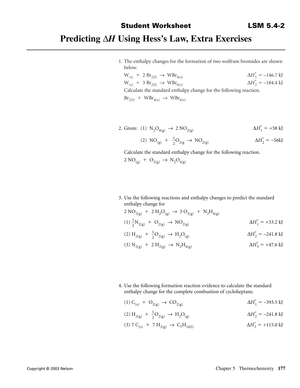
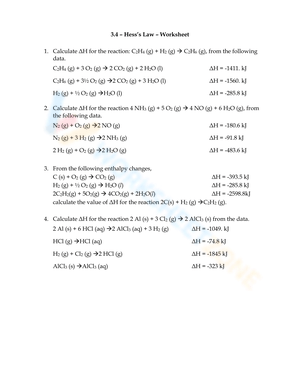
Every Hess's Law problem reduces to two moves. First, students may need to reverse an equation, which flips the sign of its delta H. Second, they may need to multiply an equation by a whole-number coefficient, which multiplies its delta H by that same factor. Once the target equation lines up, the intermediates cancel and the adjusted enthalpies add together.
A quick concrete example makes the two moves stick. If a target reaction needs a compound on the product side but a given equation shows it as a reactant, students reverse that equation and change the sign of its delta H. If the target needs two moles of that compound but the equation makes only one, they double the whole equation and double its delta H. Working one example this explicitly on the board before assigning the worksheet saves a lot of confusion later.
Worksheets that isolate these two moves early pay off later. When students practice flipping and scaling on short two-equation problems first, they build the muscle memory to handle three- and four-equation problems without losing track of signs.
Pairing Worksheets With Standard Enthalpy of Formation Tables
Many teachers pair Hess's Law practice with standard enthalpy of formation tables, and for good reason. The formation approach is really Hess's Law in a compact form: the enthalpy of a reaction equals the sum of the products' formation enthalpies minus the sum of the reactants', each weighted by its coefficient. Giving students both methods on the same worksheet lets them check one answer against the other.
This pairing also varies the problem types on a single page. Some items ask students to combine three messy equations by hand; others hand them a clean table and ask for a single subtraction. Students who can move between the two representations understand the underlying idea, not just one procedure.
Using These Worksheets In Chemistry Classes
Hess's Law worksheets work in several instructional slots. Use a short two-equation set as a warm-up to check whether students remember how reversing changes a sign. Use a mixed page as formative assessment a day or two before the thermochemistry test, then group students by the specific error pattern you see. For small-group intervention, hand struggling students color-coded equations so they can physically line up and cancel intermediates before doing any math.
Before students attempt these problems, confirm they can balance equations, work with coefficients, and read a delta H value with its sign. The AACT thermochemistry and thermodynamics unit plan is a helpful frame for sequencing where Hess's Law fits alongside calorimetry and enthalpy diagrams across the unit.
For enrichment, ask early finishers to write their own three-equation problem that produces a target reaction, then trade with a partner. Building a problem backward forces students to think about which intermediates must cancel, which is the same reasoning the worksheets are training. That kind of reverse design is also a quick way to spot which students truly understand the method versus those who are pattern-matching.
Frequently Asked Questions
1. What grade level or course covers Hess's Law?
Hess's Law usually appears in high school chemistry, most often in first-year or honors courses during the thermochemistry unit. It also shows up in introductory college general chemistry, so these worksheets suit both advanced high schoolers and dual-enrollment students.
2. How do teachers use these worksheets for review versus new instruction?
For new instruction, teachers usually assign scaffolded two-equation problems right after modeling one example. For review, a mixed worksheet with three- and four-equation problems works well as spiral practice or as a pre-test check a few days before the unit exam.
3. What prior skills should students have first?
Students should be able to balance chemical equations, multiply equations by coefficients, and interpret a delta H value with its positive or negative sign. Comfort with basic stoichiometry and the idea of enthalpy as energy makes Hess's Law problems far more approachable.
4. How can these worksheets support small-group intervention?
Short, single-skill worksheets let you target one move at a time. Give a small group only reversing problems until signs are automatic, then only scaling problems, before combining both. Color-coded or cut-apart equations help students see intermediates cancel before the arithmetic starts.