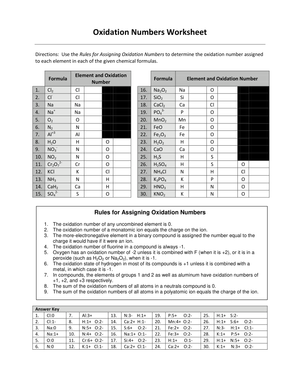
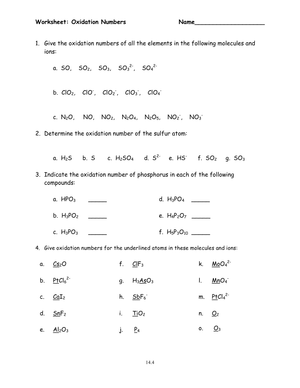
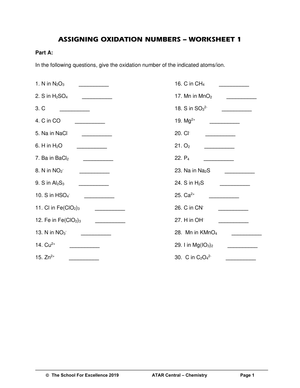
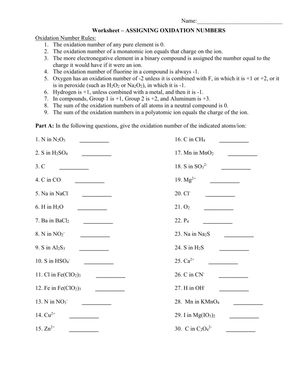
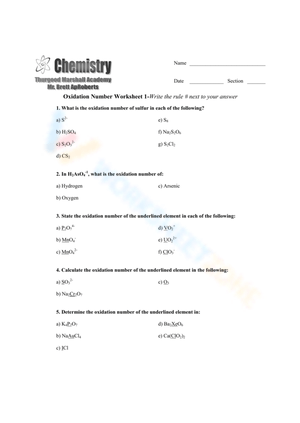
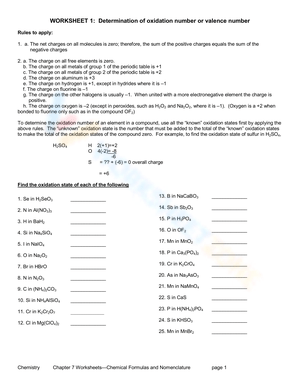
Before students can balance a redox equation or explain electron transfer, they need a reliable method for assigning oxidation numbers. Assigning oxidation numbers worksheets give grades 9-12 chemistry teachers a low-stakes way to build that fluency before the unit moves into more demanding balancing and titration work. Rather than opening with a full redox reaction, start narrow: give students a handful of formulas and ask them to assign a number to every atom using a fixed rule order. That single skill, repeated across several class periods, prevents the confusion that shows up later when students try to balance half-reactions.
The Core Rules Students Need First
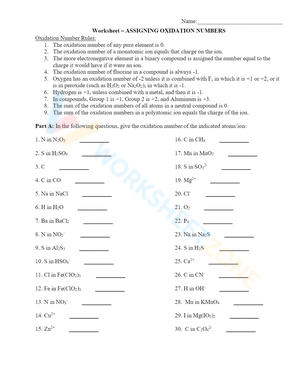
Introduce the rule set in a strict hierarchy so students always know which rule wins when two seem to apply. Free elements in their uncombined state, such as H2, Na, O2, and P4, always have an oxidation number of 0. Monatomic ions take an oxidation number equal to their ionic charge, so Fe3+ is +3 and O2- is -2. Fluorine is always -1 in its compounds, which makes it the most dependable fixed rule in the whole system and a good anchor point for students who feel unsure where to start. Oxygen is -2 in most compounds, and hydrogen is +1 in most compounds, but both have exceptions covered later in this article. Finally, the oxidation numbers in a neutral molecule must sum to zero, and in a polyatomic ion they must sum to the ion's overall charge. That summing rule is what lets students solve for an unknown oxidation number once the fixed values are in place.
Applying the Rules Step by Step
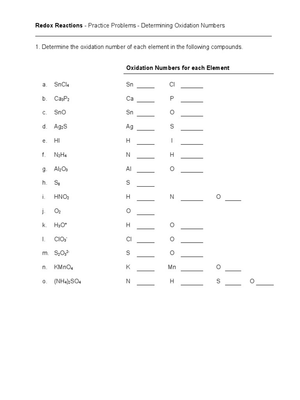
Once students have the rule order, walk through a worked example as a class before assigning independent practice. Take sulfuric acid, H2SO4. Hydrogen is assigned +1 for a total of +2, and oxygen is assigned -2 across four atoms for a total of -8. Since the molecule is neutral, the four values must sum to zero, so sulfur must be +6. This same logic transfers directly to worksheet items: identify every atom whose oxidation number is fixed by a rule, total those values, then use the neutral-molecule or ion-charge rule to solve for the one unknown atom. Students who practice this sequence on five or six formulas typically stop guessing and start reasoning through the math.
The order in which rules get applied matters more than most worksheets make explicit. Students who default to memorizing common values like oxygen at -2 often stall on formulas where a fixed rule, such as fluorine at -1 or a stated ionic charge, should take priority. Sequencing practice items so the fixed-value rules appear before any oxygen or hydrogen exception cuts down on the most frequent scoring error seen on early redox assessments: an oxygen or hydrogen value applied where a higher-priority rule should have governed the atom instead.
Tricky Cases: Peroxides, Hydrides, and Polyatomic Ions
Most student errors on assigning oxidation numbers worksheets cluster around three exception categories, so give each one dedicated practice items. Oxygen is -2 in most compounds but -1 in peroxides such as H2O2, where the oxygen-oxygen bond changes the usual assignment. Hydrogen is +1 in most compounds but -1 when bonded to a metal in a hydride, such as NaH or CaH2, because the metal is less electronegative than hydrogen in that pairing. Polyatomic ions like sulfate, nitrate, and phosphate require students to apply the ion-charge summing rule instead of the neutral-molecule rule, since the whole group carries a charge rather than summing to zero. A short worksheet section that isolates these three exceptions, separate from the general practice set, helps students recognize the pattern instead of treating each formula as a brand-new problem.
Classroom Implementation
Assigning oxidation numbers worksheets work well as a short daily warm-up rather than a single long assignment. Open two or three class periods with a five-minute drill covering four to six formulas, cycling in one exception case, such as a peroxide or hydride, once students show consistency with the basic rules. Partner practice works well for the exception cases specifically, since students can talk through which rule takes priority before committing to an answer. For a quick formative check, an exit ticket with two formulas, one straightforward and one exception case, gives a clear read on whether students are ready to move into redox balancing or need another day of targeted practice. Keep an answer key visible only after students submit their exit ticket so the check stays a genuine measure of independent understanding.
Frequently Asked Questions
1. What is the easiest way to teach students the order of oxidation number rules
Present the rules as a hierarchy rather than a list. Teach free elements and monatomic ions first since they are fixed values, then fluorine as the most reliable fixed nonmetal rule, then the oxygen and hydrogen defaults with their exceptions, and finally the summing rule that solves for any unknown atom.
2. How do oxidation numbers differ from ionic charge
Ionic charge describes the actual charge on an ion formed by electron loss or gain. Oxidation number is a bookkeeping value assigned to every atom in a compound, including atoms in covalent molecules that never form true ions, which is why the two terms are not interchangeable even though they match for simple monatomic ions.
3. Why does oxygen have a different oxidation number in peroxides
In a peroxide such as H2O2, the two oxygen atoms are bonded directly to each other, which changes the electron distribution compared with typical oxide compounds. That oxygen-oxygen bond is why oxygen is assigned -1 in peroxides instead of the usual -2 default.
4. How can teachers check for understanding before starting redox balancing
A short exit ticket with a standard formula and one exception case, such as a hydride or polyatomic ion, is enough to see whether students are applying the rule hierarchy correctly or still relying on memorized defaults without checking for higher-priority rules first.
5. What grade level typically introduces oxidation number assignment
Oxidation number assignment is typically introduced during high school chemistry, most often in grades 9 through 12, as part of a unit building toward redox reactions and connecting to the NGSS HS-PS1-2 focus on electron transfer in chemical reactions.