




























0
Views
0
Downloads

Save
0 Likes
Share
Periodic Trends Practice: Answer Key Worksheet
0 Views
0 Downloads

Paste this activity's link or code into your existing LMS (Google Classroom, Canvas, Teams, Schoology, Moodle, etc.).
Students can open and work on the activity right away, with no student login required.
You'll still be able to track student progress and results from your teacher account.
Information
Description
What It Is:
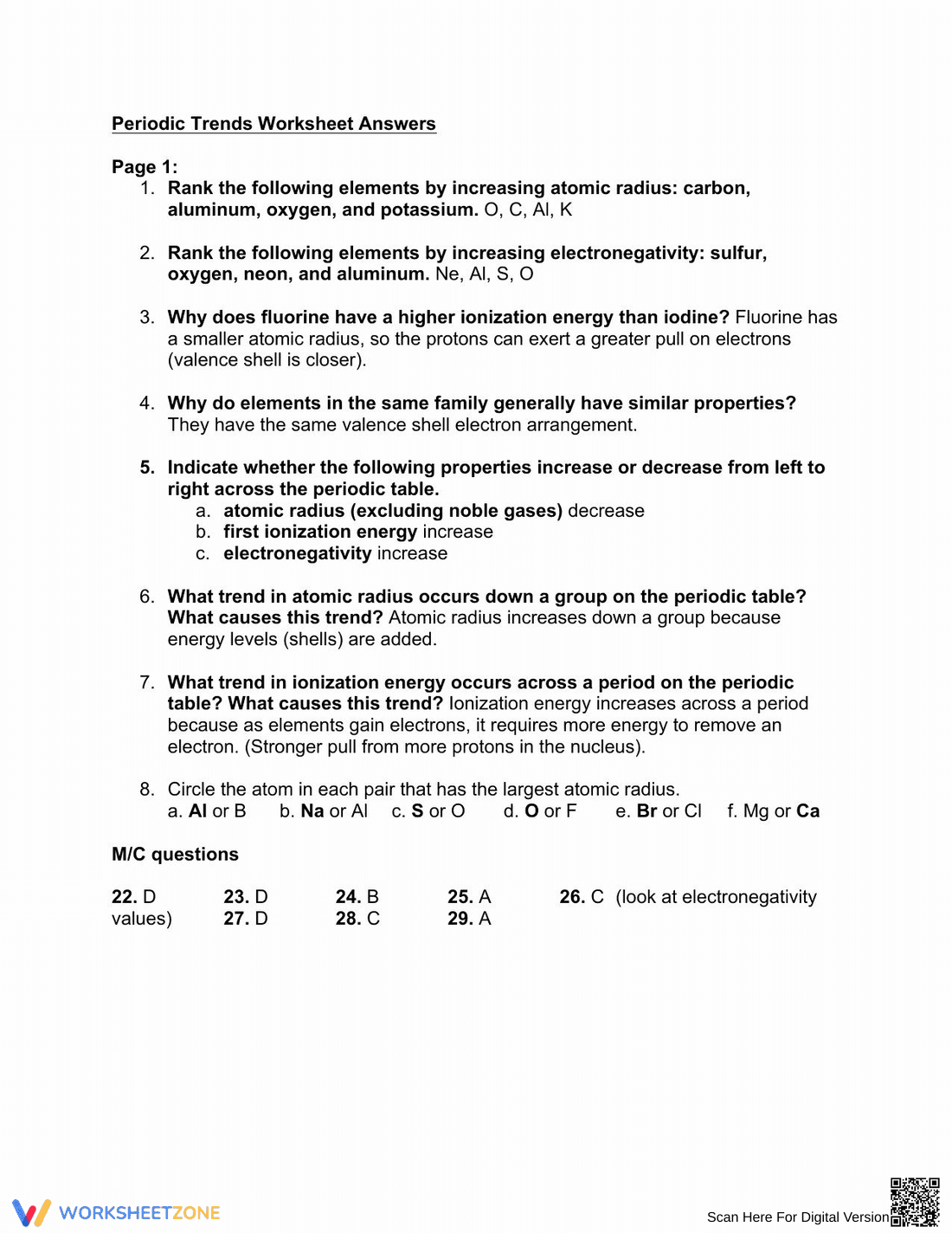
This is an educational worksheet focused on periodic trends in chemistry. It includes questions about ranking elements by increasing atomic radius and electronegativity, explaining trends in ionization energy and atomic radius across periods and down groups, identifying reasons for similar properties within element families, and determining how properties change across the periodic table. It also has multiple-choice questions related to atomic radius.
Grade Level Suitability:
This worksheet is suitable for high school chemistry, specifically grades 9-12. The concepts covered, such as electronegativity, ionization energy, and atomic radius, are typically introduced at the high school level. The analytical and reasoning required also aligns with this age group.
Why Use It:
This worksheet reinforces understanding of periodic trends, including atomic radius, ionization energy, and electronegativity. It encourages critical thinking by asking students to explain the reasons behind these trends and relate them to electron configuration and nuclear charge. It tests knowledge of how elements are organized and their properties vary within the periodic table.
How to Use It:
Students should first review the concepts of periodic trends. Then, they can work through the worksheet, answering each question based on their understanding. For ranking questions, they need to consider the positions of the elements on the periodic table. For explanation questions, they should use their knowledge of electron configuration and nuclear charge. For multiple-choice questions, they should choose the best answer based on the periodic trends.
Target Users:
The target users are high school students taking chemistry courses, particularly those studying periodic trends. It is also useful for teachers as a review or assessment tool. Homeschooling parents teaching chemistry can also use this worksheet.
This is an educational worksheet focused on periodic trends in chemistry. It includes questions about ranking elements by increasing atomic radius and electronegativity, explaining trends in ionization energy and atomic radius across periods and down groups, identifying reasons for similar properties within element families, and determining how properties change across the periodic table. It also has multiple-choice questions related to atomic radius.
Grade Level Suitability:
This worksheet is suitable for high school chemistry, specifically grades 9-12. The concepts covered, such as electronegativity, ionization energy, and atomic radius, are typically introduced at the high school level. The analytical and reasoning required also aligns with this age group.
Why Use It:
This worksheet reinforces understanding of periodic trends, including atomic radius, ionization energy, and electronegativity. It encourages critical thinking by asking students to explain the reasons behind these trends and relate them to electron configuration and nuclear charge. It tests knowledge of how elements are organized and their properties vary within the periodic table.
How to Use It:
Students should first review the concepts of periodic trends. Then, they can work through the worksheet, answering each question based on their understanding. For ranking questions, they need to consider the positions of the elements on the periodic table. For explanation questions, they should use their knowledge of electron configuration and nuclear charge. For multiple-choice questions, they should choose the best answer based on the periodic trends.
Target Users:
The target users are high school students taking chemistry courses, particularly those studying periodic trends. It is also useful for teachers as a review or assessment tool. Homeschooling parents teaching chemistry can also use this worksheet.


