




























Views
Downloads

Essential Nitrogen Cycle Worksheet | Grades 9-12 Science

Paste this activity's link or code into your existing LMS (Google Classroom, Canvas, Teams, Schoology, Moodle, etc.).
Students can open and work on the activity right away, with no student login required.
You'll still be able to track student progress and results from your teacher account.
This high school science worksheet reinforces nitrogen cycle vocabulary and foundational processes. Students analyze molecular structures, trace biogeochemical pathways on diagrams, interpret runoff data, and correct plant nutrition misconceptions. The 22 structured tasks bridge introductory chemistry and ecosystem dynamics.
At a Glance
- Grade: Grades 9–12 · Subject: Science
- Standard: Matter Cycling — Model matter cycling and energy transfer through ecosystems
- Skill Focus: Nitrogen cycle vocabulary and foundational mechanisms
- Format: 4 pages · 22 problems · Answer key included · PDF
- Best For: Unit launch or diagnostic review
- Time: 40–50 minutes
What's Inside
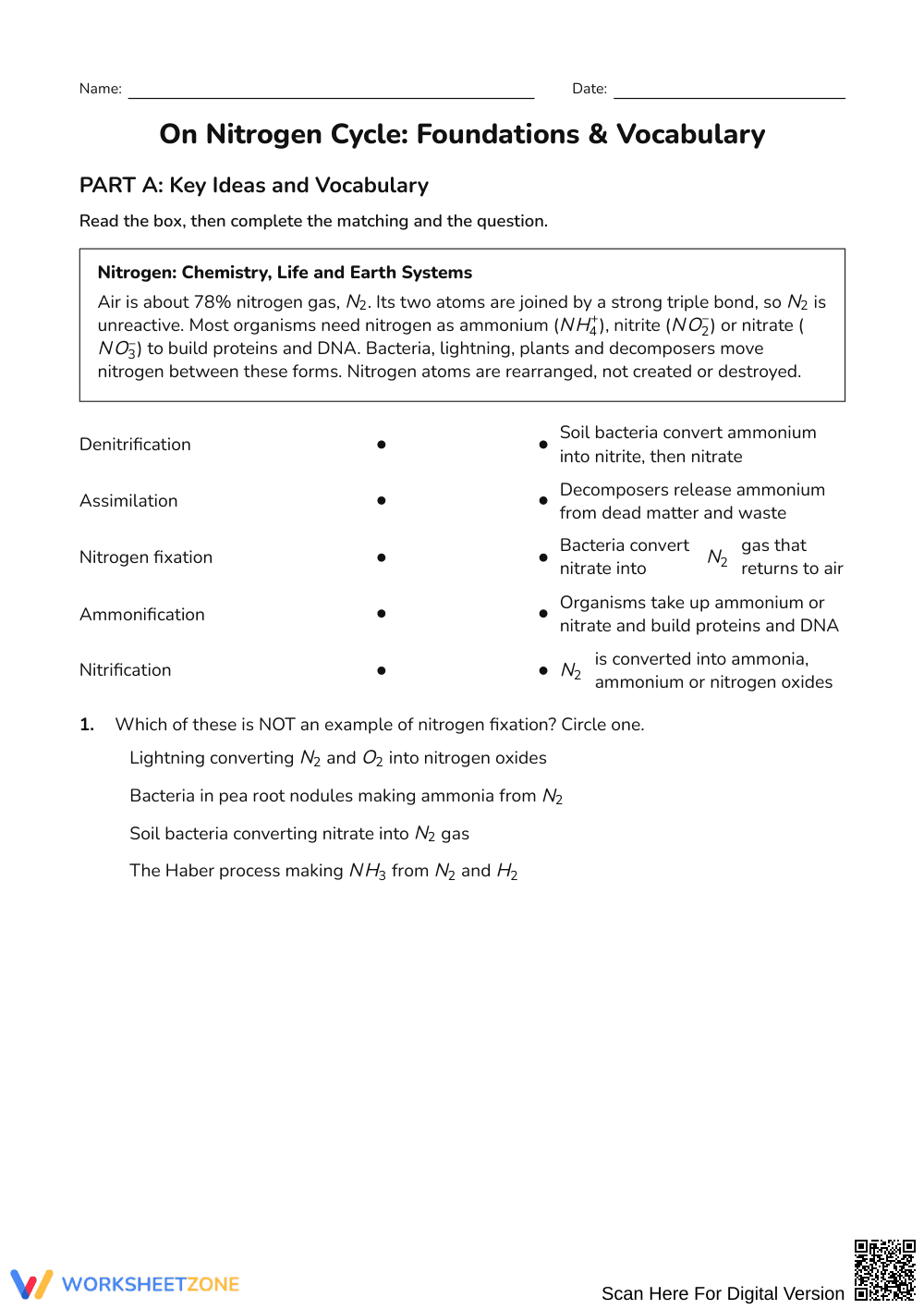
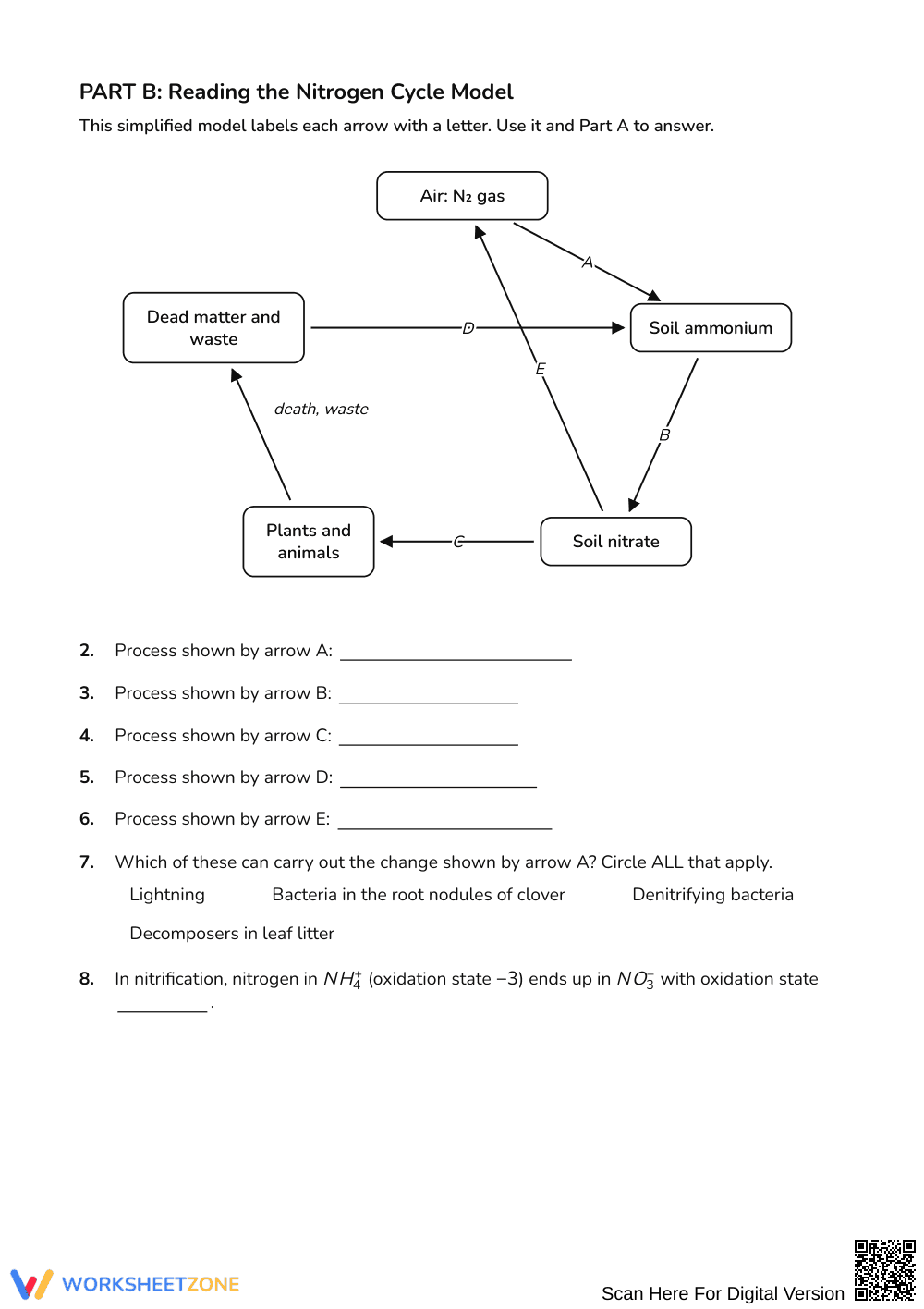
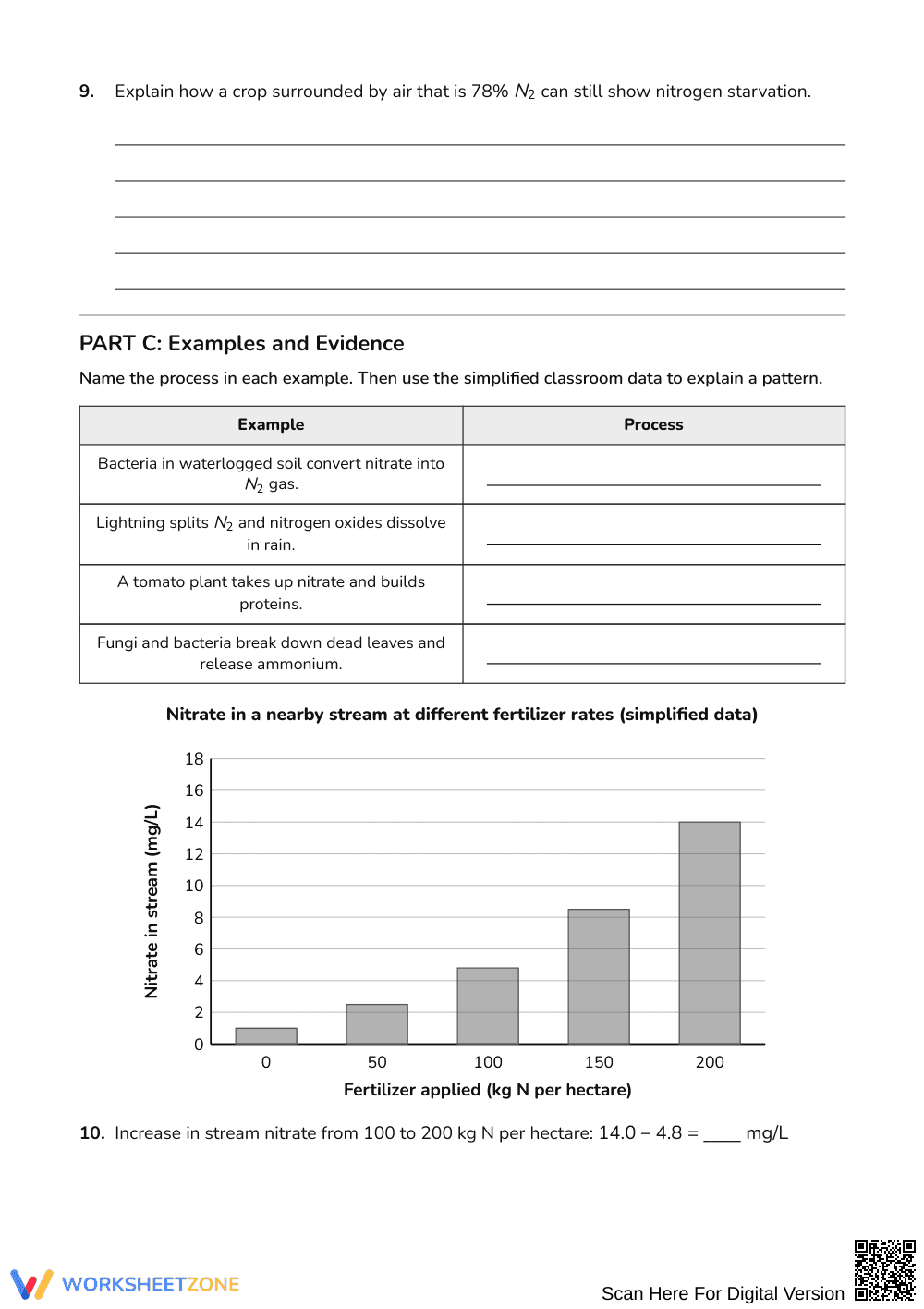
This 4-page worksheet includes 22 problems across four distinct parts. It features a chemistry reference box defining five core processes, a labeled pathway diagram, a quantitative agricultural runoff data table, and misconception correction exercises. A 4-page answer key supplies complete explanations.
Skill Progression
- Guided practice (Part A, 6 tasks): Vocabulary matching supported by a chemistry definition box.
- Supported practice (Parts B and C, 12 tasks): Diagram pathway tracing and stream nitrate data interpretation.
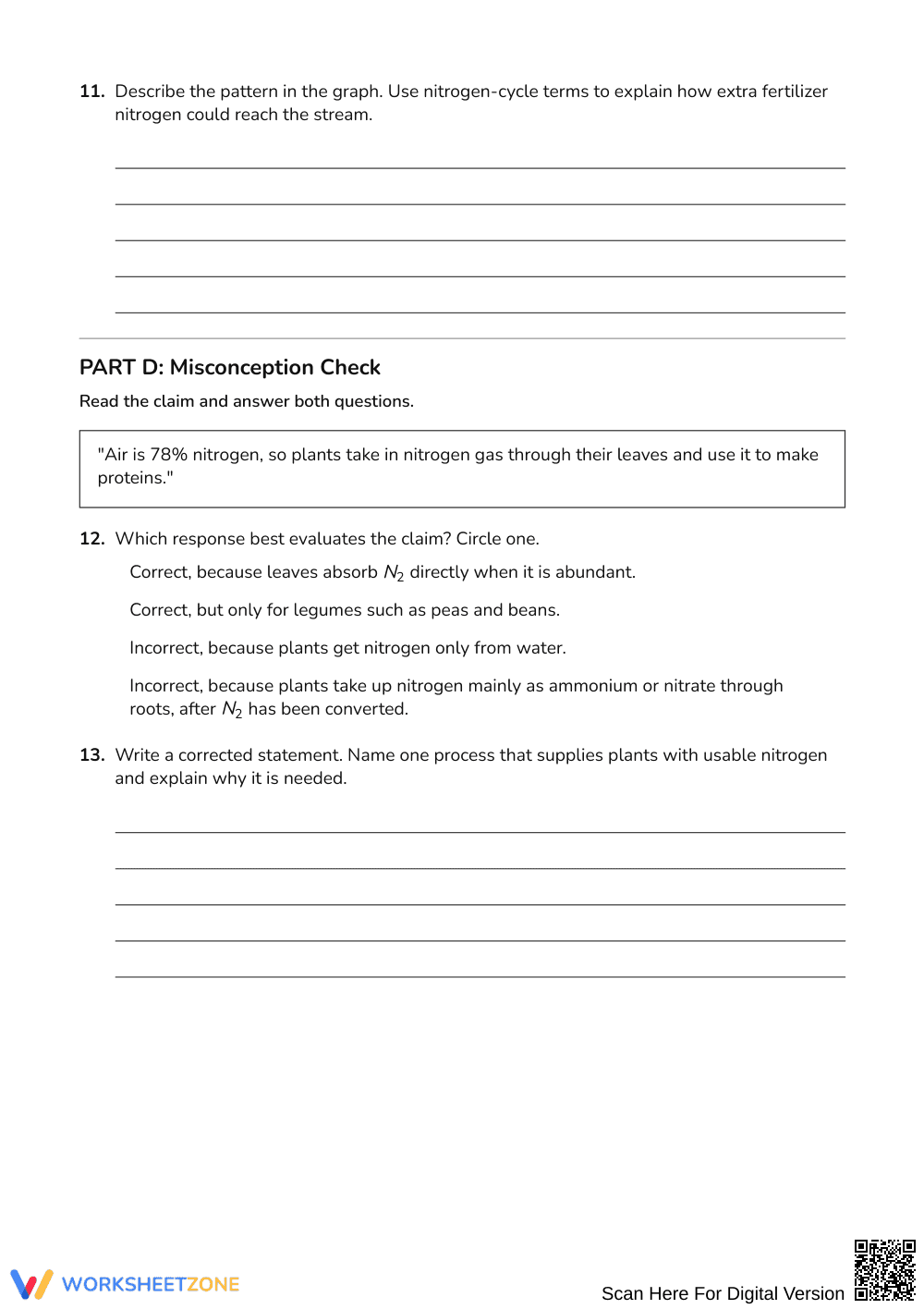
- Independent practice (Part D, 4 tasks): Evaluating and rewriting flawed statements regarding plant nitrogen uptake.
This sequence follows a gradual-release model, advancing from supported definitions to independent synthesis.
Standards Alignment
This resource aligns with high school standards covering matter cycling and energy flow in ecosystems. Students model chemical shifts and biological transformations across biotic and abiotic reservoirs. Both standard codes can be copied directly into lesson plans, IEP goals, or district curriculum mapping tools.
How to Use It
Assign this worksheet following direct instruction on biogeochemical cycles or use Part A and Part B as mid-unit diagnostic stations. For formative assessment, check student explanations of fertilizer runoff in Part C to verify understanding of nitrification. Expected completion time is 40 to 50 minutes.
Who It's For
Designed for biology and environmental science students, this resource includes reference boxes to support developing readers. Pair it with an anchor chart on the carbon cycle or an agricultural case study on eutrophication.
High school science instruction requires clear scaffolding to help students connect molecular chemistry with ecosystem-level processes. This 4-page resource targets essential nitrogen cycle vocabulary and mechanisms across 22 problems, addressing chemical transformations including nitrification, nitrogen fixation, and assimilation. By engaging students in diagram analysis, quantitative fertilizer data interpretation, and explicit misconception refutation, the worksheet solidifies foundational knowledge prior to complex ecological modeling. According to research by Fisher & Frey (2014) on instructional scaffolding, moving learners systematically from structured reference tasks to independent conceptual evaluation substantially deepens content retention and scientific reasoning. Educators can readily assess student readiness as learners articulate why plants cannot directly absorb atmospheric nitrogen gas despite its environmental abundance. The included 4-page answer key supports rapid formative feedback and student self-assessment, making this document a reliable, research-supported practice tool for secondary science classrooms.


