




























Views
Downloads


Complete Nitrogen Cycle Worksheet | Grade 9-12 Science

Paste this activity's link or code into your existing LMS (Google Classroom, Canvas, Teams, Schoology, Moodle, etc.).
Students can open and work on the activity right away, with no student login required.
You'll still be able to track student progress and results from your teacher account.
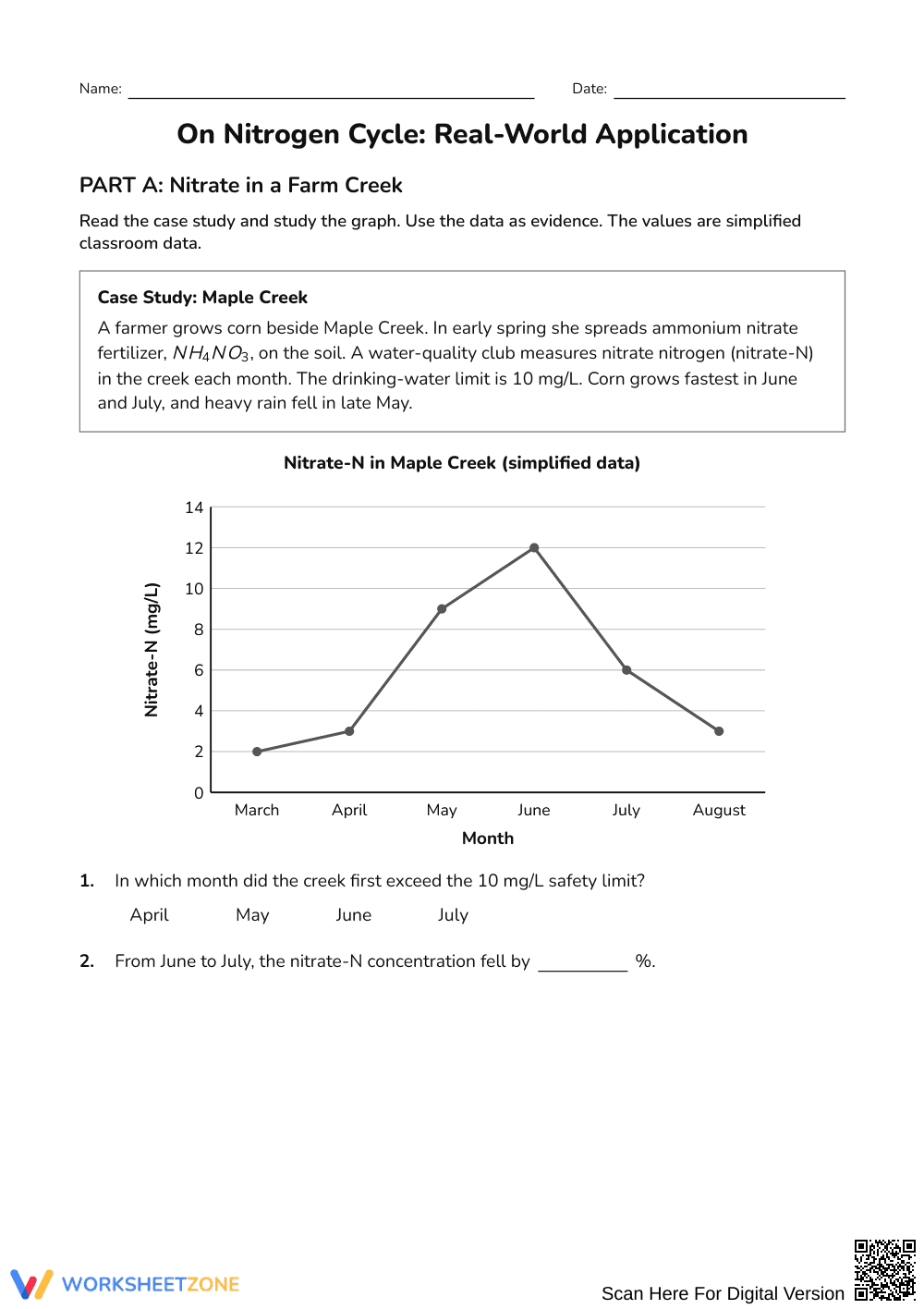
This high school science worksheet engages students in evaluating nutrient pollution through the biochemical nitrogen cycle. Learners interpret environmental monitoring data from an agricultural watershed, track oxidation states during biological transformations, calculate fertilizer nitrogen percentages, and analyze conservation strategies to mitigate hazardous nitrate runoff into aquatic ecosystems.
At a Glance
- Grade: Grades 9–12 · Subject: Science
- Standard: High School Science — Model cycling of matter and energy flows in ecosystems
- Skill Focus: Nitrogen cycle processes, agricultural runoff, and stoichiometry
- Format: 4 pages · 19 problems · Answer key included · PDF
- Best For: Environmental science and biology practice
- Time: 45–60 minutes
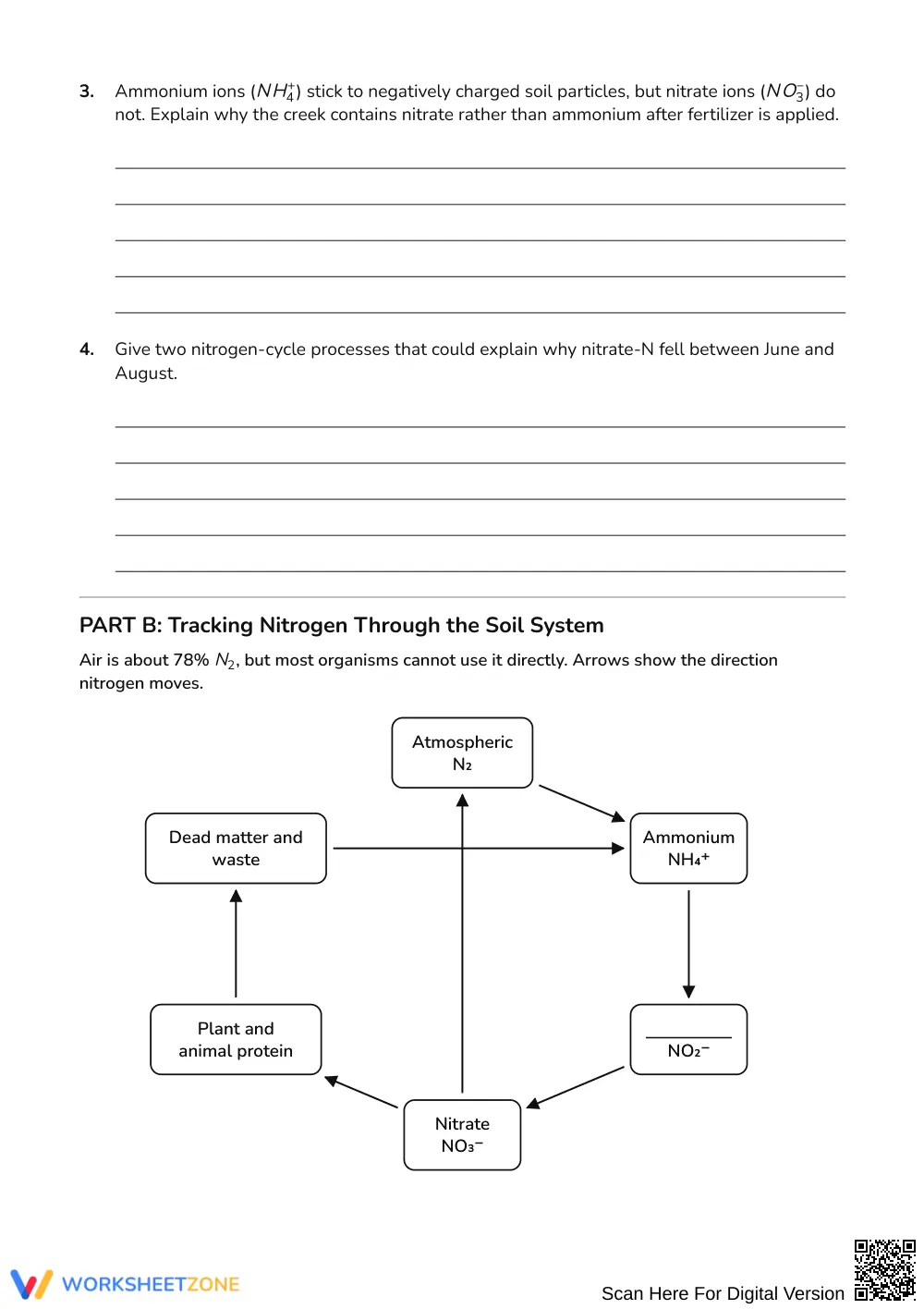
The four-page printable packet contains 19 analytical tasks organized into four case study sections. Students analyze Maple Creek watershed data, trace biological fixation and denitrification pathways, execute molar mass calculations using a reference table, and evaluate farm management plans. A complete four-page answer key provides thorough explanations and values.
Skill Progression
- Guided practice (Part A): Students examine creek data alongside a rule on soil-ion attraction, answering 4 introductory prompts on nitrate thresholds and leaching.
- Supported practice (Parts B & C): Learners complete 8 intermediate items tracking oxidation states from -3 to +5 and computing fertilizer mass percentages.
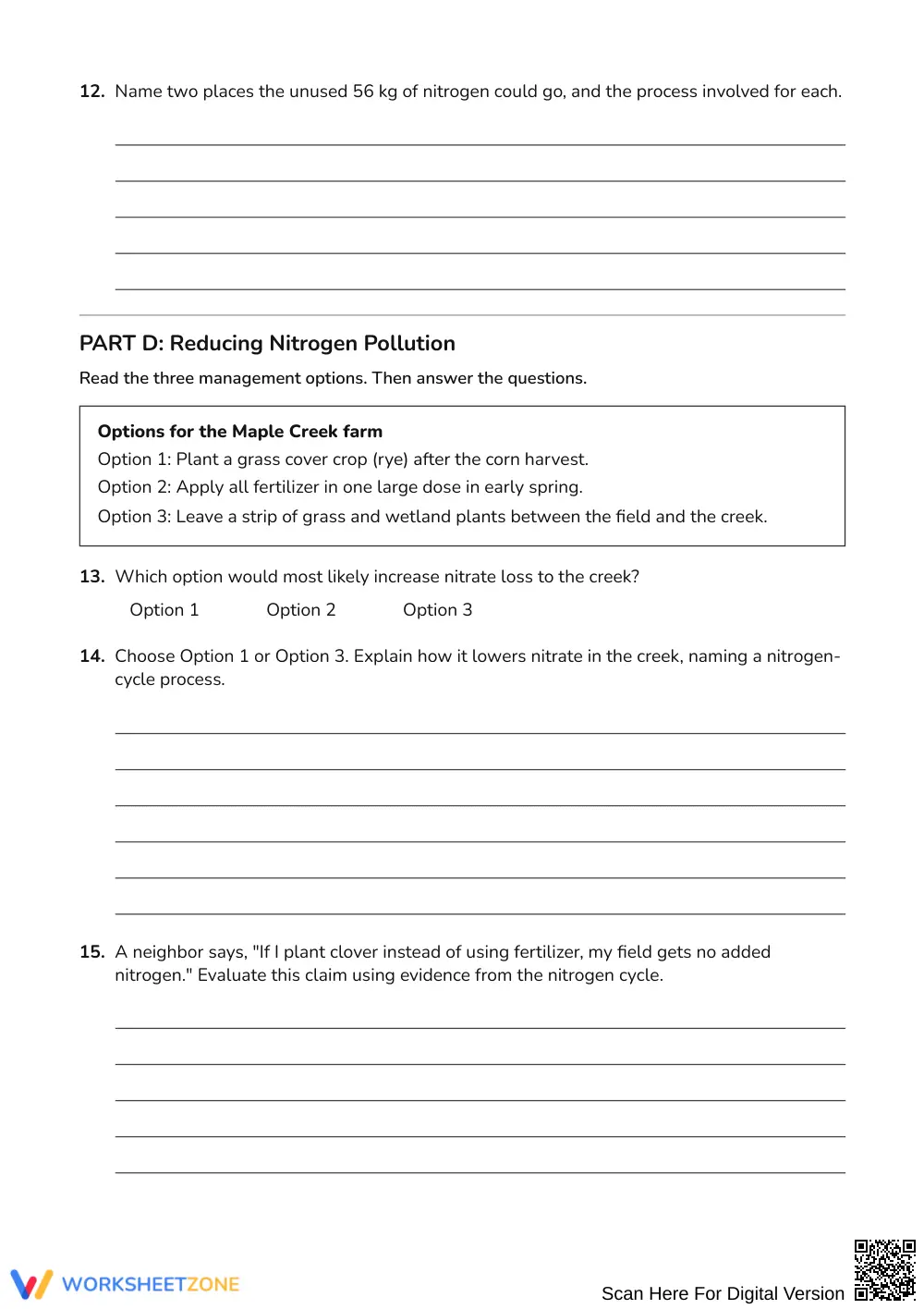
- Independent practice (Part D): Students independently evaluate 7 complex prompts regarding cover crops, riparian buffer strips, and biological nitrogen fixation.
This sequence follows a gradual-release model, moving students from data comprehension to independent ecological evaluation.
Standards Alignment
This resource aligns with high school standards for Matter and Energy in Ecosystems, requiring students to model the cycling of matter in physical environments. It also supports core quantitative expectations through stoichiometric mass percentage calculations. These standard descriptions can be copied directly into lesson plans, IEP goals, or district curriculum mapping tools.
How to Use It
Deploy this worksheet after direct instruction on biogeochemical cycles to deepen conceptual transfer. In an inquiry lesson, have student pairs complete Parts A and B collaboratively before attempting the calculations in Part C individually. Formatively assess understanding by checking whether students correctly explain why negatively charged nitrate leaches while ammonium binds to soil particles. Completion requires 45 to 60 minutes.
Who It's For
This practice packet is designed for Grade 9–12 students in Biology, Environmental Science, or Agricultural Science. For differentiated support, provide the chemical formula reference guide to emerging learners, while prompting advanced students to balance the redox reactions in denitrification. Pair this activity directly with an aquatic ecology lab or agricultural runoff case study.
According to research on structured secondary science inquiry highlighted by Fisher & Frey (2014), gradual-release instructional sequences significantly improve students' ability to synthesize complex ecological mechanisms and quantitative chemical reasoning. This worksheet scaffolds 19 authentic tasks across 4 comprehensive pages, targeting the core high school standard requiring learners to model how matter cycles through biological and chemical Earth systems. Beginning with concrete watershed monitoring data, students analyze bacterial nitrification, track nitrogen oxidation states, compute molar mass percentages for urea and ammonium salts, and evaluate agricultural best management practices such as riparian buffer zones. Grounding abstract nutrient cycling in a local agricultural pollution scenario enables high school learners to bridge the gap between microscopic microbial biochemistry and macroscopic environmental stewardship. Complete with a 4-page answer key, this resource delivers targeted, measurable mastery verification for high school biology, chemistry, and environmental science classrooms.


