




























Views
Downloads


Essential Nitrogen Cycle Worksheet | Grade 9–12 Science

Paste this activity's link or code into your existing LMS (Google Classroom, Canvas, Teams, Schoology, Moodle, etc.).
Students can open and work on the activity right away, with no student login required.
You'll still be able to track student progress and results from your teacher account.
Opening
This worksheet guides high school students through the nitrogen cycle, moving them from basic recall to making predictions and explaining real-world impacts. By completing 21 scaffolded tasks, learners will confidently apply cycle concepts to data, scenarios, and environmental questions.
At a Glance
- Grade: Grades 9–12 · Subject: Science
- Standard: General Science — Explain nitrogen transformations and predict environmental impacts
- Skill Focus: apply the concept to several scaffolded scenarios that move from direct recall to prediction and explanation
- Format: 4 pages · 21 problems · Answer key included · PDF
- Best For: classroom labs & environmental units
- Time: 30–45 minutes
What's Inside
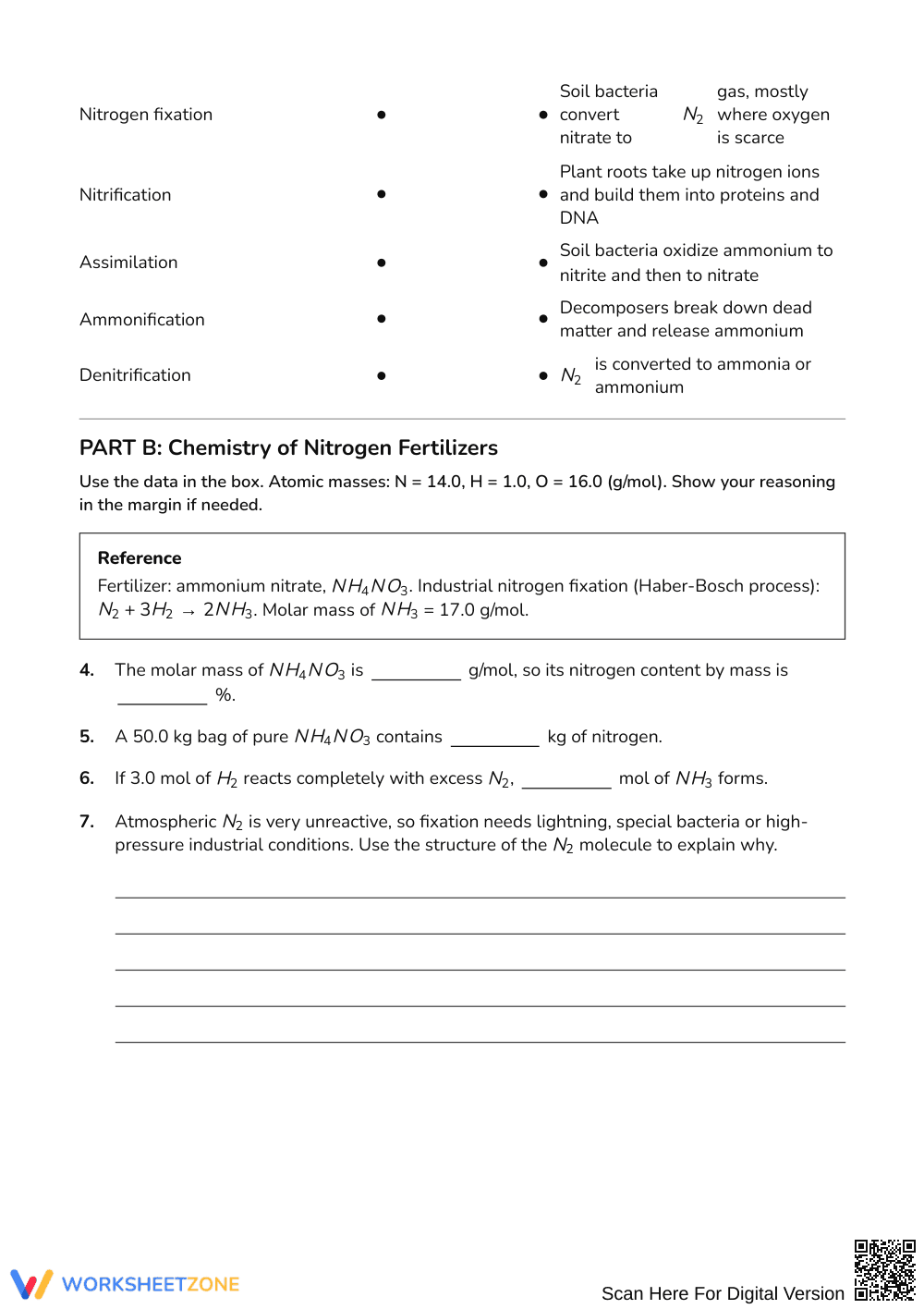
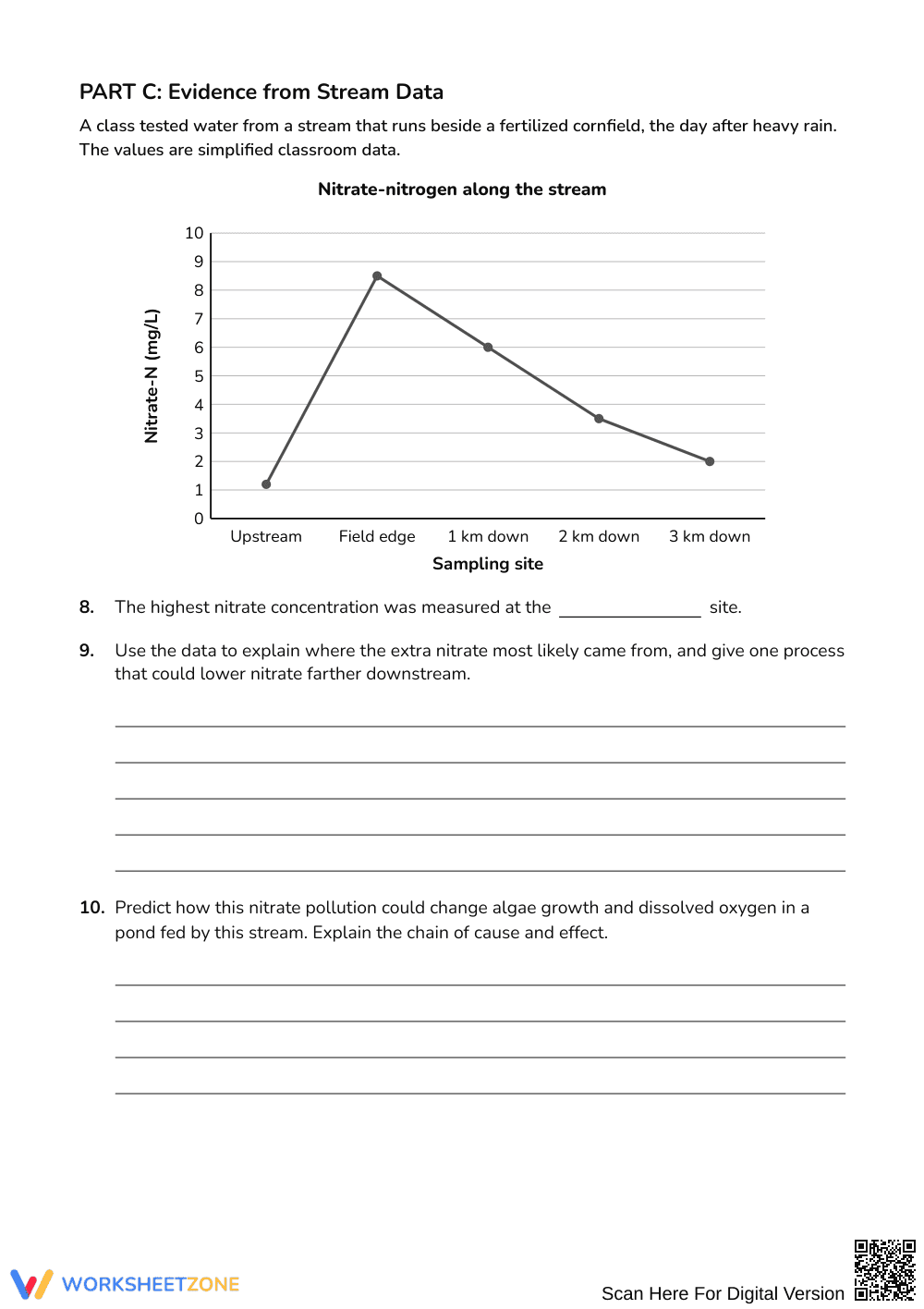
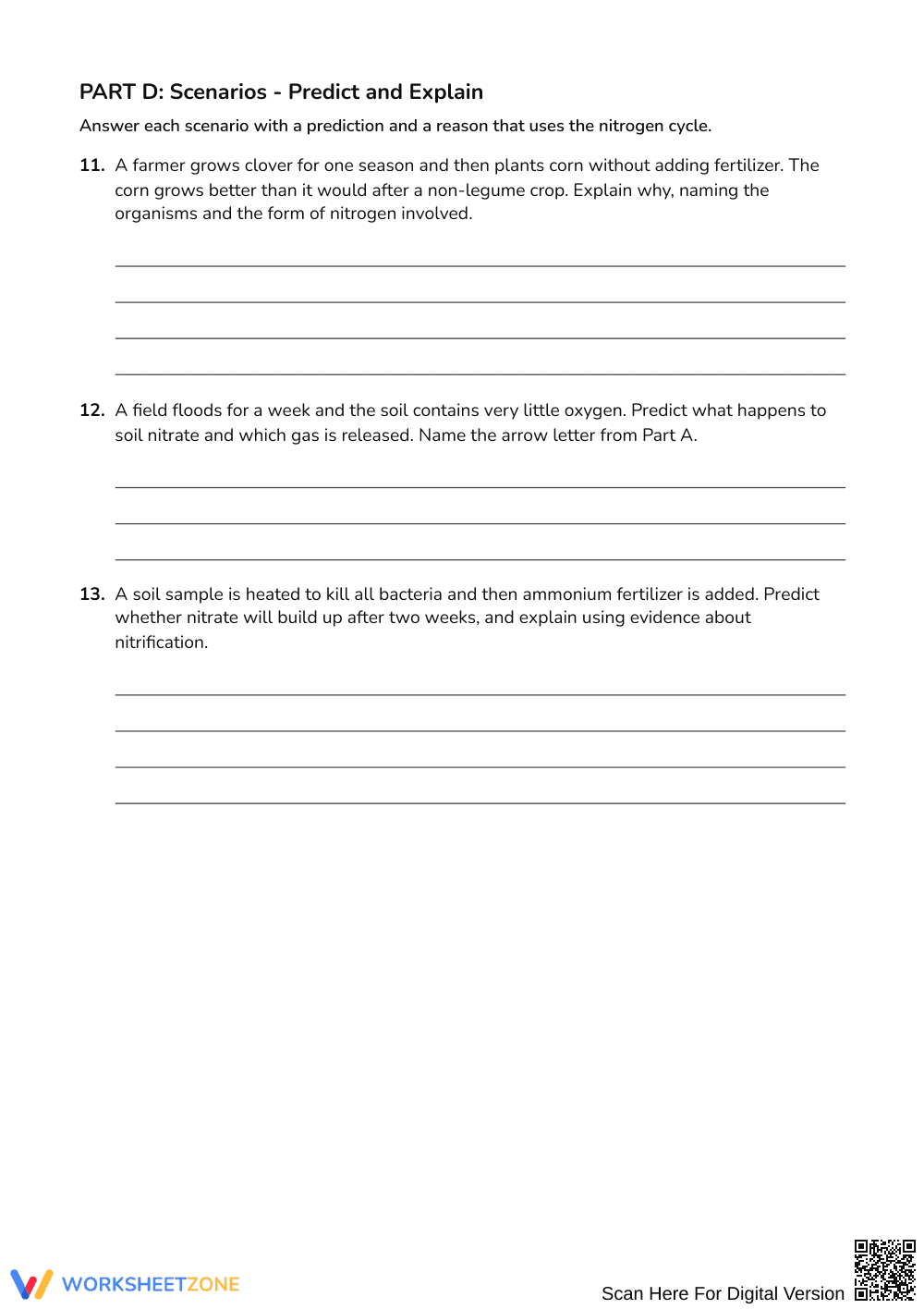
The packet includes a reading of a simplified nitrogen cycle diagram, multiple-choice concept checks, short-answer data analysis, and three prediction scenarios. All 4 pages are printable; the answer key occupies a full back-to-back page. Margin prompts and sentence frames support students as they move toward independent explanation.
Skill Progression
- Guided practice – 6 problems with sentence frames and a word bank to reinforce terminology.
- Supported practice – 8 problems requiring short written explanations and diagram labeling.
- Independent practice – 7 problems that ask for full predictions, cause-effect chains, and justification.
The worksheet follows a gradual-release model (I Do, We Do, You Do) to build confidence at each step.
Curriculum Alignment
Students explain each step of the nitrogen cycle and apply biological concepts to real-world environmental scenarios. This resource fits naturally into high school biology, ecology, and earth science units, allowing educators to insert the learning goals directly into lesson plans, IEP goals, or district curriculum mapping frameworks.
How to Use It
Before instruction: Deploy Part A as a quick diagnostic (10-15 min) to gauge prior knowledge of nitrogen transformations.
After a water-quality lab: Use Parts C and D for data interpretation and extension (20-30 min). Observe whether students correctly identify arrow F for denitrification as a formative check.
Who It's For
Designed for grades 9-12 science classes, especially environmental science, advanced biology, and earth systems courses. The built-in scaffolds allow differentiation without separate versions; teachers can simplify prompts for struggling readers. Pair with a short video on nitrogen-fixing bacteria for a multimodal lesson.
Research in secondary science education consistently demonstrates that structured instructional scaffolding helps high school learners master complex biogeochemical cycles and transfer abstract knowledge to novel problem-solving tasks (Fisher & Frey, 2014). By beginning with explicit vocabulary banks and progressing systematically through guided diagram analysis, supported short answers, and independent scenario predictions, this resource effectively models evidence-based gradual release principles. Learners develop robust conceptual frameworks of microbial transformations such as fixation, nitrification, assimilation, and denitrification before confronting challenging real-world environmental dilemmas. Furthermore, providing supportive sentence stems substantially lowers extraneous cognitive load, enabling emerging bilingual learners and struggling readers to formulate clear, coherent scientific explanations. When educators integrate targeted formative assessment checks alongside progressive inquiry tasks, students achieve significant gains in analytical confidence, data interpretation skills, and long-term conceptual retention across diverse secondary classroom learning settings throughout the academic year.


