




























Views
Downloads

Complete Nitrogen Cycle Worksheet | Grades 9-12 Science

Paste this activity's link or code into your existing LMS (Google Classroom, Canvas, Teams, Schoology, Moodle, etc.).
Students can open and work on the activity right away, with no student login required.
You'll still be able to track student progress and results from your teacher account.
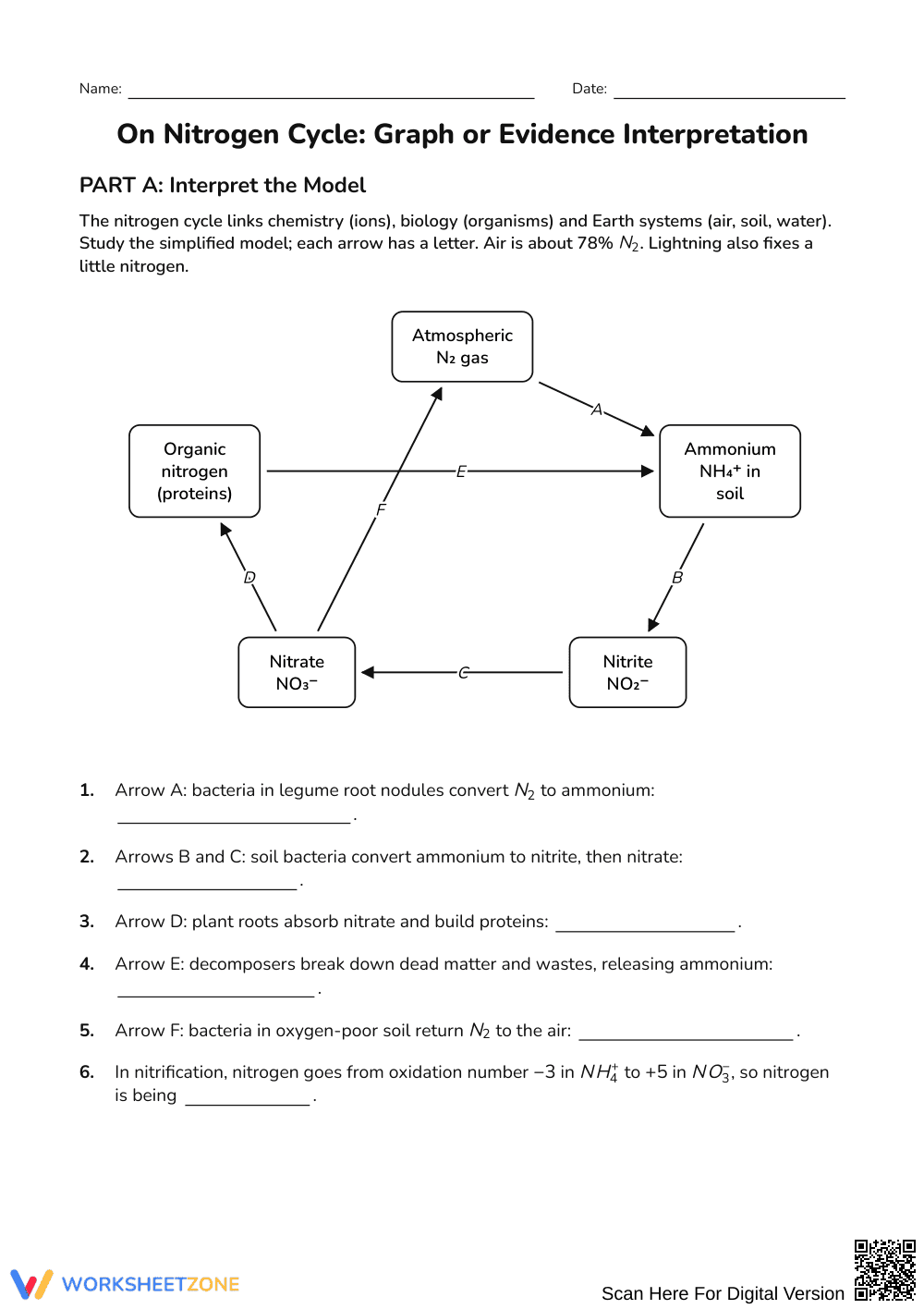
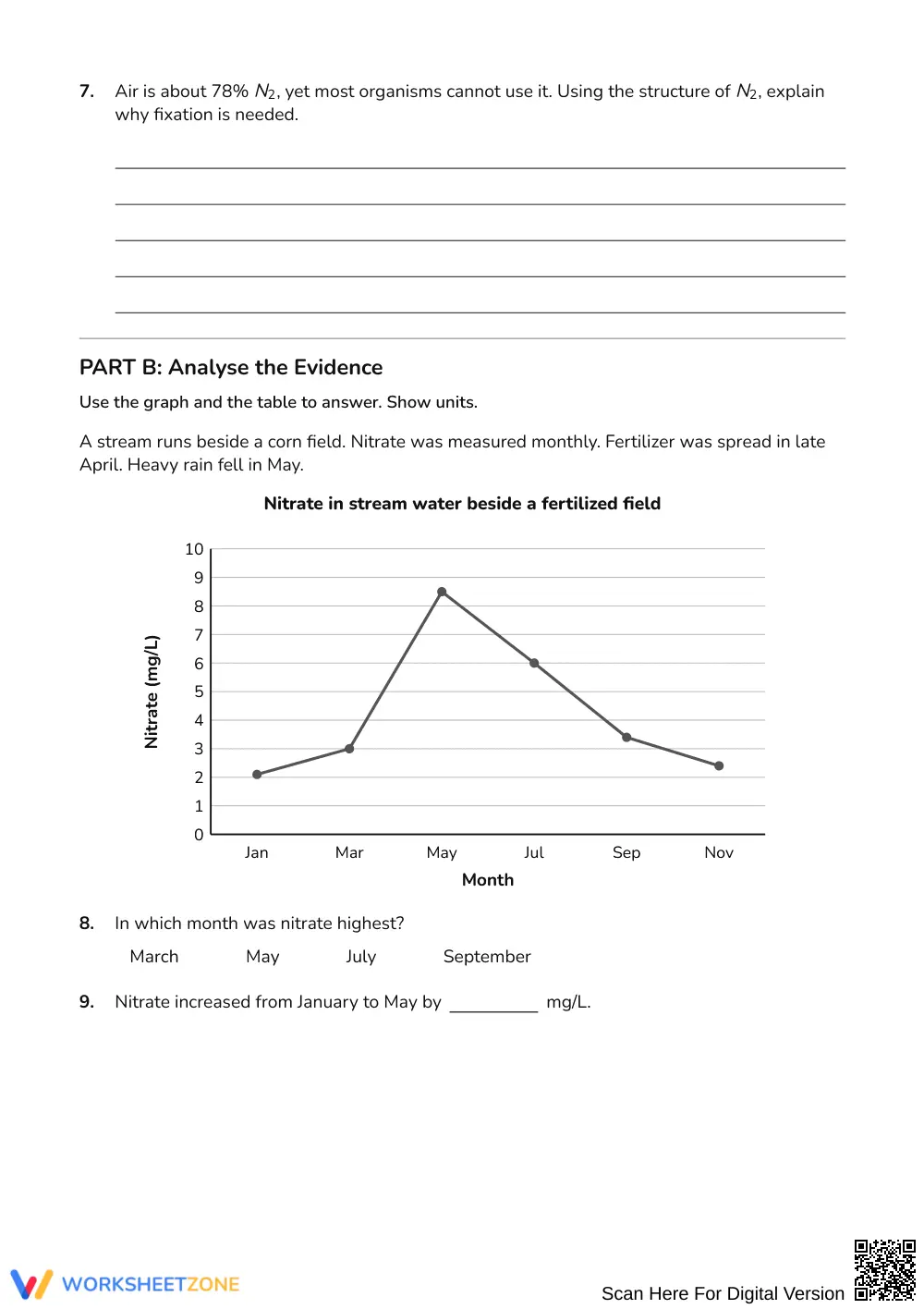
This comprehensive high school science worksheet guides students through chemical transformations and ecological flows within the nitrogen cycle. Learners interpret molecular models, calculate agricultural runoff data, and construct evidence-based scientific arguments explaining environmental impacts. Designed for biology, chemistry, and environmental science, this resource equips students to connect biochemical mechanisms to ecosystem stability.
At a Glance
- Grade: Grades 9–12 · Subject: Science
- Standard: Ecosystem Matter Cycling — Analyze and interpret data on matter cycling and nutrient flows in ecosystems
- Skill Focus: Nitrogen cycle models, chemical oxidation, and data analysis
- Format: 4 pages · 20 problems · Answer key included · PDF
- Best For: Biogeochemical cycles unit practice or assessment
- Time: 45–60 minutes
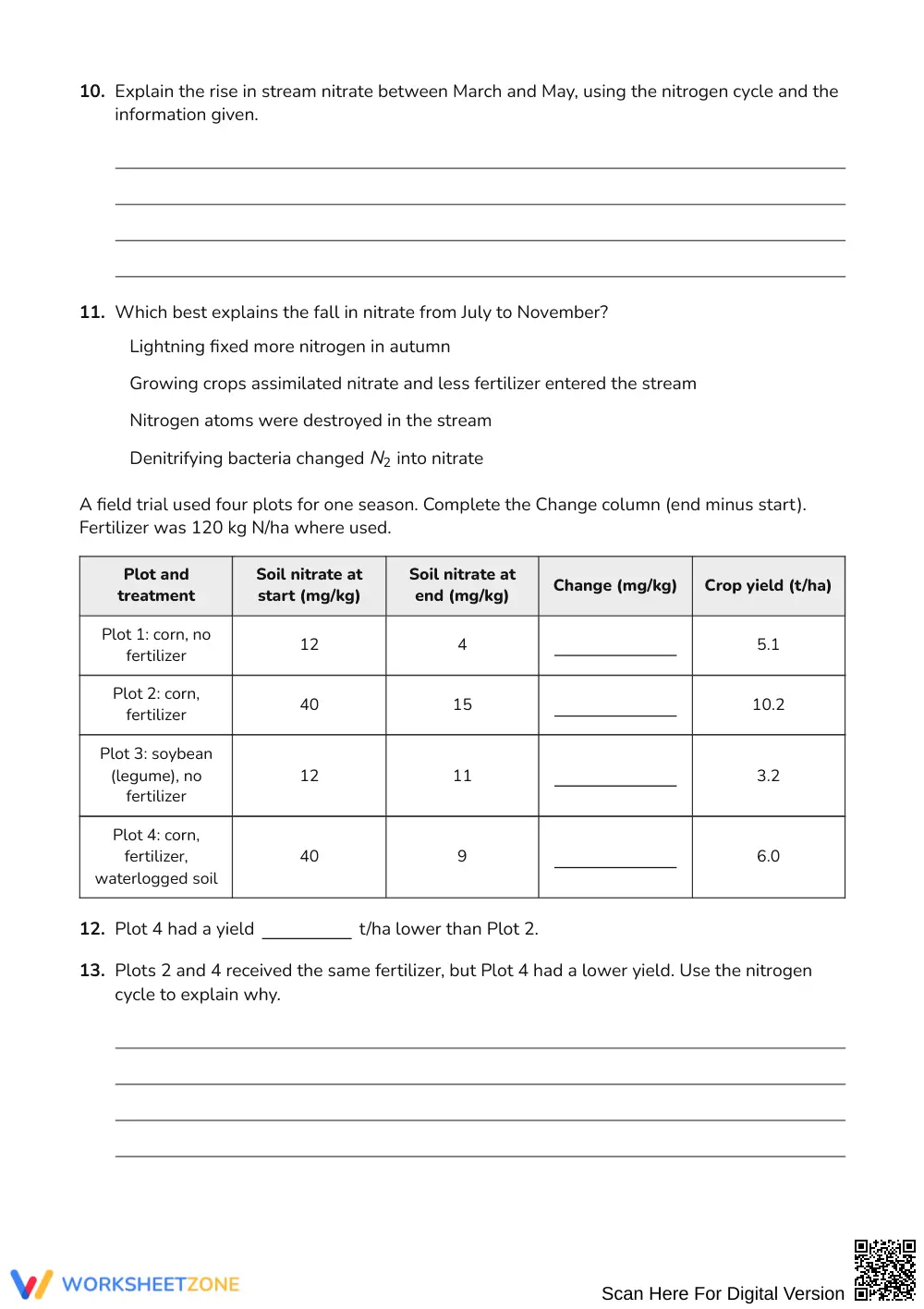
Students engage with 20 targeted tasks spread across four clean, printable pages. The activity incorporates a detailed chemical transformation pathway, monthly stream runoff tables, and multi-treatment agronomic yield data. A comprehensive 4-page answer key provides complete chemical oxidation states, quantitative calculations, and exemplar Claim-Evidence-Reasoning responses for straightforward grading and self-assessment.
Skill Progression
- Guided practice (Tasks 1–6): Students analyze a visual nitrogen cycle model, identify chemical formulas and oxidation states from ammonium to nitrate, and explain why molecular nitrogen requires biological fixation.
- Supported practice (Tasks 7–15): Learners evaluate monthly stream nitrate concentrations and calculate soil nutrient changes across four agricultural experimental plots using quantitative data tables.
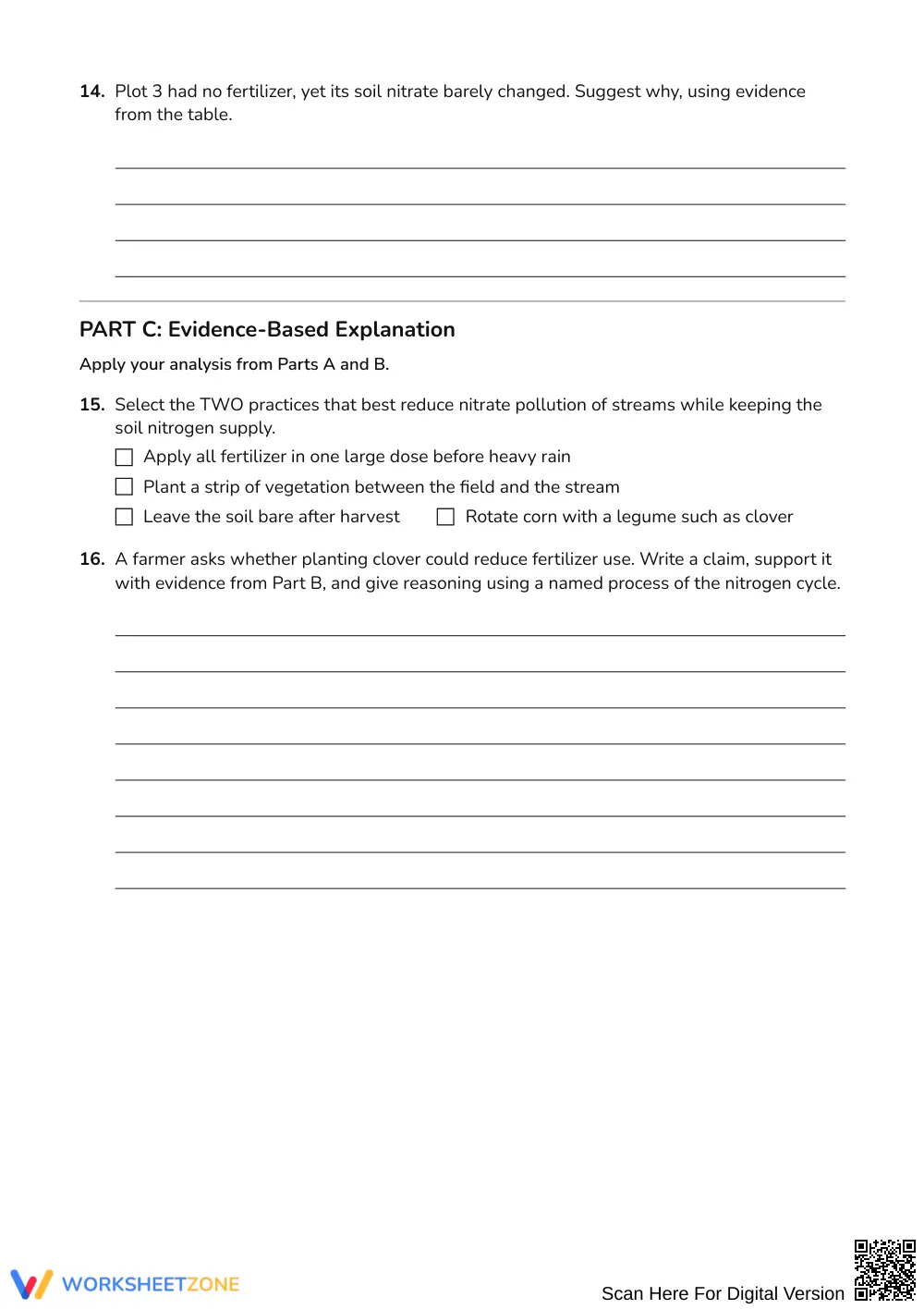
- Independent practice (Tasks 16–20): Students synthesize ecological principles by evaluating agricultural conservation strategies and constructing a formal Claim-Evidence-Reasoning response on crop rotation.
This structured progression follows the gradual-release framework, moving students systematically from conceptual model comprehension to independent data synthesis.
Standards Alignment
This worksheet addresses core high school life science and environmental science objectives on biogeochemical cycles and matter conservation. Students analyze the cycling of nitrogen between atmospheric, biological, and soil reservoirs while tracking oxidation states and ecosystem disruptions. Both standard codes can be copied directly into lesson plans, IEP goals, or district curriculum mapping tools.
How to Use It
Deploy this worksheet after direct instruction on biogeochemical cycles as mid-unit collaborative practice or as an independent summative review before an exam. During the lesson, monitor how accurately students explain bacterial denitrification when analyzing waterlogged soils to check for common conceptual gaps. Completion typically takes between 45 and 60 minutes of focused class time.
Who It's For
This worksheet serves general biology, chemistry, and environmental science students in grades 9 through 12. Teachers can support struggling learners with the provided chemical ion reference while challenging advanced students to balance oxidation numbers. Pair this activity with an interactive biogeochemical cycle lecture or laboratory investigation.
According to Fisher & Frey (2014), structured instructional scaffolds that combine explicit model interpretation with quantitative data analysis significantly increase secondary science proficiency. Secondary students frequently struggle to link microscopic chemical transformations—such as bacterial nitrification and ammonium oxidation—with macro-level environmental phenomena like agricultural runoff and aquatic eutrophication. This 20-problem resource targets these foundational conceptual hurdles by embedding multiple representations of matter cycling within a gradual-release architecture. Students analyze molecular structures, calculate empirical yield differences across experimental plots, and formulate written scientific arguments supported by quantitative evidence. Research on gradual release emphasizes that systematically transitioning from guided diagram labeling to independent evidence-based reasoning promotes durable retention of complex ecological concepts. Teachers can utilize this four-page print-and-go worksheet to verify student mastery of biogeochemical cycles while establishing rigorous data interpretation routines that support high school scientific literacy.


