




























Views
Downloads


Complete Nitrogen Cycle Worksheet | Grade 9-12 Science

Paste this activity's link or code into your existing LMS (Google Classroom, Canvas, Teams, Schoology, Moodle, etc.).
Students can open and work on the activity right away, with no student login required.
You'll still be able to track student progress and results from your teacher account.
This comprehensive high school science assessment deepens student understanding of biochemical systems through quantitative modeling and data analysis. Students analyze chemical transformations, calculate mass percentages of nitrogen compounds, and interpret ecological runoff data across 20 rigorous tasks to explain matter conservation and energy flow in environmental cycles.
At a Glance
- Grade: Grades 9–12 · Subject: Science
- Standard: High School Science — Model cycling of matter and energy flow in ecosystems
- Skill Focus: Nitrogen cycle modeling, stoichiometry, and ecological data analysis
- Format: 4 pages · 20 problems · Answer key included · PDF
- Best For: Cumulative unit assessment or review
- Time: 45–60 minutes
What's Inside
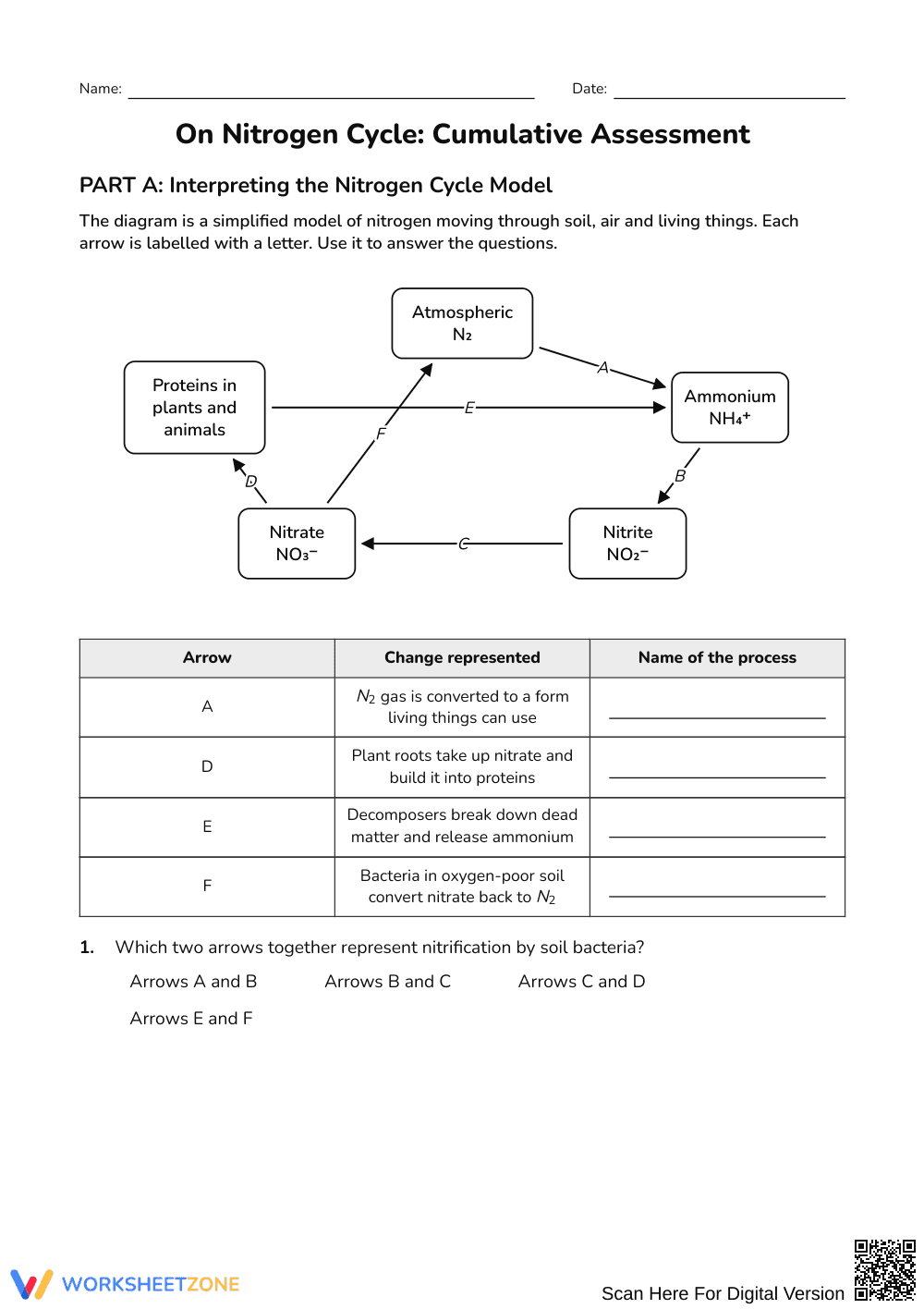
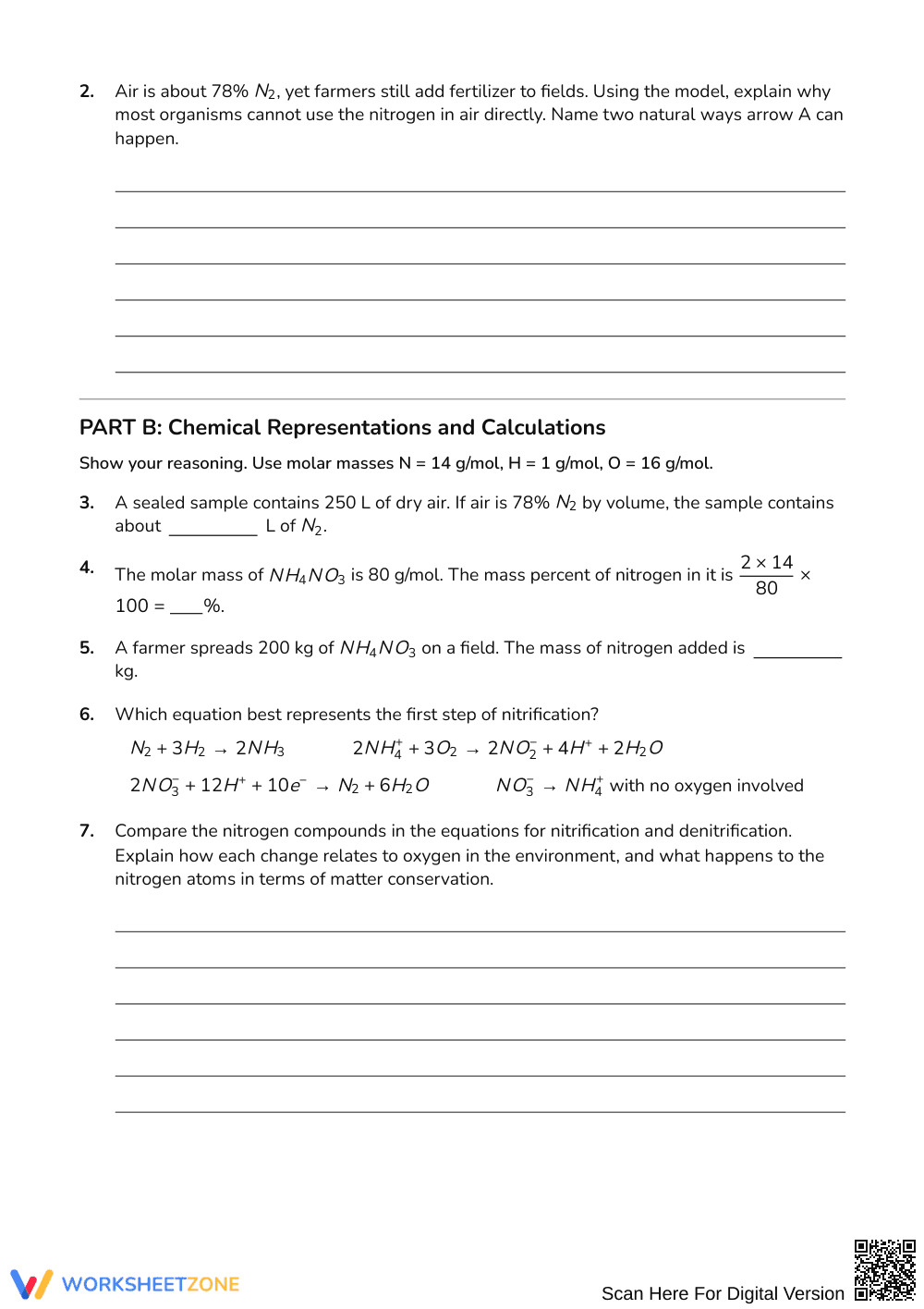
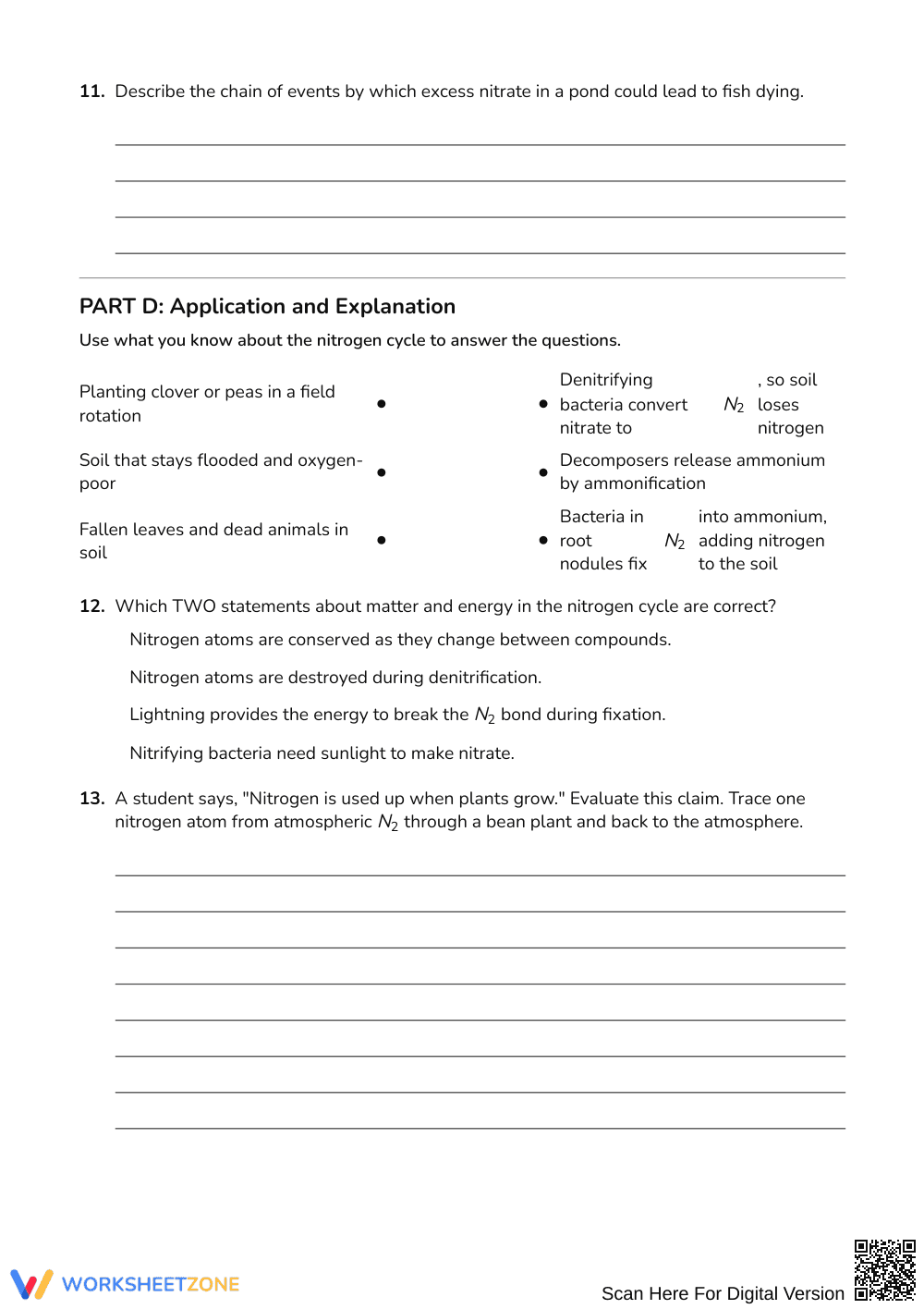
The four-page student packet contains four structured sections: pathway diagram interpretation, chemical equation balancing with molar mass stoichiometry, claim-evidence-reasoning graph analysis, and real-world agricultural scenarios. A matching four-page teacher answer key provides full calculation steps, balanced chemical formulas, and sample written explanations for straightforward grading.
Skill Progression
- Guided practice (Part A & Part B, 8 problems): Students identify nitrogen reservoirs, process names, and chemical formulas with direct reference to visual models and atomic mass data tables.
- Supported practice (Part C, 6 problems): Learners evaluate monthly ditch runoff data using a claim-evidence-reasoning scaffold to trace fertilizer leaching and describe eutrophication mechanisms.
- Independent practice (Part D, 6 problems): Students evaluate student misconceptions, construct unprompted explanations of matter conservation, and trace single nitrogen atoms across atmospheric, biological, and geological reservoirs.
This structured sequence reflects the gradual-release model, advancing students from foundational vocabulary and quantitative reasoning to independent synthesis.
Standards Alignment
This worksheet aligns with high school physical and life science standards requiring students to model the cycling of matter and flow of energy across ecosystems. The quantitative tasks directly support standards calling for mathematical representations of chemical equations and conservation of atoms. These curricular objectives can be copied directly into lesson plans or IEP goals.
How to Use It
Administer this four-page worksheet after direct instruction on biogeochemical cycles or agricultural chemistry. Teachers can assign Parts A and B as a collaborative checkpoint during class, followed by Parts C and D as an independent assessment. During completion, monitor how students articulate lightning and bacterial fixation; misconceptions regarding plant nitrogen absorption often surface here. Anticipate a completion window of 45 to 60 minutes.
Who It's For
This resource is designed for Grades 9–12 biology, chemistry, and environmental science students. Differentiated prompts allow co-taught classes to leverage visual cycle models and chemical equation frames, while honors students tackle multi-step stoichiometry and eutrophication CER writing. Pair this assessment with an anchor chart detailing microbial pathways or an introductory reading on soil microbiology.
According to Fisher & Frey (2014), structured progression from conceptual models to independent evidentiary writing significantly enhances student retention in secondary science courses. This 20-problem nitrogen cycle assessment operationalizes that research by leading high school learners through matter transformations, stoichiometry, and empirical data analysis. Students begin by interpreting particle diagrams of fixation and nitrification, advance to calculating fertilizer mass percentages, and culminate in authoring claim-evidence-reasoning explanations of agricultural runoff and eutrophication. By requiring learners to evaluate common misconceptions regarding atom destruction and trace single nitrogen atoms through closed bio-geological loops, the resource reinforces conservation of matter across macroscopic and microscopic scales. The included four-page answer key provides complete stoichiometric work and explanatory rubrics, ensuring teachers can efficiently diagnose conceptual hurdles. This cohesive structure supports rigorous secondary standards for biogeochemical cycling, chemical stoichiometry, and environmental systems analysis.


