




























Views
Downloads




Essential Equilibrium Shifts Worksheet | Grade 11 Chemistry

Paste this activity's link or code into your existing LMS (Google Classroom, Canvas, Teams, Schoology, Moodle, etc.).
Students can open and work on the activity right away, with no student login required.
You'll still be able to track student progress and results from your teacher account.
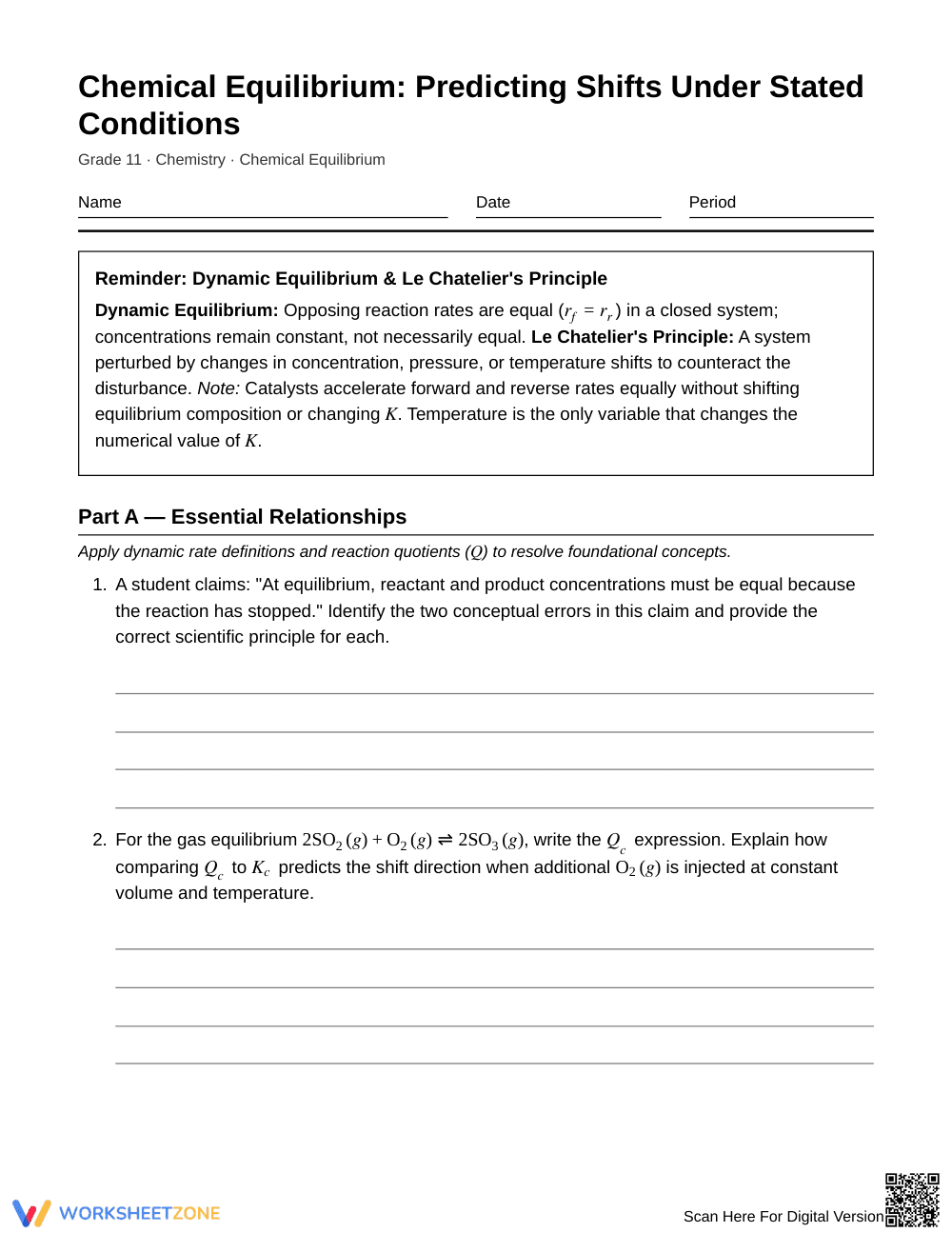
This 11th-grade chemistry worksheet equips students to accurately predict equilibrium shifts under stress through quantitative rate analysis and qualitative Le Chatelier reasoning. Learners examine dynamic equilibrium fundamentals, evaluate perturbing stresses using reaction quotient relationships, and interpret industrial data records to build robust mechanistic models.
At a Glance
- Grade: 11 · Subject: High School Chemistry
- Standard: Chemistry Core — Predict chemical system shifts using Le Chatelier's principle and dynamic reaction quotients
- Skill Focus: Predict Shifts Under Stated Equilibrium Conditions
- Format: 5 pages · 12 multi-part problems · Full answer key included · PDF
- Best For: Chemistry practice and unit assessment preparation
- Time: 45–60 minutes of analytical student work
What's Inside
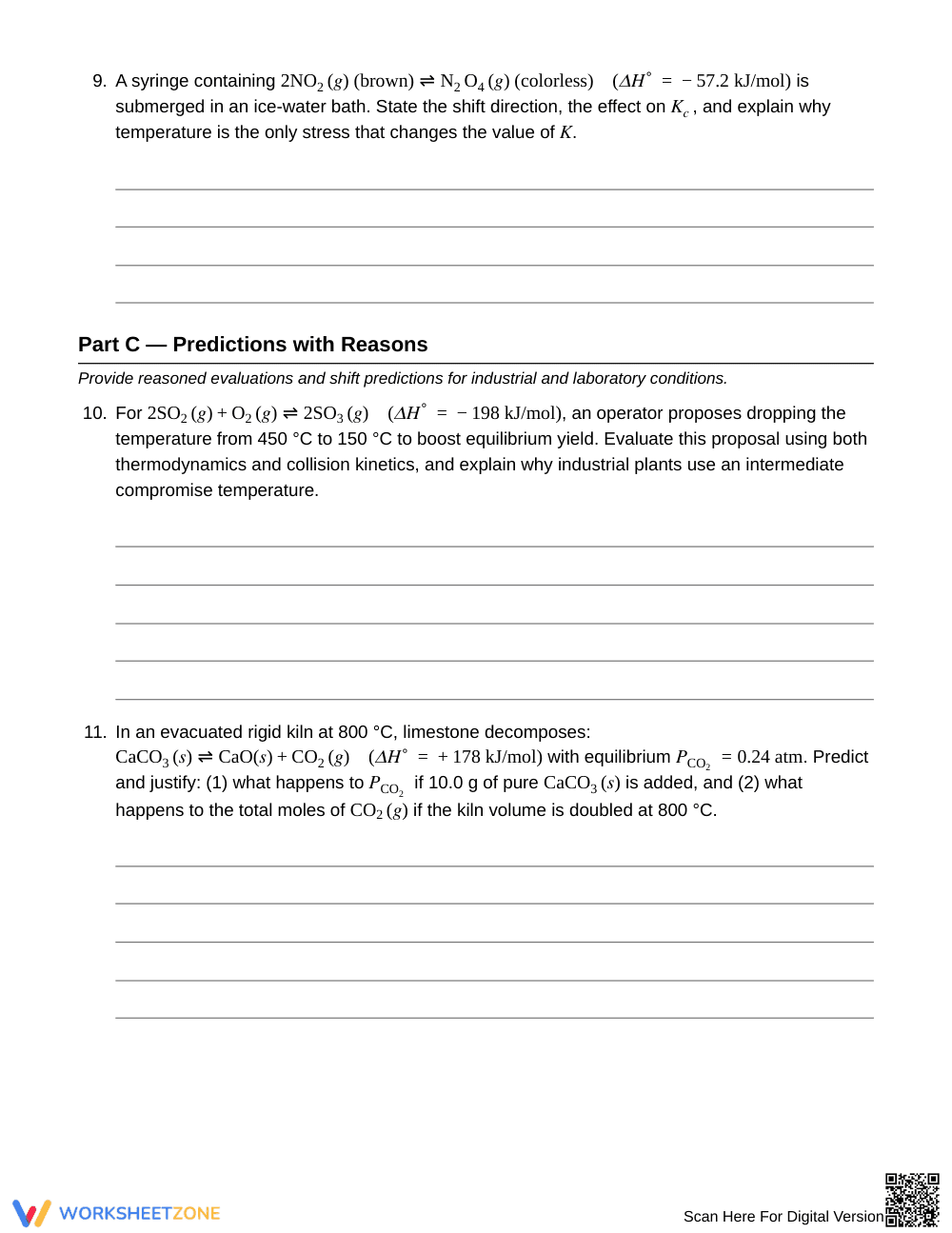
This 5-page resource includes a reference header reviewing dynamic rates and Le Chatelier's principle, followed by 12 analytical problems. Students evaluate student claim errors, calculate reaction quotients, analyze noble gas additions, and interpret synthetic rate and concentration records. A thorough 3-page answer key provides complete mechanistic explanations, rate comparisons, and step-by-step reasoning for all 12 tasks.
Skill Progression
- Guided practice (Part A, 3 problems): Students resolve foundational misconceptions, write quotient expressions, and evaluate noble gas additions with structural prompts.
- Supported practice (Part B, 6 problems): Learners interpret mechanical stresses and rate responses across concentration tables with intermediate scaffolding.
- Independent practice (Part C, 3 problems): Students autonomously evaluate industrial conditions, heterogeneous equilibria, and catalyst yield trade-offs.
This sequence follows the gradual-release model, moving students from guided conceptual diagnosis to unprompted evaluative reasoning.
Standards Alignment
This worksheet aligns with high school chemistry benchmarks requiring students to apply Le Chatelier's principle and reaction quotients to predict shifts in chemical equilibria under temperature, pressure, and concentration changes. Both standard codes can be copied directly into lesson plans, IEP goals, or district curriculum mapping tools.
How to Use It
Assign this worksheet after direct instruction on equilibrium disturbances or during comprehensive test preparation. For formative assessment, observe whether students check stoichiometric mole differences (Δn_gas) before predicting pressure shifts in Part B. Expect 11th-grade chemistry students to complete the 12 tasks in 45 to 60 minutes.
Who It's For
This practice set serves Grade 11 chemistry students in standard and honors courses mastering dynamic equilibrium. For differentiated support, pair the worksheet with an anchor chart summarizing Le Chatelier shift rules and Q versus K comparisons. Advanced students can explore the equilibrium yield trade-offs in Part C.
High school chemistry students master the plain-English skill of predicting equilibrium shifts under stress when curricula move beyond rote directional rules toward mechanism-based kinetic reasoning. Grounded in the instructional framework articulated by Fisher & Frey (2014), this 12-task worksheet operationalizes purposeful gradual release by moving learners from core reaction quotient relationships through tabular rate analysis to authentic industrial synthesis evaluations. Empirical findings synthesized by Fisher & Frey (2014) demonstrate that structured scaffolding across guided, collaborative, and independent phases significantly enhances conceptual retention and reduces common misconceptions regarding dynamic balance. By requiring 11th-grade students to contrast instantaneous forward and reverse rates, inspect synthetic concentration records, and balance kinetic rates against thermodynamic yields, this resource cultivates rigorous analytical reasoning. Chemistry educators can reliably utilize this 5-page curriculum asset to document student progression toward full mastery of dynamic equilibrium systems.


