




























Views
Downloads



Essential Equilibrium Shift Worksheet | Grade 11 Chemistry

Paste this activity's link or code into your existing LMS (Google Classroom, Canvas, Teams, Schoology, Moodle, etc.).
Students can open and work on the activity right away, with no student login required.
You'll still be able to track student progress and results from your teacher account.
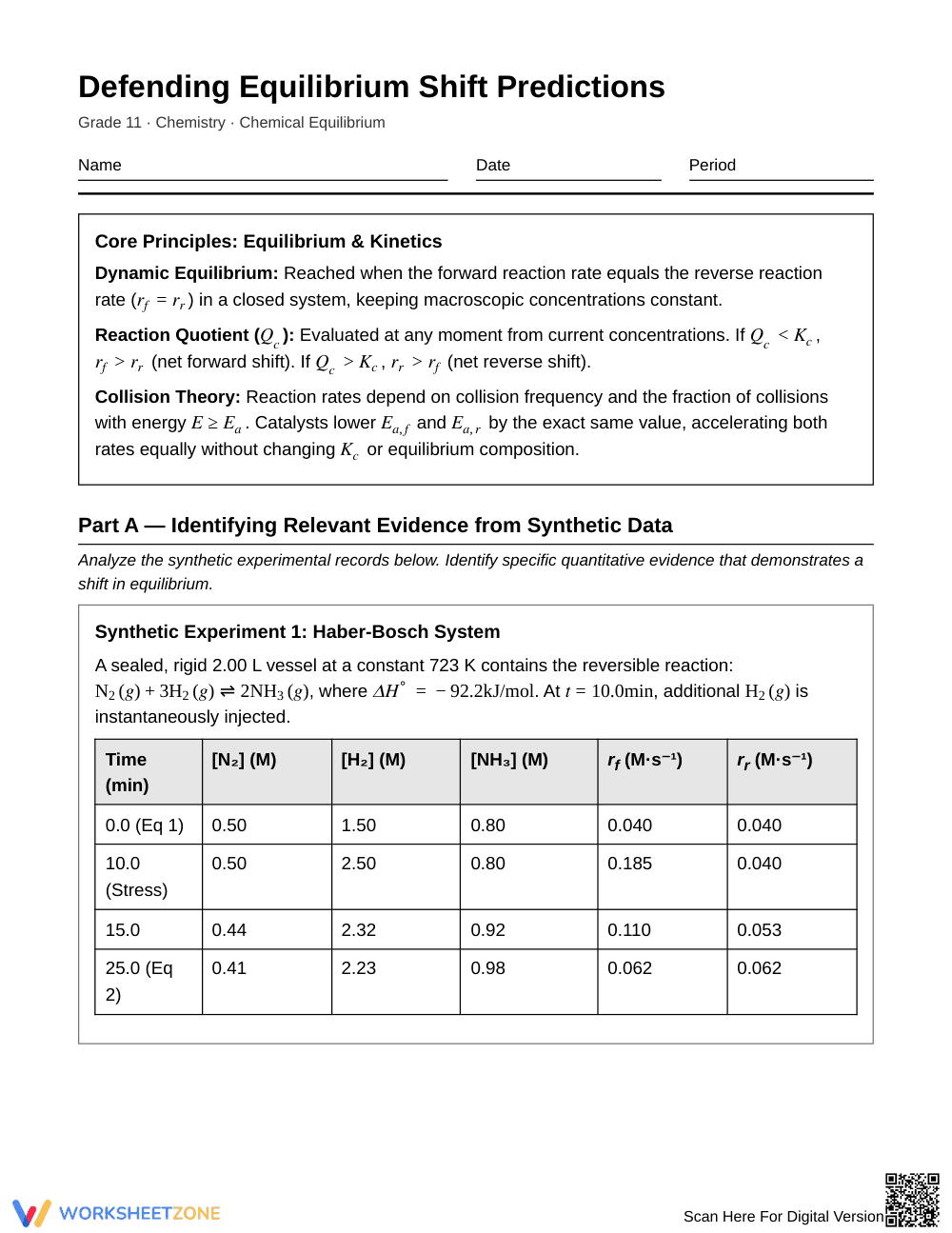
This Grade 11 chemistry worksheet equips students to defend chemical equilibrium shift predictions using rate kinetics, collision theory, and reaction quotients. Learners move beyond rote memorization of Le Chatelier’s principle by analyzing synthetic rate data and constructing mechanistic explanations to explain why equilibrium positions shift when conditions change.
At a Glance
- Grade: 11 · Subject: High School Chemistry
- Standard: Chemical Equilibrium — Evaluate dynamic equilibrium shifts using reaction rates and quotients
- Skill Focus: Defending equilibrium shift predictions with kinetic evidence
- Format: 5 pages · 8 problems · Comprehensive answer key included · PDF
- Best For: Advanced chemical equilibrium and kinetics conceptual practice
- Time: 45–60 minutes of active seatwork
What's Inside
This 5-page printable instructional packet contains 8 analytical tasks paired with a complete 4-page answer key. The worksheet opens with a core principles reference box covering dynamic equilibrium, reaction quotients, and collision theory. Students analyze synthetic rate and concentration tables, evaluate gas-phase perturbations involving volume and pressure, examine temperature changes via Maxwell-Boltzmann distributions, and critique student misconceptions.
Skill Progression
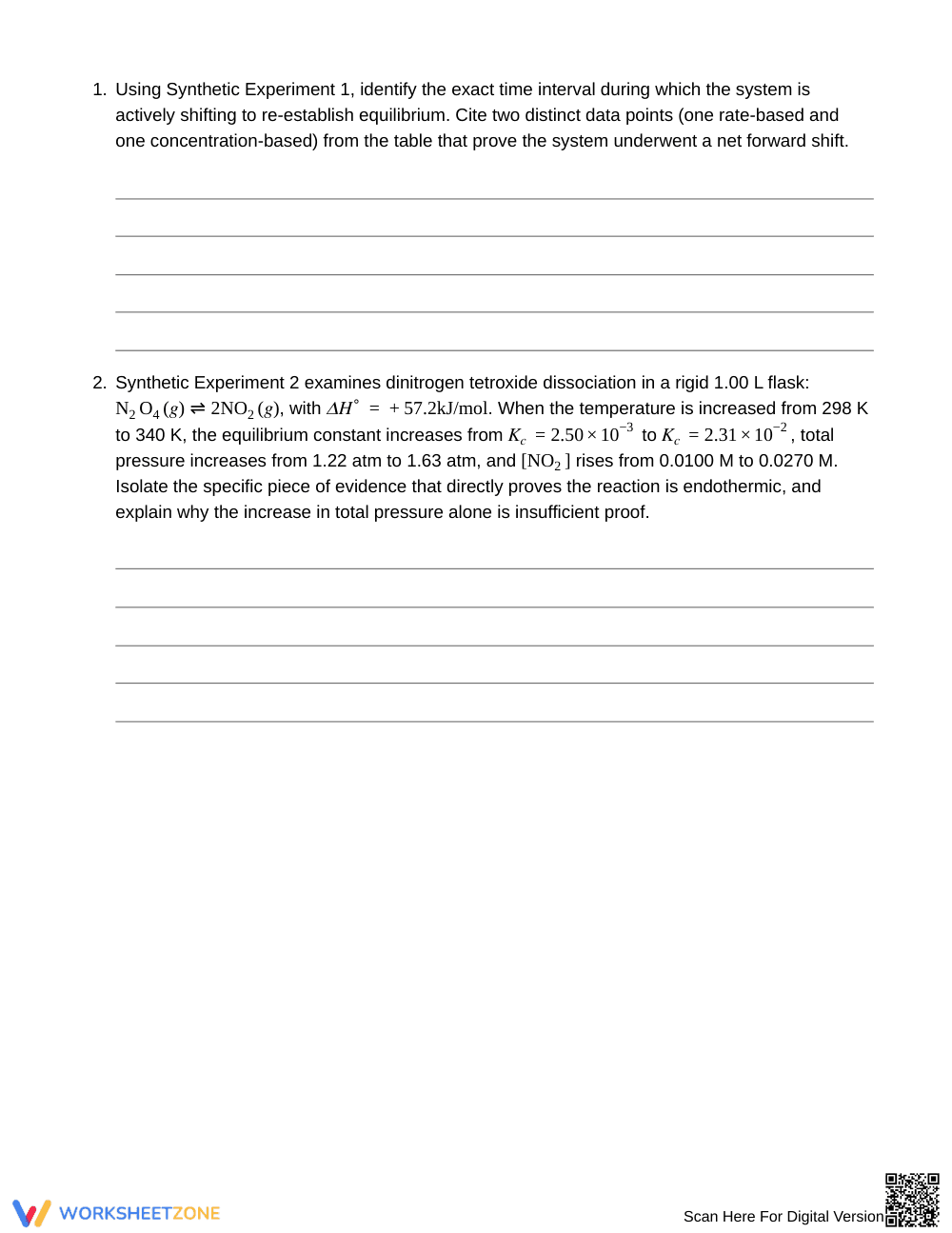
- Guided practice: Part A (Tasks 1–2) scaffolds evidence extraction from synthetic Haber-Bosch and dinitrogen tetroxide data tables, prompting learners to identify rate- and concentration-based shifts.
- Supported practice: Part B (Tasks 3–6) requires students to construct mechanistic explanations linking volume, temperature, and inert gas stresses to forward and reverse reaction rates.
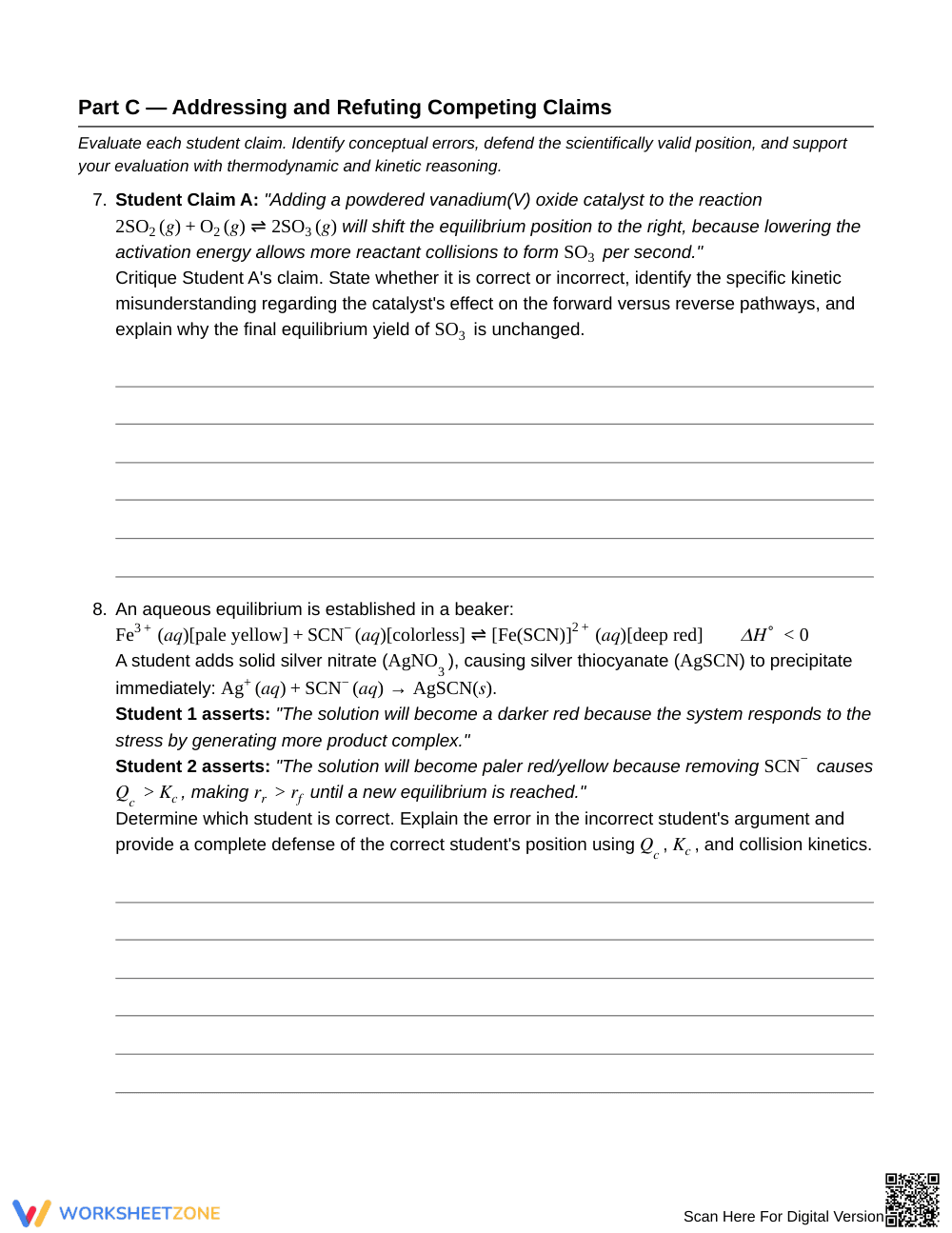
- Independent practice: Part C (Tasks 7–8) challenges students to critique and refute competing peer claims regarding catalysts and precipitation equilibrium shifts.
This sequence follows a gradual-release model, moving students from guided data interpretation to autonomous scientific argumentation.
Standards Alignment
This worksheet addresses secondary chemistry standards focused on dynamic chemical equilibrium and reaction rates. Students analyze how changing reaction conditions perturbs dynamic equilibrium using collision kinetics and reaction quotients. Both standard codes can be copied directly into lesson plans, IEP goals, or district curriculum mapping tools.
How to Use It
Assign this worksheet after direct instruction on Le Chatelier’s principle to move students from qualitative rules to rate-based justifications. It also serves as an effective mid-unit formative assessment. During work time, observe whether students mistakenly believe adding an inert gas at constant volume shifts equilibrium. Students typically finish in 45 to 60 minutes.
Who It's For
This packet is designed for Grade 11 Chemistry, Honors, and AP Chemistry students exploring chemical systems. Support developing writers by providing sentence starters for rate comparisons, and challenge advanced students to derive algebraic quotient expressions. Pair this worksheet with an aqueous equilibrium precipitation lab or molecular simulation.
According to research in Fisher & Frey (2014), structured argumentation and gradual-release frameworks significantly deepen student conceptual understanding in secondary science disciplines. High school chemistry students frequently rely on superficial heuristics when predicting dynamic chemical shifts, often treating Le Chatelier's principle as an unexplained mechanical rule. This 5-page curriculum resource directly targets this persistent learning barrier across 8 rigorous analytical tasks, training learners to defend equilibrium shift predictions using concrete empirical evidence, forward and reverse reaction rates, and collision theory. By systematically guiding students through quantitative synthetic datasets, mechanistic derivations, and the refutation of common peer misconceptions, the instructional sequence cultivates durable scientific reasoning. Research confirms that engaging students in diagnosing flawed conceptual claims solidifies mechanistic comprehension and promotes transferable analytical skills required for advanced STEM coursework, rigorous college-level science assessments, and independent laboratory inquiry.


