




























Views
Downloads


Free Equilibrium Adjustment Worksheet | Grade 11 Chemistry

Paste this activity's link or code into your existing LMS (Google Classroom, Canvas, Teams, Schoology, Moodle, etc.).
Students can open and work on the activity right away, with no student login required.
You'll still be able to track student progress and results from your teacher account.
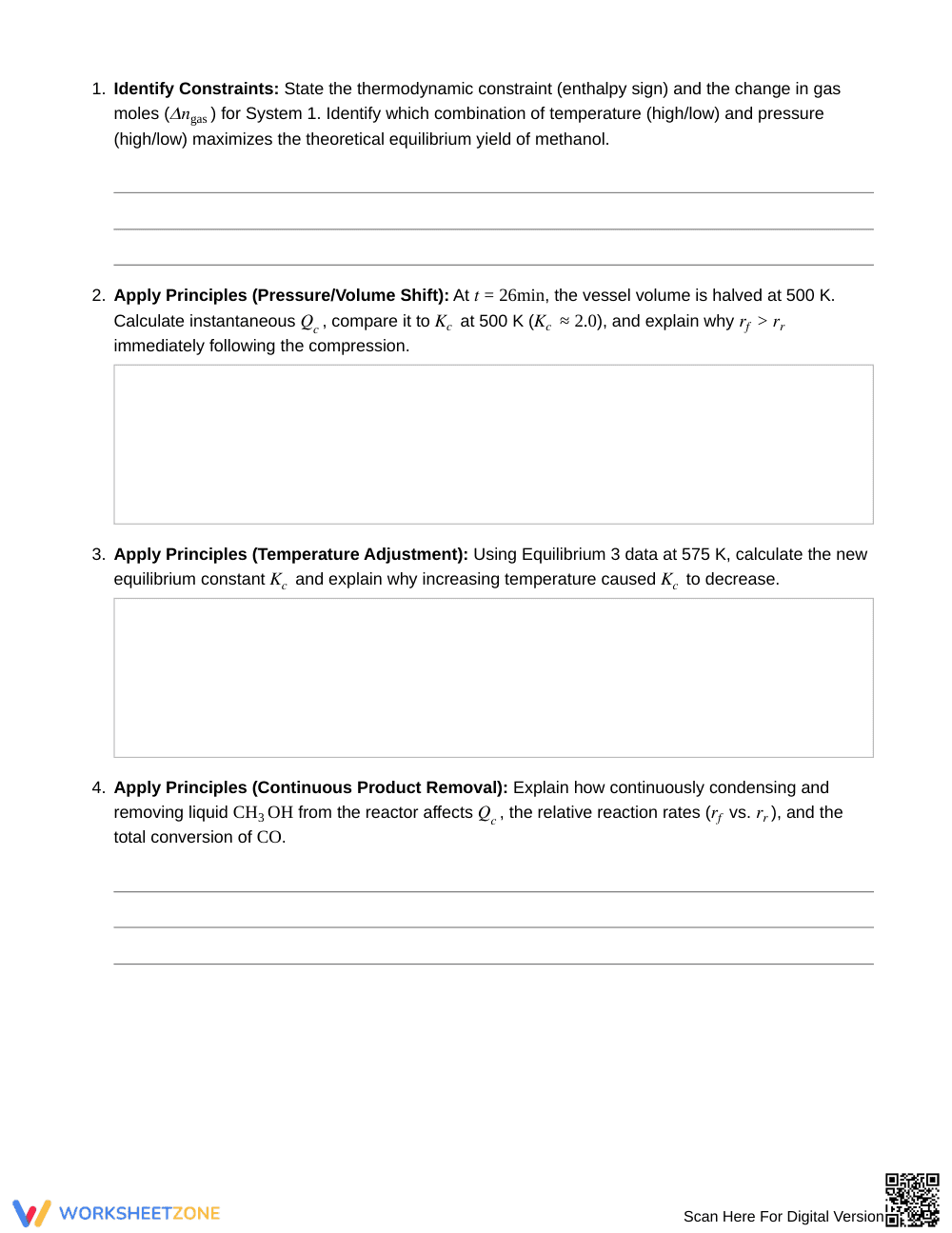
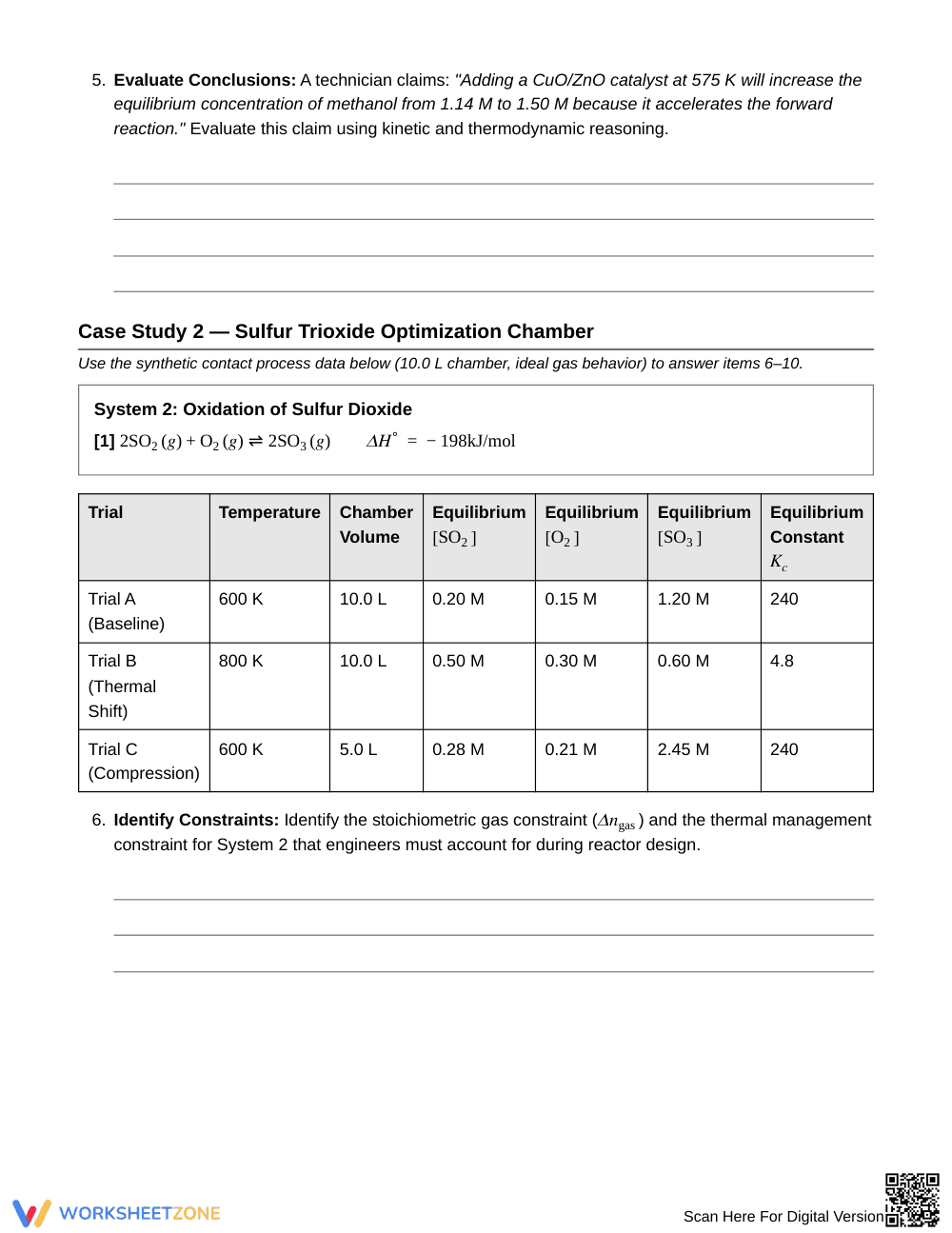
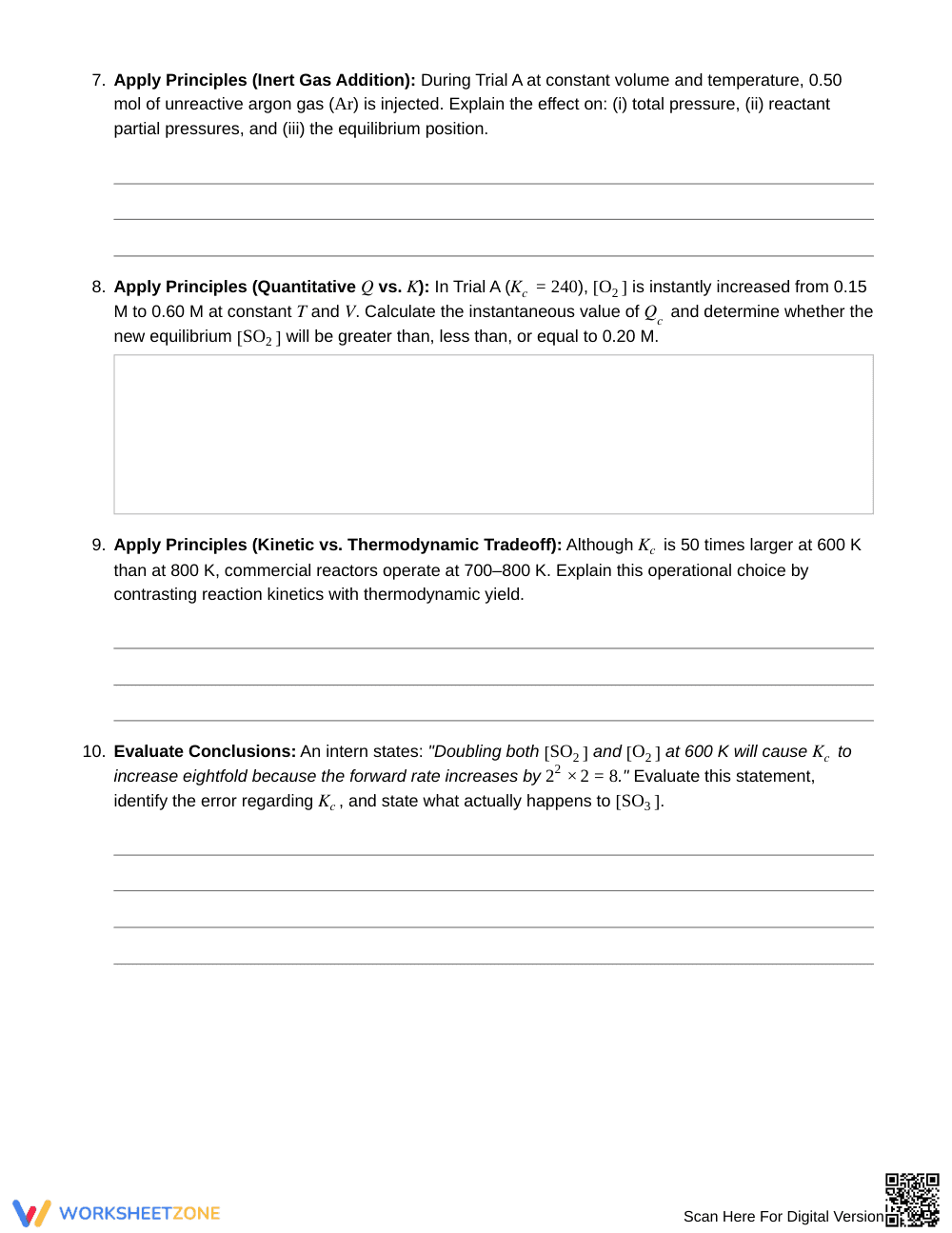
This chemistry worksheet equips Grade 11 students to evaluate real-world dynamic equilibria through two industrial case studies. Learners analyze concentration, temperature, and volume perturbations in methanol and sulfur trioxide synthesis, calculating reaction quotients and explaining rate-driven adjustments. Students gain practical mastery over Le Chatelier's principle and equilibrium constants across 10 rigorous, multi-part analytical problems.
At a Glance
- Grade: 11 · Subject: Chemistry
- Standard: Chemical Equilibrium — Explain how stress affects reaction quotients, reaction rates, and chemical equilibrium positions
- Skill Focus: Explain a Practical Equilibrium Adjustment
- Format: 4 pages · 10 problems · Answer key included · PDF
- Best For: Advanced chemistry unit review and practice
- Time: 45–60 minutes
Across 4 pages, this worksheet presents authentic chemical engineering scenarios with tabular reaction data. Students solve 10 multi-part analytical items spanning thermodynamic constraints, reaction quotient calculations, kinetic tradeoffs, and catalyst evaluations. The resource provides core formula callouts on page 1 and includes a comprehensive 3-page answer key detailing mathematical steps and conceptual explanations.
Skill Progression
- Guided practice (Problems 1 and 6): Students identify thermodynamic signs, mole differentials, and baseline states using provided formulas and data prompts.
- Supported practice (Problems 2–4 and 7–9): Learners calculate reaction quotients, compare them to equilibrium constants, and predict rate adjustments under volume, temperature, and concentration shifts.
- Independent practice (Problems 5 and 10): Students evaluate technical claims and critique misconceptions regarding catalysts, rates, and yields without transitional hints.
This sequence mirrors the gradual-release framework, guiding students from scaffolded parameter identification to independent evaluation of equilibrium systems.
Standards Alignment
This resource aligns with high school chemistry expectations for chemical equilibrium. Students refine reaction designs by applying Le Chatelier's principle, calculating reaction quotients, and balancing rates with thermodynamic yields. Additionally, it supports crosscutting concepts concerning system stability and change. Both standard codes can be copied directly into lesson plans, IEP goals, or district curriculum mapping tools.
How to Use It
Administer this 4-page worksheet after direct instruction on reaction quotients and Le Chatelier's principle. For formative assessment, check student work on Problem 2 to verify whether learners square reactant concentrations correctly when computing quotients. The activity functions effectively as an in-class collaborative task or independent capstone review requiring 45 to 60 minutes.
Who It's For
Designed for Grade 11 chemistry students, this resource challenges learners with strong foundational knowledge in stoichiometry and kinetics. Teachers can differentiate by providing sentence starters for qualitative explanations in Problems 4 and 8. Pair this document with an equilibrium simulation or industrial synthesis lecture to deepen dynamic equilibrium comprehension.
Mastering chemical equilibrium adjustments requires students to reconcile microscopic kinetic behaviors with macroscopic thermodynamic observations in reversible reactions. According to Fisher & Frey (2014), structured case-based instructional progressions that systematically guide learners from quantitative data extraction to independent misconception evaluation foster significant, measurable gains in scientific reasoning and conceptual retention. This Grade 11 chemical equilibrium resource specifically targets student ability to explain practical equilibrium adjustments under variable industrial operating conditions. By requiring high school chemistry students to compute instantaneous reaction quotients, interpret shifts in temperature-dependent equilibrium constants, and critique flawed technician statements across 10 structured tasks, the worksheet effectively bridges theoretical equilibrium models and authentic chemical engineering dilemmas. The 4-page format, reinforced by explicit formula reference boxes and an exhaustive 3-page answer key, delivers the structured scaffolding essential for deep analytical mastery in advanced secondary physical science classrooms.


